. 2022 Jan;10(1):e003289.
doi: 10.1136/jitc-2021-003289.

CD70 as an actionable immunotherapeutic target in recurrent glioblastoma and its microenvironment

Affiliations

CD70 as an actionable immunotherapeutic target in recurrent glioblastoma and its microenvironment

Mathieu Seyfrid et al. J Immunother Cancer. 2022 Jan.

Erratum in

Abstract

Purpose: Glioblastoma (GBM) patients suffer from a dismal prognosis, with standard of care therapy inevitably leading to therapy-resistant recurrent tumors. The presence of cancer stem cells (CSCs) drives the extensive heterogeneity seen in GBM, prompting the need for novel therapies specifically targeting this subset of tumor-driving cells. Here, we identify CD70 as a potential therapeutic target for recurrent GBM CSCs.

Experimental design: In the current study, we identified the relevance and functional influence of CD70 on primary and recurrent GBM cells, and further define its function using established stem cell assays. We use CD70 knockdown studies, subsequent RNAseq pathway analysis, and in vivo xenotransplantation to validate CD70's role in GBM. Next, we developed and tested an anti-CD70 chimeric antigen receptor (CAR)-T therapy, which we validated in vitro and in vivo using our established preclinical model of human GBM. Lastly, we explored the importance of CD70 in the tumor immune microenvironment (TIME) by assessing the presence of its receptor, CD27, in immune infiltrates derived from freshly resected GBM tumor samples.

Results: CD70 expression is elevated in recurrent GBM and CD70 knockdown reduces tumorigenicity in vitro and in vivo. CD70 CAR-T therapy significantly improves prognosis in vivo. We also found CD27 to be present on the cell surface of multiple relevant GBM TIME cell populations, notably putative M1 macrophages and CD4 T cells.

Conclusion: CD70 plays a key role in recurrent GBM cell aggressiveness and maintenance. Immunotherapeutic targeting of CD70 significantly improves survival in animal models and the CD70/CD27 axis may be a viable polytherapeutic avenue to co-target both GBM and its TIME.

Keywords: antigens; brain neoplasms; cell engineering; chimeric antigen; immunotherapy; neoplasm; receptors.


Conflict of interest statement

Competing interests: DU, DB and PV are employees of Century Therapeutics Canada. The other authors declare no competing interests.

Figures
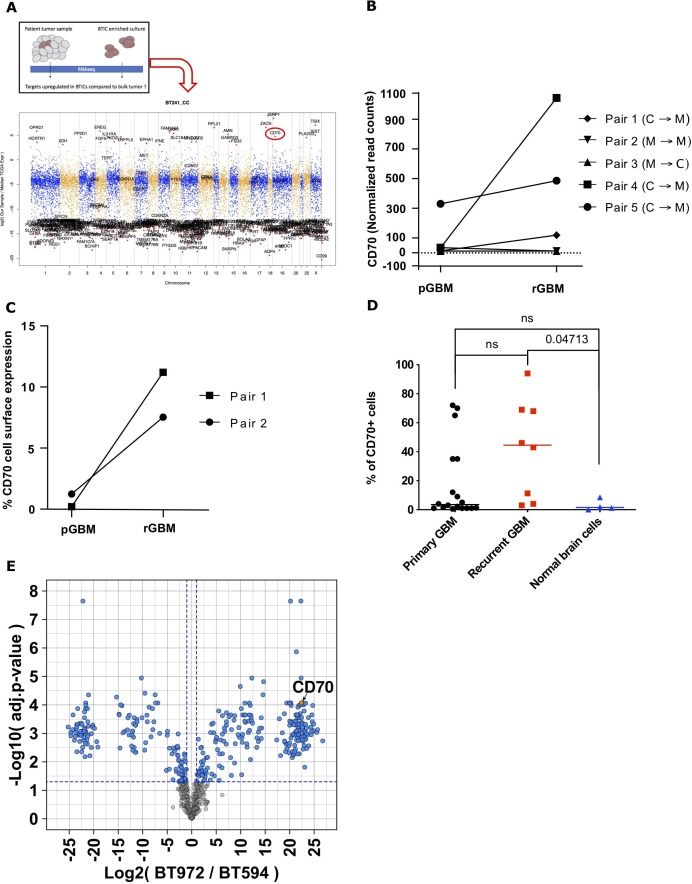
Figure 1
Figure 1
CD70 expression is a relevant marker of rGBM. (A) Manhattan plot of the top upregulated RNAseq genes in the recurrent patient-derived GBM cancer stem cells (rGBM CSCs) BT241, compared with the publicly available the Cancer Genome Atlas database, identified CD70 (circled) as a target candidate upregulated in the CSC subpopulation, compared with tumor bulk. (B) Analysis of CD70 mRNA levels in the five TGCA primary/recurrent patient matched GBM pairs depicts an CD70 increase in three pairs on recurrence, alongside a switch towards the Mesenchymal subtype (GBM subtype classification: C, classical; P, proneural; M, mesenchymal). (C) Among GBM CSCs from figure 1C, the two in-house matched p/rGBM CSCs pairs display an increase of CD70 cell surface expression on tumor recurrence. (D) Dot plot representation of CD70 cell surface expression in rGBM CSCs compared with primary (p-) GBM CSCs and normal brain cells (astrocytes, neural stem cells), assessed by flow cytometry (Singh lab brain tumor database). (E) Volcano plot of the top up- and down-regulated cell surface proteins of pair two from figure 1D, as assessed by glycocapture proteomics. CSC, cancer stem cell; GBM, glioblastoma; rGBM, recurrent GBM.
Figure 2
Figure 2
CD70 is a dedicated player in GBM maintenance and tumor formation. (A) GBM CSCs were sorted into positive and negative populations and proliferation was assessed by PrestoBlue assay (B) Limiting dilution analyses of CD70 positive and negative cells in pGBM (GBM8) and rGBM (BT241). (C) Cell surface CD70 expression after shRNA knockdown in three CD70HIGH GBM lines, as assessed by flow cytometry. (D) Silencing of CD70 expression by shRNA (shCD70) knockdown and sphere formation ability was assessed compared with shGFP (control shRNA). (E–I) Immunocompromised mice (NSG, a minimum of six mice per condition) were intracranially injected with shGFP or shCD70 CSCs. (E, F) Tumor area of CD70-silenced CSCs compared with control knockdown CSCs was measured using formalin-fixed, H&E-stained mouse brain slices (right, representative image). (G, H) Kaplan-Meier survival curves comparing mice engrafted with shCD70 CSCs compared with shGFP CSCs. The two remaining BT241 shCD70 mice at the end of experiment showed an absence of tumor by H&E staining at experimental endpoint (data not shown). (I) MRI images representative of xenografts from shGFP and shCD70 transduced GBM CSC line BT241. Images on the right are control images of normal mouse brain. (*P<0.05; **p<0.01; ***p<0.001; ****p<0.0001). CSCs, cancer stem cells; GBM, glioblastoma; pGBM, primary GBM; NSG, NOD/SCID gamma; shRNA, short hairpin RNA.
Figure 3
Figure 3
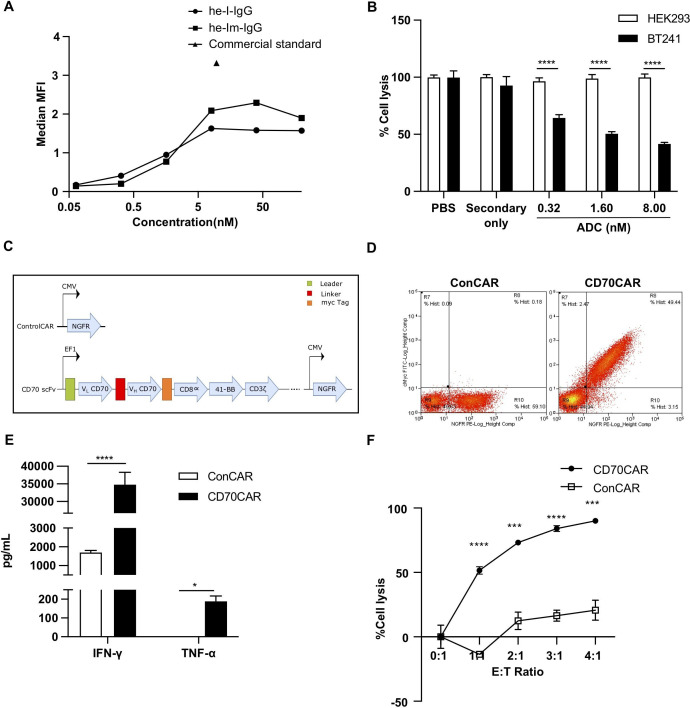
Generation and in vitro characterization of CD70-Specific CAR-T Cells. (A) Binding curve comparing CD70-specific Fabs to commercial standard antibody. (B) Anti-CD70 Fab’2 is specific against CD70, assessed by cytotoxicity assay under combination treatment with 2ºADC, against GBM cells expressing high (GBMCSC BT241) or no (HEK293) CD70. (C) Schematic representation of CAR structure. (D) Successful transduction of CAR-T vectors as observed by NGFR+ cells in ConCAR-T cells and NGFR+Myc+ cells in CD70 CAR-T cells, displayed as a representative flow plot. (E) Testing of CAR-T cell activation; IFN-γ and TNF-α cytokine release during coculture of GBM CSC BT241 with CD70 CAR-T, compared with ConCAR-T cells, as analyzed by ELISA (n=3). (F) Cytotoxicity assay to assess CD70CAR killing capacity compared with ConCAR after coculturing for 24 hours, tested at various effector to target (E:T) ratios (n=3). (***p<0.001; ****p<0.0001). CAR, chimeric antigen receptor; CSCs, cancer stem cells; GBM, glioblastoma; MFI, mean fluorescence intensity.
Figure 4
Figure 4
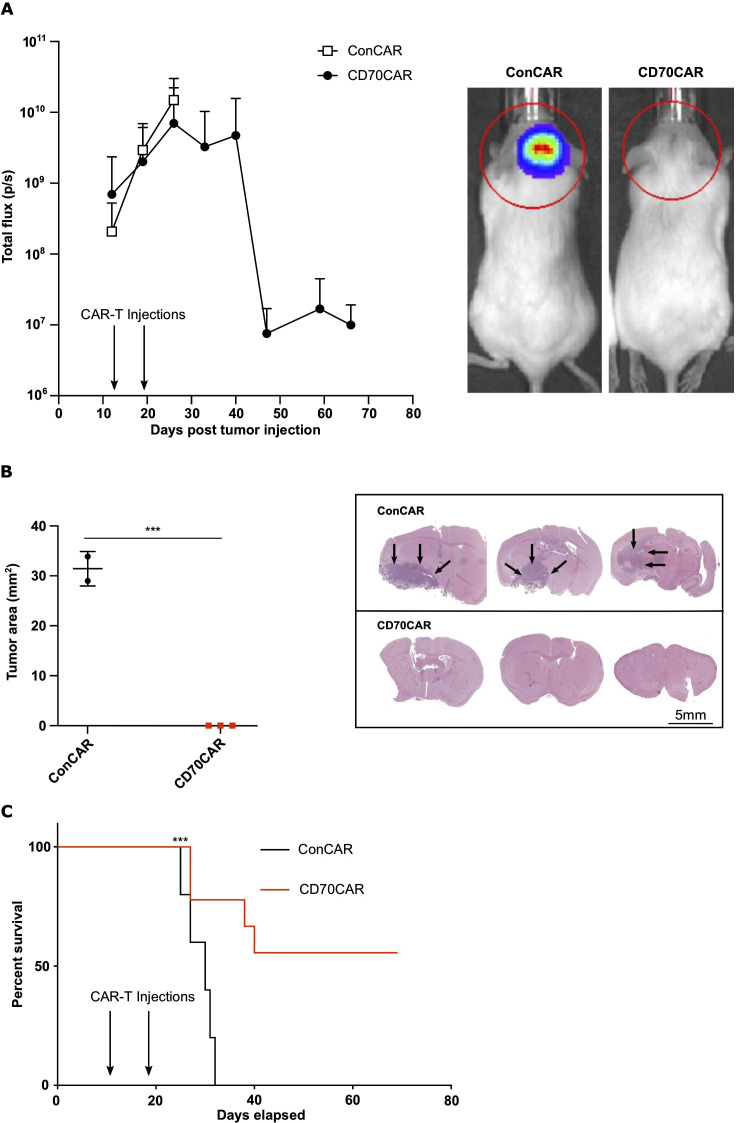
CD70 CAR-Ts are efficacious against recurrent GBM tumors in vivo. NSG mice (at least n=6 per group) were intracranially implanted with 100,000 human BT241 ffLuc GBM cells. Upon successful engraftment, mice were treated with 1×10⁶ CD70CAR-T or ConCAR-T cells, delivered intracranially once a week for 2 weeks. (A) CD70 CAR-T treated mice showed decreased tumor signal, as assessed by bioluminescence measurement (right, representative image of radiance measurement in the region of interest). A lower tumor burden was observed in the CD70 CAR-T group compared with the control group, as measured on (B) formalin-fixed, H&E-stained mouse brain slices (representative image on the right), and (C) an extended survival (Kaplan-Meier curve) (***p<0.001). CAR, chimeric antigen receptor; GBM, glioblastoma; NSG, NOD/SCID Gamma.
Figure 5
Figure 5
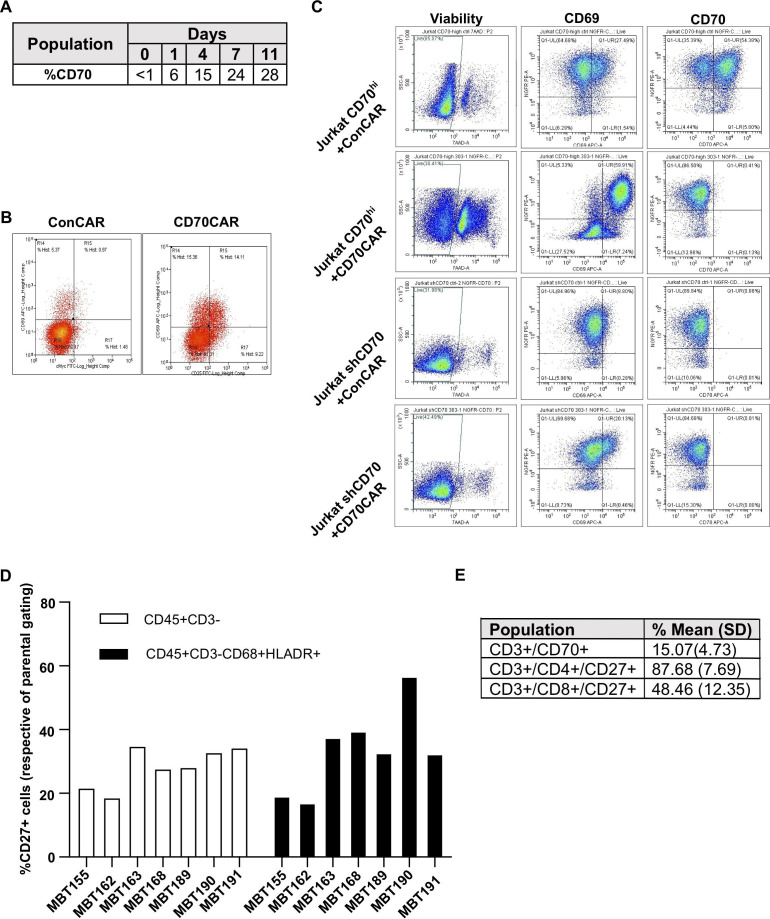
Modeling of CD70s influence on GBM TIME. (A) CD70 expression kinetics on in-house, activated T cells and (B) levels of CD69 and cMyc displayed by CD70CAR or ConCAR-T cells 9 days post-transduction, evaluated by flow cytometry. (C) CD70-enriched or -silenced Jurkat cells were transduced with either ConCAR or CD70CAR. After 8 days, CD69 and CD70 levels were assessed by flow cytometry. (D) TIME cells extracted from patient tumor samples were analyzed by flow cytometry, evaluating the pattern of expression of CD27 in non-lymphoid (CD45+CD3-) and M1 populations (CD45+CD3-CD68+HLADR+). (E) Average expression of CD27 on CD4/CD8 lymphoid population, and CD70 expression on the lymphoid population (CD3+). CAR, chimeric antigen receptor; GBM, glioblastoma; TIME, tumor immune microenvironment.
Figure 6
Figure 6
CD70 and CD27 expression in GBM and immune cells. (A, B) ScRNAseq profile of human GBM and immune infiltrate (Neftel 2019). Cell-type annotated UMAP (A) and expression of CD70 (top) and CD27 (bottom) visualized on UMAP and stratified by cell type (all cells included), Neftel GBM subtype (GBM only), and Richards GBM subtype (GBM only) (B). (C, D) ScRNAseq profile of human glioblastoma stem cells (Richards 2021). Cell-type annotated UMAP (C) and expression of CD70 (top) and CD27 (bottom) visualized on UMAP and stratified by Neftel GBM subtype and Richards GBM subtype (D). (E, F) ScRNAseq profile of immune cell infiltrates in murine GL261 tumors (Ochocka 2021). Cell-type annotated UMAP (E) and expression of CD70 (top) and CD27 (bottom) visualized on UMAP and stratified by cell type (F). Astrocyte-like, BAM, border-associated macrophage; DC, dendritic cell; Develop., Developmental; Expr, expression; GBM, glioblastoma; Injury Resp, injury response; MES1, mesenchymal type 1; MES2, mesenchymal type 2; NK, natural killer; NPC1, neural progenitor cell type 1; NPC2, neural progenitor cell type 2; OPC, oligodendrocyte progenitor cell.

References

    1. Ostrom QT, Cioffi G, Gittleman H, et al. CBTRUS statistical report: primary brain and other central nervous system tumors diagnosed in the United States in 2012-2016. Neuro Oncol 2019;21:v1–100. 10.1093/neuonc/noz150 - DOI - PMC - PubMed
    1. Stupp R, Mason WP, van den Bent MJ, et al. Radiotherapy plus concomitant and adjuvant temozolomide for glioblastoma. N Engl J Med 2005;352:987–96. 10.1056/NEJMoa043330 - DOI - PubMed
    1. Stupp R, Taillibert S, Kanner A, et al. Effect of Tumor-Treating fields plus maintenance temozolomide vs maintenance temozolomide alone on survival in patients with glioblastoma: a randomized clinical trial. JAMA 2017;318:2306–16. 10.1001/jama.2017.18718 - DOI - PMC - PubMed
    1. Rønning PA, Helseth E, Meling TR, et al. A population-based study on the effect of temozolomide in the treatment of glioblastoma multiforme. Neuro Oncol 2012;14:1178–84. 10.1093/neuonc/nos153 - DOI - PMC - PubMed
    1. van Linde ME, Brahm CG, de Witt Hamer PC, et al. Treatment outcome of patients with recurrent glioblastoma multiforme: a retrospective multicenter analysis. J Neurooncol 2017;135:183–92. 10.1007/s11060-017-2564-z - DOI - PMC - PubMed

Publication types