. 2022 Jan 25;50(2):1187-1197.
doi: 10.1093/nar/gkab1295.

Comprehensive analysis of prime editing outcomes in human embryonic stem cells

Affiliations

Comprehensive analysis of prime editing outcomes in human embryonic stem cells

Omer Habib et al. Nucleic Acids Res. .

Abstract

Prime editing is a versatile and precise genome editing technique that can directly copy desired genetic modifications into target DNA sites without the need for donor DNA. This technique holds great promise for the analysis of gene function, disease modeling, and the correction of pathogenic mutations in clinically relevant cells such as human pluripotent stem cells (hPSCs). Here, we comprehensively tested prime editing in hPSCs by generating a doxycycline-inducible prime editing platform. Prime editing successfully induced all types of nucleotide substitutions and small insertions and deletions, similar to observations in other human cell types. Moreover, we compared prime editing and base editing for correcting a disease-related mutation in induced pluripotent stem cells derived form a patient with α 1-antitrypsin (A1AT) deficiency. Finally, whole-genome sequencing showed that, unlike the cytidine deaminase domain of cytosine base editors, the reverse transcriptase domain of a prime editor does not lead to guide RNA-independent off-target mutations in the genome. Our results demonstrate that prime editing in hPSCs has great potential for complementing previously developed CRISPR genome editing tools.


Figures

Figure 1.
Figure 1.
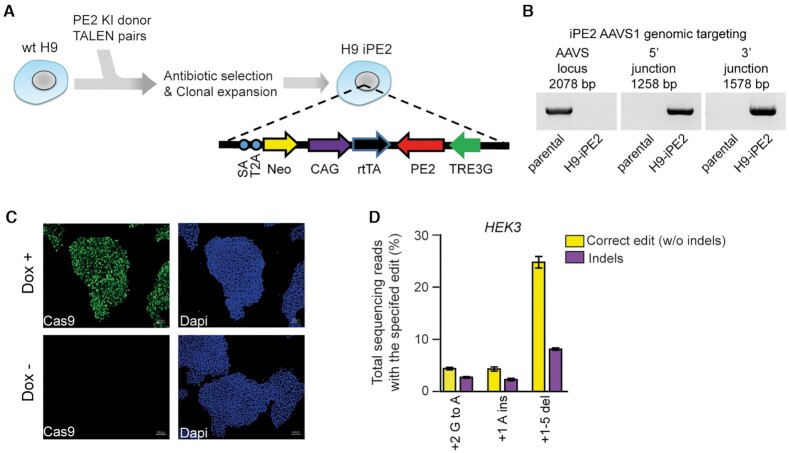
Generation and characterization of H9-iPE2. (A) Schematic diagram of the strategy for TALEN-mediated targeting of the AAVS1 locus to generate H9-iPE2 cells, in which PE2 expression is induced by dox. The AAVS1 donor vector contains a cassette in which PE2 expression is under the control of the dox-inducible TRE3G promoter. SA, splice acceptor; 2A, self-cleaving 2A peptide; Neo, neomycin resistance gene; rtTA, dox-controlled reverse transcriptional activator; CAG, cytomegalovirus early enhancer/chicken β actin promoter. (B) PCR-based confirmation that the iPE2 construct was targeted to the AAVS1 locus. A primer pair that flanks the AAVS1 knock-in site only amplifies a product in wild-type cells; lack of a product indicates that the H9-iPE2 clone used in this study is homozygous (left panel). Junction PCR confirmed on-target integration of the cassette into the AAVS1 locus (center and right panels). (C) Immunostaining of H9-iPE2 cells before and after 48 h of dox treatment with an anti-Cas9 antibody (green). Nuclei were stained with DAPI (blue). (D) Editing efficiency in H9-iPE2 cells. H9-iPE2 cells maintained in the presence of dox were electroporated with plasmids encoding a pegRNA and a nicking sgRNA (for PE3 system). The editing efficiency is indicated as the percentage of total sequencing reads that contain the intended edit and do not contain indels. Mean ± s.d. of n = 3 independent biological replicates.
Figure 2.
Figure 2.
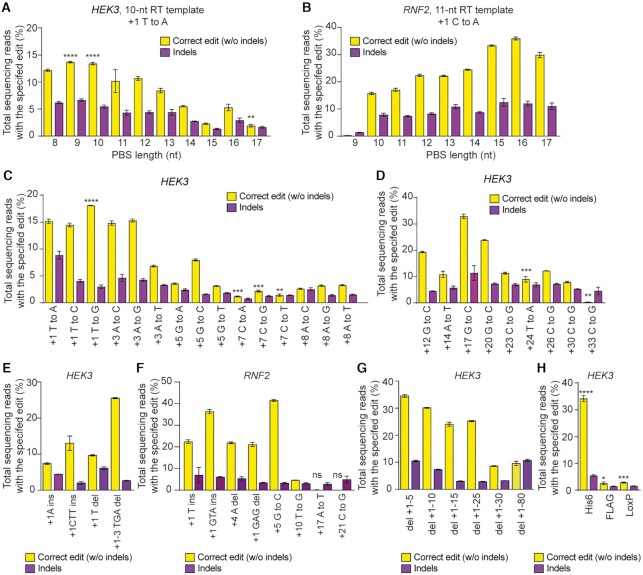
Prime editing of genomic DNA in H9-iPE2 cells by PE3. (AB) PE3 editing efficiencies at HEK3 and RNF2 genomic sites with pegRNAs containing varying PBS lengths. (C) Efficiencies of all 12 types of transition and transversion edits at the indicated positions in the HEK3 site. (D) Efficiencies of long distance edits at the HEK3 site using a 34-nt RT template. (EF) Editing efficiencies for the generation of intended indels at the HEK3 and RNF2 genomic sites. Yellow, desired indel; purple, undesired indel. (G) Editing efficiencies for the generation of targeted deletions of 5–80 bp at the HEK3 site. (H) Editing efficiencies for the generation of targeted insertions of a His6 tag, Flag epitope tag, and loxP site at the HEK3 site. The editing efficiency is indicated as the percentage of total sequencing reads that contain the intended edit and do not contain unintended indels. Mean ± s.d. of n = 3 independent biological replicates.
Figure 3.
Figure 3.
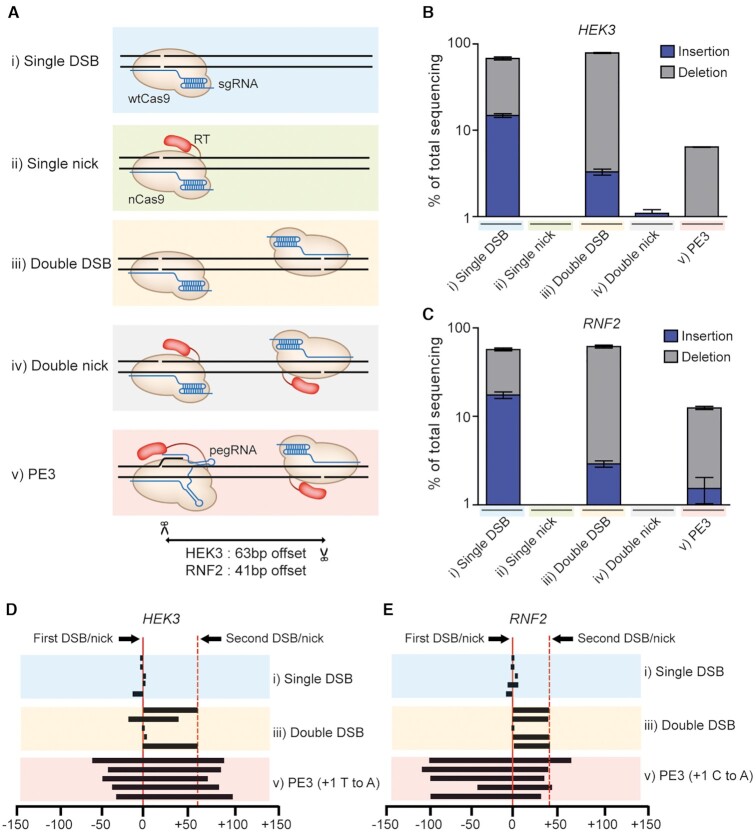
Comparison of indel frequencies and endpoints after different DNA cleavage and nicking scenarios. (A) Schematic of enzymes and guide RNAs tested to compare indel frequencies. (BC) Indel frequencies generated by the experimental set ups diagrammed in (A) at the HEK3 and and RNF2 genomic sites. (DE) Deletion patterns obtained after single cuts, double cuts, and PE3-mediated base substitutions at the HEK3 and RNF2 sites. Each line designates the extent of a deletion. The five most frequent types of deletions are shown for each case. Mean ± s.d. of n = 3 independent biological replicates.
Figure 4.
Figure 4.
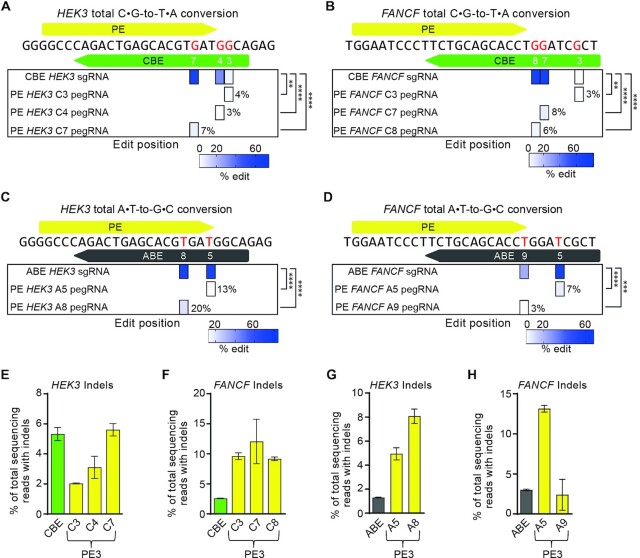
Comparison of prime editing and base editing outcomes at the same target sites. (AB) CBE- and PE-generated frequencies of C•G-to-T•A edits at target nucleotides, highlighted in red, in the endogenous HEK3 and FANCF sites. Base positions are numbered relative to the PAM of the CBE sgRNA. The PAM nucleotides are numbered 21–23. (CD) ABE- and PE-generated frequencies of A•T-to-G•C edits at endogenous HEK3 and FANCF sites. **P < 0.01, ***P < 0.001, ****P < 0.0001. for (A)–(D). (EF) Indel frequencies from the experiments in (A) and (B). (GH) Indel frequencies from the experiments in (C) and (D). Mean ± s.d. of n = 3 independent biological replicates.
Figure 5.
Figure 5.
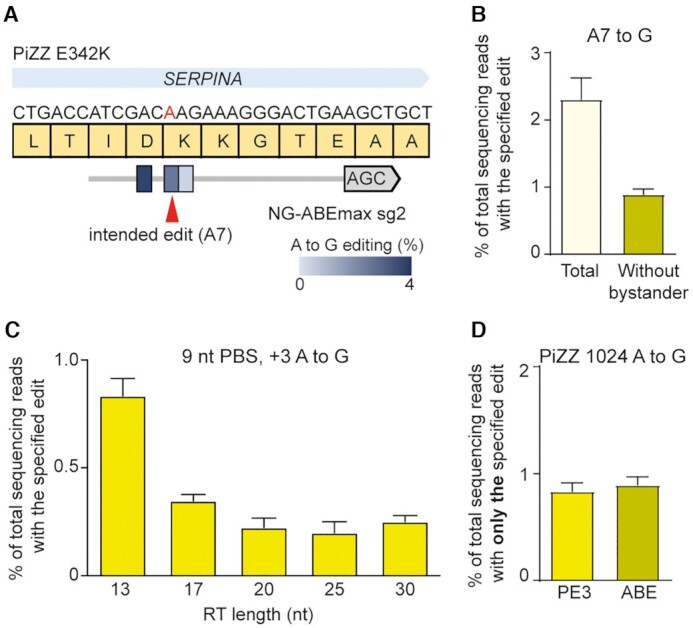
Repair of the PiZZ 1024 G > A mutation in induced pluripotent stem cells (iPSCs) derived from a patient with alpha-1-antitrypsin deficiency. (A) Schematic of the disease-associated 1024 G > A mutation in the SERPINA1 gene, the altered protein sequence (E342K), and the sgRNA used to correct the mutation with NG-ABEmax. (B) Frequencies of A-to-G conversions in the editing window induced by NG-ABEmax. (C) Frequences of A-to-G conversions at the G > A mutation site induced by NG-PE3 system. pegRNAs with varying RT lengths were tested. (D) Comparison of the frequencies of precise correction of the PiZZ mutation in patient-derived iPSCs by NG-PE3 and NG-ABEmax. Mean ± s.d. of n = 3 independent biological replicates.
Figure 6.
Figure 6.
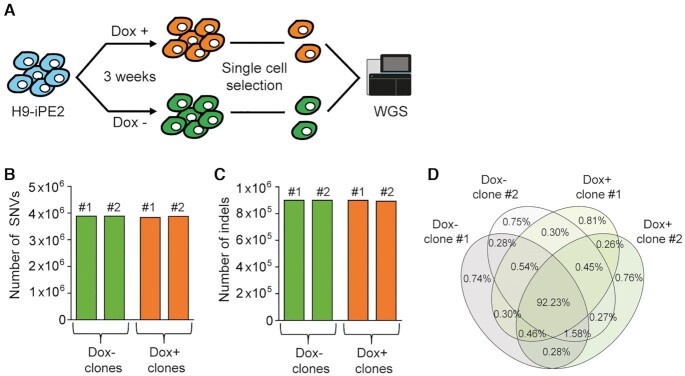
PE does not lead to genome-wide off-target effects. (A) Schematic diagram of the experimental design for clonal expansion and whole genome sequencing analysis of H9-iPE2 cells with or without dox-induced PE2 expression for 3 weeks. (BC) Numbers of mutations in uninduced and induced H9-iPE2 clones. The numbers represent all sequence variations, including indels and single nucleotide variations. (D) Venn diagrams showing the ratios of common SNVs in H9-iPE2 clones.

References

    1. Hotta A., Yamanaka S.. From genomics to gene therapy: induced pluripotent stem cells meet genome editing. Annu. Rev. Genet. 2015; 49:47–70. - PubMed
    1. Hockemeyer D., Jaenisch R.. Induced pluripotent stem cells meet genome editing. Cell Stem Cell. 2016; 18:573–586. - PMC - PubMed
    1. Komor A.C., Badran A.H., Liu D.R.. CRISPR-based technologies for the manipulation of eukaryotic genomes. Cell. 2017; 168:20–36. - PMC - PubMed
    1. Soldner F., Jaenisch R.. Stem cells, genome editing, and the path to translational medicine. Cell. 2018; 175:615–632. - PMC - PubMed
    1. Jinek M., Chylinski K., Fonfara I., Hauer M., Doudna J.A., Charpentier E.. A programmable dual-RNA-guided DNA endonuclease in adaptive bacterial immunity. Science. 2012; 337:816–821. - PMC - PubMed

Publication types