


DWI-related texture analysis for prostate cancer: differences in correlation with histological aggressiveness and data repeatability between peripheral and transition zones
- PMID: 35018507
- PMCID: PMC8752657
- DOI: 10.1186/s41747-021-00252-y
DWI-related texture analysis for prostate cancer: differences in correlation with histological aggressiveness and data repeatability between peripheral and transition zones
Erratum in
-
Correction: DWI-related texture analysis for prostate cancer: differences in correlation with histological aggressiveness and data repeatability between peripheral and transition zones.Eur Radiol Exp. 2022 Mar 23;6(1):16. doi: 10.1186/s41747-022-00268-y. Eur Radiol Exp. 2022. PMID: 35318550 Free PMC article. No abstract available.
Abstract
Background: We investigated the correlation between texture features extracted from apparent diffusion coefficient (ADC) maps or diffusion-weighted images (DWIs), and grade group (GG) in the prostate peripheral zone (PZ) and transition zone (TZ), and assessed reliability in repeated examinations.
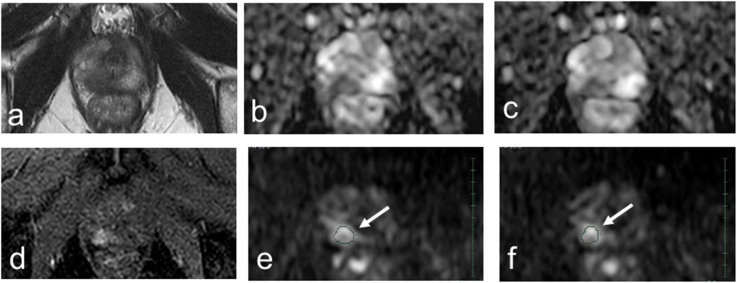
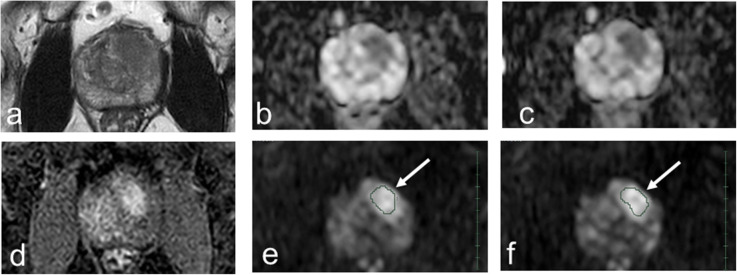
Methods: Patients underwent 3-T pelvic magnetic resonance imaging (MRI) before radical prostatectomy with repeated DWI using b-values of 0, 100, 1,000, and 1,500 s/mm2. Region of interest (ROI) for cancer was assigned to the first and second DWI acquisition separately. Texture features of ROIs were extracted from comma-separated values (CSV) data of ADC maps generated from several sets of two b-value combinations and DWIs, and correlation with GG, discrimination ability between GG of 1-2 versus 3-5, and data repeatability were evaluated in PZ and TZ.
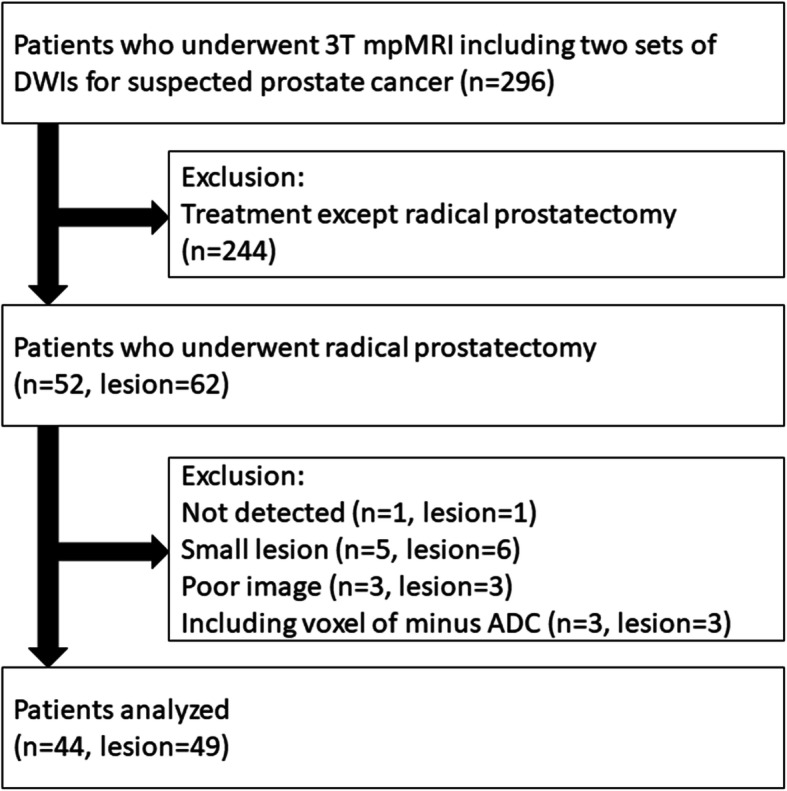
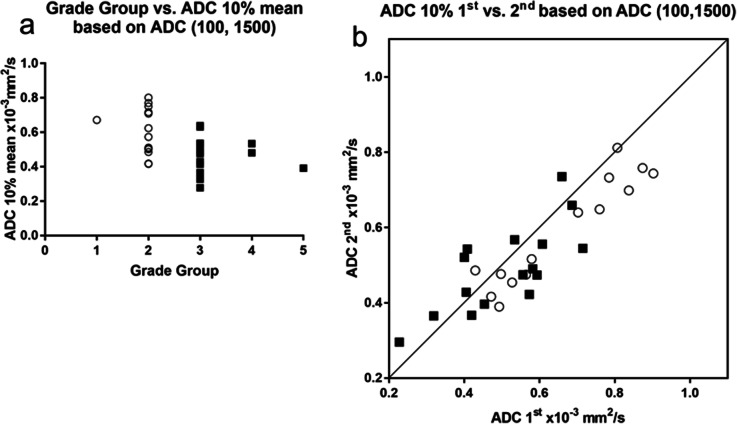
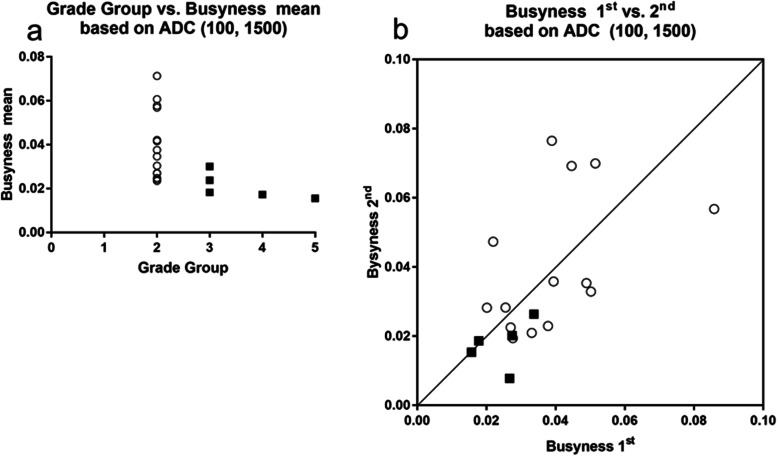
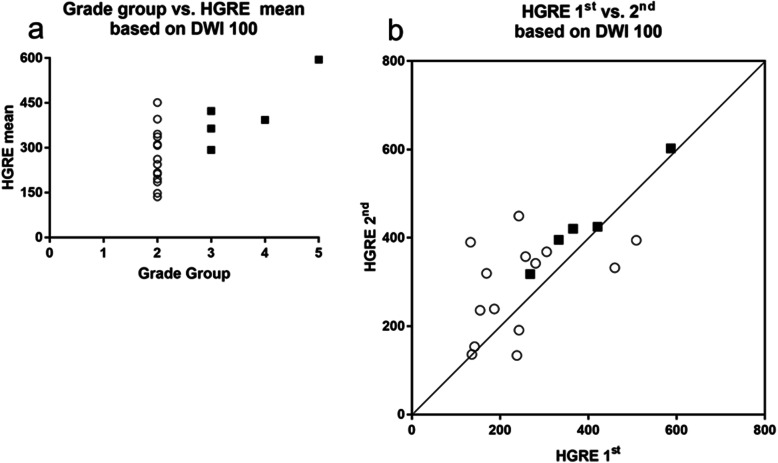
Results: Forty-four patients with 49 prostate cancers met the eligibility criteria. In PZ, ADC 10% and 25% based on ADC map of two b-value combinations of 100 and 1,500 s/mm2 and 10% based on ADC map with b-value of 0 and 1,500 s/mm2 showed significant correlation with GG, acceptable discrimination ability, and good repeatability. In TZ, higher-order texture feature of busyness extracted from ADC map of 100 and 1,500 s/mm2, and high gray-level run emphasis, short-run high gray-level emphasis, and high gray-level zone emphasis from DWI with b-value of 100 s/mm2 demonstrated significant correlation, excellent discrimination ability, but moderate repeatability.
Conclusions: Some DWI-related features showed significant correlation with GG, acceptable to excellent discrimination ability, and moderate to good data repeatability in prostate cancer, and differed between PZ and TZ.
Keywords: Diffusion magnetic resonance imaging; Image interpretation (computer-assisted); Neoplasm grading; Prostate neoplasms; Reproducibility of results.
© 2022. The Author(s) under exclusive licence to European Society of Radiology.
Conflict of interest statement
The authors declare that they have no competing interests.
Figures
References
-
- Lubner MG, Smith AD, Sandrasegaran K, Sahani DV, Pickhardt PJ (2017) CT texture analysis: definitions, applications, biologic correlates, and challenges. Radiographics 37:1483–1503 https://pubs.rsna.org/doi/10.1148/rg.2017170056 - DOI - PubMed
-
- Schieda N, Lim CS, Zabihollahy F, et al (2021) Quantitative prostate MRI. J Magn Reson Imaging 53:1632─1645. 10.1002/jmri.27191 - PubMed
-
- Lovinfosse P, Polus M, Van Daele D, et al (2018) FDG PET/CT radiomics for predicting the outcome of locally advanced rectal cancer. Eur J Nucl Med Mol Imaging 45:365─375. 10.1007/s00259-017-3855-5 - PubMed
-
- Varghese BA, Cen SY, Hwang DH, Duddalwar VA (2019) Texture Analysis of Imaging: What Radiologists Need to Know. AJR Am J Roentgenol 212:520─528. https://www.ajronline.org/doi/10.2214/AJR.18.20624 - DOI - PubMed
MeSH terms
LinkOut - more resources
Full Text Sources
Medical
Miscellaneous