Patient Factors Associated With Appendectomy Within 30 Days of Initiating Antibiotic Treatment for Appendicitis
- PMID: 35019975
- PMCID: PMC8756360
- DOI: 10.1001/jamasurg.2021.6900
Patient Factors Associated With Appendectomy Within 30 Days of Initiating Antibiotic Treatment for Appendicitis
Abstract
Importance: Use of antibiotics for the treatment of appendicitis is safe and has been found to be noninferior to appendectomy based on self-reported health status at 30 days. Identifying patient characteristics associated with a greater likelihood of appendectomy within 30 days in those who initiate antibiotics could support more individualized decision-making.
Objective: To assess patient factors associated with undergoing appendectomy within 30 days of initiating antibiotics for appendicitis.
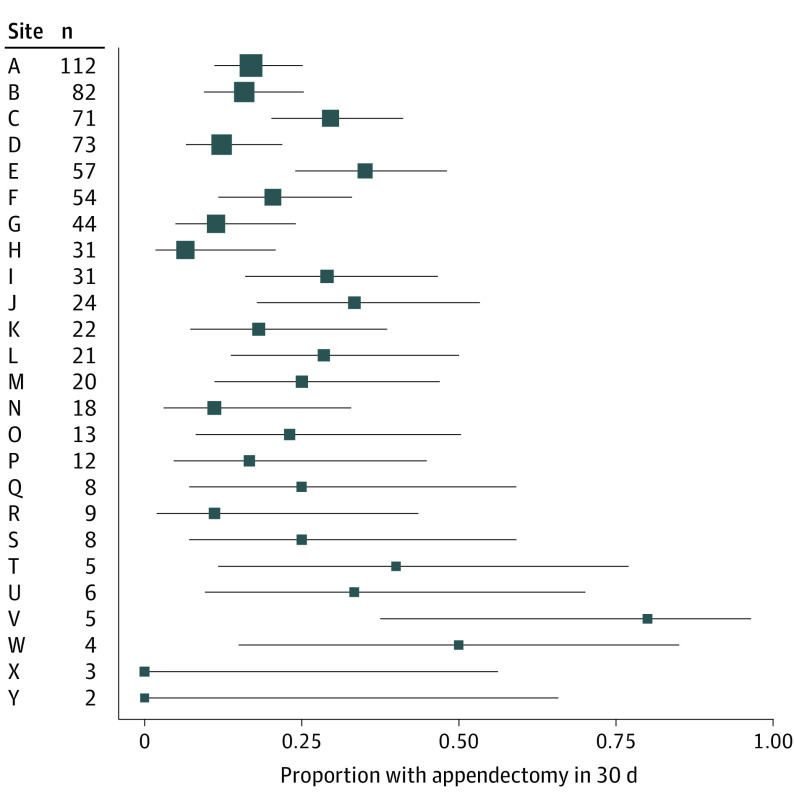
Design, setting, and participants: In this cohort study using data from the Comparison of Outcomes of Antibiotic Drugs and Appendectomy (CODA) randomized clinical trial, characteristics among patients who initiated antibiotics were compared between those who did and did not undergo appendectomy within 30 days. The study was conducted at 25 US medical centers; participants were enrolled between May 3, 2016, and February 5, 2020. A total of 1552 participants with acute appendicitis were randomized to antibiotics (776 participants) or appendectomy (776 participants). Data were analyzed from September 2020 to July 2021.
Exposures: Appendectomy vs antibiotics.
Main outcomes and measures: Conditional logistic regression models were fit to estimate associations between specific patient factors and the odds of undergoing appendectomy within 30 days after initiating antibiotics. A sensitivity analysis was performed excluding participants who underwent appendectomy within 30 days for nonclinical reasons.
Results: Of 776 participants initiating antibiotics (mean [SD] age, 38.3 [13.4] years; 286 [37%] women and 490 [63%] men), 735 participants had 30-day outcomes, including 154 participants (21%) who underwent appendectomy within 30 days. After adjustment for other factors, female sex (odds ratio [OR], 1.53; 95% CI, 1.01-2.31), radiographic finding of wider appendiceal diameter (OR per 1-mm increase, 1.09; 95% CI, 1.00-1.18), and presence of appendicolith (OR, 1.99; 95% CI, 1.28-3.10) were associated with increased odds of undergoing appendectomy within 30 days. Characteristics that are often associated with increased risk of complications (eg, advanced age, comorbid conditions) and those clinicians often use to describe appendicitis severity (eg, fever: OR, 1.28; 95% CI, 0.82-1.98) were not associated with odds of 30-day appendectomy. The sensitivity analysis limited to appendectomies performed for clinical reasons provided similar results regarding appendicolith (adjusted OR, 2.41; 95% CI, 1.49-3.91).
Conclusions and relevance: This cohort study found that presence of an appendicolith was associated with a nearly 2-fold increased risk of undergoing appendectomy within 30 days of initiating antibiotics. Clinical characteristics often used to describe severity of appendicitis were not associated with odds of 30-day appendectomy. This information may help guide more individualized decision-making for people with appendicitis.
Conflict of interest statement
Figures
Comment in
-
Appendicoliths, Antibiotic Treatment Failure, and Appendectomy-Is the Glass Half Full or Half Empty?JAMA Surg. 2022 Mar 1;157(3):e216901. doi: 10.1001/jamasurg.2021.6901. Epub 2022 Mar 9. JAMA Surg. 2022. PMID: 35019951 No abstract available.
-
Patient Factors and Pathology and Ultrasonography Findings Associated With Appendectomy-Reply.JAMA Surg. 2022 Sep 1;157(9):856-857. doi: 10.1001/jamasurg.2022.1560. JAMA Surg. 2022. PMID: 35612833 No abstract available.
-
Patient Factors and Pathology and Ultrasonography Findings Associated With Appendectomy.JAMA Surg. 2022 Sep 1;157(9):855. doi: 10.1001/jamasurg.2022.1558. JAMA Surg. 2022. PMID: 35612850 No abstract available.
-
Patient Factors and Pathology and Ultrasonography Findings Associated With Appendectomy.JAMA Surg. 2022 Sep 1;157(9):855-856. doi: 10.1001/jamasurg.2022.1559. JAMA Surg. 2022. PMID: 35612869 No abstract available.
References
-
- Turhan AN, Kapan S, Kütükçü E, Yiğitbaş H, Hatipoğlu S, Aygün E. Comparison of operative and non operative management of acute appendicitis. Ulus Travma Acil Cerrahi Derg. 2009;15(5):459-462. - PubMed
Publication types
MeSH terms
Substances
LinkOut - more resources
Full Text Sources
Medical