Review
. 2022 Jan 12;21(1):14.
doi: 10.1186/s12943-022-01500-4.

The role of m6A RNA methylation in cancer metabolism

Affiliations
Review

The role of m6A RNA methylation in cancer metabolism

Yuanyuan An et al. Mol Cancer. .

Abstract

Metabolic reprogramming is one of the main characteristics of malignant tumors, which is due to the flexible changes of cell metabolism that can meet the needs of cell growth and maintain the homeostasis of tissue environments. Cancer cells can obtain metabolic adaptation through a variety of endogenous and exogenous signaling pathways, which can not only promote the growth of malignant cancer cells, but also start the transformation process of cells to adapt to tumor microenvironment. Studies show that m6A RNA methylation is widely involved in the metabolic recombination of tumor cells. In eukaryotes, m6A methylation is the most abundant modification in mRNA, which is involved in almost all the RNA cycle stages, including regulation the transcription, maturation, translation, degradation and stability of mRNA. M6A RNA methylation can be involved in the regulation of physiological and pathological processes, including cancer. In this review, we discuss the role of m6A RNA methylation modification plays in tumor metabolism-related molecules and pathways, aiming to show the importance of targeting m6A in regulating tumor metabolism.

Keywords: Cancer; Metabolism reprogramming; The m6A.


Conflict of interest statement

The authors declare that there is no potential competing interest.

Figures
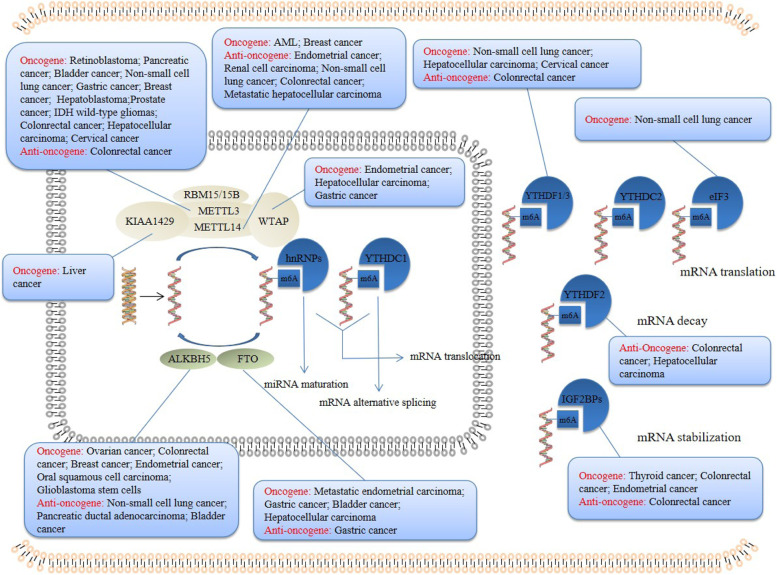
Fig. 1
Fig. 1
The function, expression location and function in different tumors of m6A methylases, demethylases and recognition proteins
Fig. 2
Fig. 2
M6A methylases, demethylases and recognition proteins regulate signaling pathways, transcription factors and metabolic enzymes related to cancer metabolism. The red font indicates that there is a positive regulation between m6A methylases and proteins, and the black font indicates that there is a negative regulation between m6A methylases and proteins
Fig. 3
Fig. 3
The function of m6A methylases that participate in cancer metabolism pathways, including glycolysis, amino acid synthesis, nucleotide synthesis and fatty acid synthesis. Importantly, the glycolysis of tumor cells regulated by m6A methylases mainly refers to Warburg effect, which is aerobic glycolysis

References

    1. Lunt SY, Vander Heiden MG. Aerobic glycolysis: meeting the metabolic requirements of cell proliferation. Annu Rev Cell Dev Biol. 2011;27:441–464. - PubMed
    1. Warburg O. On the origin of cancer cells. Science. 1956;123:309–314. - PubMed
    1. Scharping NE, Rivadeneira DB, Menk AV, Vignali PDA, Ford BR, Rittenhouse NL, Peralta R, Wang Y, Wang Y, DePeaux K. Mitochondrial stress induced by continuous stimulation under hypoxia rapidly drives T cell exhaustion. Nat Immunol. 2021;22:205–215. - PMC - PubMed
    1. Boccaletto P, Machnicka MA, Purta E, Piatkowski P, Baginski B, Wirecki TK, de Crécy-Lagard V, Ross R, Limbach PA, Kotter A, et al. MODOMICS: a database of RNA modification pathways. Nucleic Acids Res. 2018;46:D303–d307. - PMC - PubMed
    1. Krug RM, Morgan MA, Shatkin AJ. Influenza viral mRNA contains internal N6-methyladenosine and 5'-terminal 7-methylguanosine in cap structures. J Virol. 1976;20:45–53. - PMC - PubMed

MeSH terms
