Review
. 2022 Jan 12;23(1):9.
doi: 10.1186/s12931-021-01895-6.

Practical guide to cardiopulmonary exercise testing in adults

Affiliations
Review

Practical guide to cardiopulmonary exercise testing in adults

Thomas Glaab et al. Respir Res. .

Abstract

Unexplained exertional dyspnoea or fatigue can arise from a number of underlying disorders and shows only a weak correlation with resting functional or imaging tests. Noninvasive cardiopulmonary exercise testing (CPET) offers a unique, but still under-utilised and unrecognised, opportunity to study cardiopulmonary and metabolic changes simultaneously. CPET can distinguish between a normal and an abnormal exercise response and usually identifies which of multiple pathophysiological conditions alone or in combination is the leading cause of exercise intolerance. Therefore, it improves diagnostic accuracy and patient health care by directing more targeted diagnostics and facilitating treatment decisions. Consequently, CPET should be one of the early tests used to assess exercise intolerance. However, this test requires specific knowledge and there is still a major information gap for those physicians primarily interested in learning how to systematically analyse and interpret CPET findings. This article describes the underlying principles of exercise physiology and provides a practical guide to performing CPET and interpreting the results in adults.

Keywords: 9-Panel plot; COPD; Cardiovascular disease; Dyspnea; Exercise limitation; Interstitial lung disease; Pulmonary hypertension; Ventilatory inefficiency.


Conflict of interest statement

The authors declare that they have no competing interests.

Figures
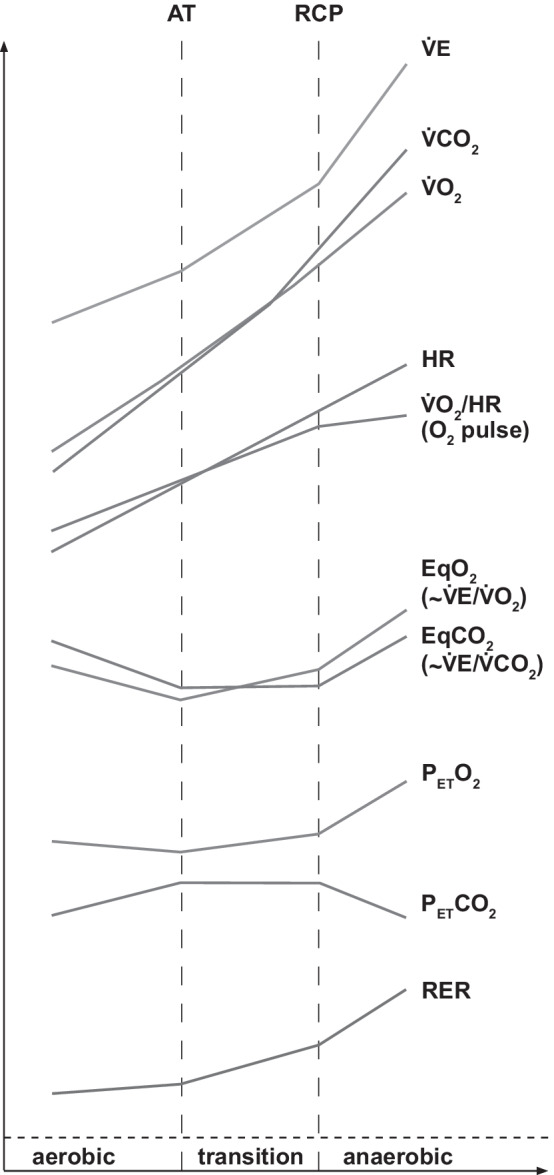
Fig. 1
Fig. 1
Principles of exercise physiology. The characteristic changes in key variables of ventilation, cardiocirculation and pulmonary gas exchange during progressive exercise are shown. Anaerobic threshold (AT) documents the transition to mixed aerobic-anaerobic metabolism, respiratory compensation point (RCP) documents the transition to predominant anaerobic metabolism. A more detailed description of Fig. 1 can be found in Additional file 1 (see Supplementary Information)
Fig. 2
Fig. 2
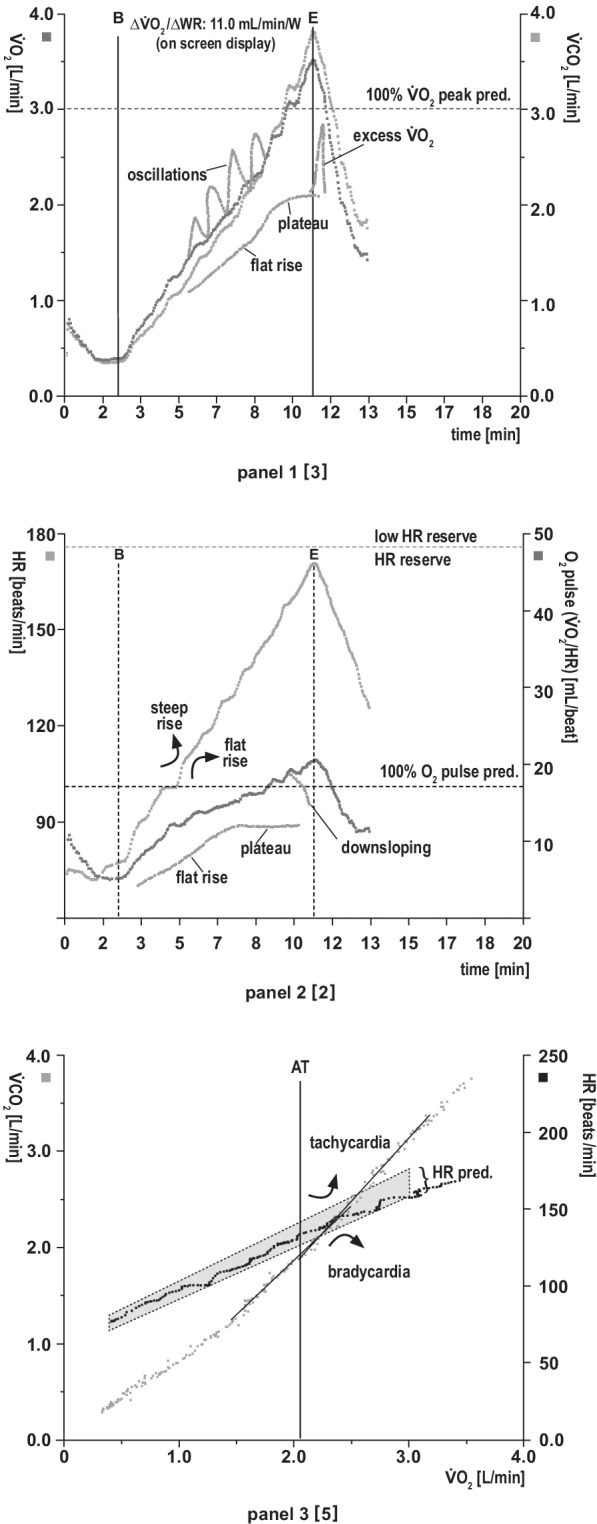
Cardiovascular panels. Panel 1: O2 uptake (VO2) and CO2 output (VCO2) vs. time plus relationship of peak VO2 and work rate (WR). B, beginning and E, end of exercise. Peak V˙O2 indicates peak exercise capacity and oxygen uptake at the end of an incremental exercise test. Validity is dependent on patient effort. It is an index of long-term survival. Increase ΔV̇O2/ΔWR: provides information about the contribution of aerobic metabolism to exercise (aerobic capacity). A low ratio indicates impaired O2 delivery and high anaerobic metabolism during exercise (e.g., peripheral artery, cardiovascular, pulmonary vascular and/or lung disease). Panel [3] refers to the original 9-panel display [26]. Analysis (target values and response kinetics): Peak V˙O2 within normal limits or reduced (indicates impaired O2 transport and/or utilisation)? Early flattening, reduction or plateau of peak V̇O2? Overshoot in V˙O2 following termination of exercise (short-term increase in stroke volume [SV] with reduced afterload; e.g., cardiovascular disease)? Post-exercise V˙O2 recovery to baseline delayed (indicates high O2 deficit during exercise)? ΔV˙O2-peak/ΔWR during exercise: normal, increased (e.g., obesity) or flattening/downsloping? Oscillatory patterns at rest/moderate exercise (indicates left chronic heart failure [CHF] with poor prognosis)? Panel 2: Relationship of heart rate and oxygen pulse vs. time. O2 pulse (V˙O2/HR) indicates the amount of oxygen extracted by the tissues per heartbeat. This provides information about SV and cardiac output (SV × C(a-υ¯) O2) during exercise. Heart rate (HR) is the factor that normally limits exercise capacity in healthy subjects. Analysis (target values and response kinetics): O2 pulse at peak exercise: normal or reduced (impaired transport of O2 and/or O2 utilisation, e.g., cardiovascular disease, anaemia, peripheral arterial disease [PAD], myopathy) or elevated (chronotropic incompetence, e.g. beta-blocker therapy, heart failure, atrial flutter, tachycardia)? Plateau formation of O2 pulse (below predicted value)? Linear or flat increase of O2 pulse during early, middle or late exercise? Post-exercise O2 pulse recovery to baseline delayed (suggests large O2 deficit during exercise)? Increase in HR vs. V˙O2 normal, steep or low (suggests chronotropic incompetence)? HR: elevated at rest? Alternating course of HR during exercise (indicates arrhythmia)? HR reserve (maximal HR predicted—peak HR at peak V˙O2): normal, high or low? Panel 3: Relationships of CO2 output (V˙CO2) (y-axis) and O2 uptake (V˙O2 (x-axis) and the relationship between HR and V˙O2. First reference to determine AT (see main text). AT corresponds to the curve point at which, due to CO2-related hyperventilation, V˙CO2 begins to continuously rise more steeply than the V˙O2 (V-slope method). The V-slope is less responsive to breathing irregularities than PETO2 and V˙E/V˙O2. HR: more detailed information on HR behaviour (incl. target value range) See also HR at Panel 2. Analysis (target values and response kinetics): AT in target range or reduced (indicates impaired O2 delivery)? Cross-check with panels 4, 7 (3-panel view). Linear increase in HR relative to V˙O2? HR reserve: normal, low or increased?
Fig. 3
Fig. 3
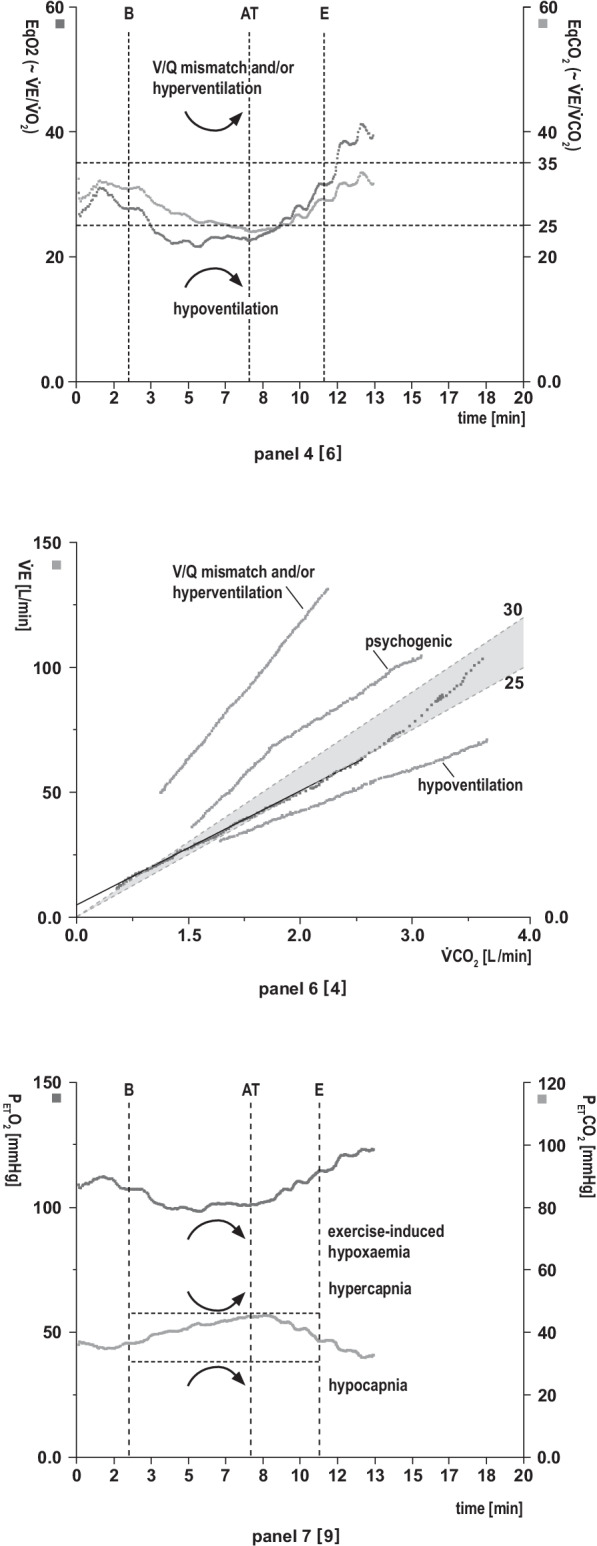
Pulmonary gas exchange panels Panel 4: The relationships of minute ventilation (V˙E) vs. O2 uptake (V˙O2) and vs. CO2 (V˙CO2) output (ventilatory equivalents) as a function of time. The ventilatory equivalents EqO2 ≈ V˙E/V˙O2 and EqCO2 ≈ V˙E/V˙CO2 indicate how many litres must be ventilated to take up 1 L of O2 or exhale 1 L of CO2 (gas exchange efficiency). The same information is found in panel 6 in a linear presentation. The lower the equivalent values, the more effective the gas exchange or work of breathing, and vice versa. Excess V˙E vs. V˙O2 and V˙CO2 occurs due to augmented ventilatory drive (nonspecific hyperventilation), metabolic acidosis (compensatory hyperventilation) and/or V/Q mismatch (true ventilatory inefficiency). Additional possibility of determining the AT. AT corresponds to the lowest point (nadir) of EqO2 directly before EqO2 continuously increases (provided EqCO2 does not increase simultaneously). Analysis (target values and response kinetics): Physiological decrease in EqO2 and EqCO2 from rest to AT? Significantly elevated EqO2 and EqCO2 values at rest or during exercise? Significantly decreased EqO2 and EqCO2 values (indicates alveolar hypoventilation)? AT within predicted values or reduced? Cross-validate with panels 3, 7 (3-panel view). Panel 6: The relationship of ventilation (V˙E) and CO2 production (V˙CO2): V˙E/V˙CO2 slope. The V˙E/V˙CO2 slope is a measure of ventilatory (gas exchange) efficiency at submaximal exercise. The same information can be found in panel 4 (EqCO2 ≈ V˙E/V˙CO2) in a nonlinear presentation, but values are not identical [21]. The V˙E/V˙CO2 slope is a prognostic indicator in CHF. Analysis (target values and response kinetics): V˙E/V˙CO2 slope within normal range (preserved V/Q matching)? Steep increase in the V˙E/V˙CO2 slope indicative of significant V/Q mismatching (V˙E/V˙CO2 slope ≥ 39 [27]) and/or nonspecific/compensatory hyperventilation (which is usually paralleled by ↑PETO2 and ↓PETCO2)? Initial sharp increase in the V˙E/V˙CO2 slope that levels off with increasing work rate (suggestive of psychogenic hyperventilation)? Decrease in the V˙E/V˙CO2 slope indicates alveolar hypoventilation. Panel 7: End-tidal partial pressures of O2 (PETO2) and CO2 (PETCO2) vs. time. Indirect measure of pulmonary gas exchange and V/Q mismatch. The more pronounced the ventilation, the lower the PETCO2 and the higher the PETO2, and vice versa in normal lungs. (Note: PETCO2 ≠ PaCO2. PETCO2 > PaCO2 during exercise (approx. 4 mmHg); at rest: PETCO2 < PaCO2 (approx. 2 mm Hg). Additional possibility of determining the AT. AT corresponds to the lowest point (nadir) of PETO2 directly before PETO2 continuously increases (provided PETCO2 remains constant). Analysis (target values and response kinetics): Physiological course of PETO2 and PETCO2 at rest and during exercise? Cross-check with BGA. AT within predicted values or reduced? Cross-check with panels 3, 4 (3-panel view). Decrease in PETO2 (indicates exercise-induced hypoxaemia) or abrupt increase at start of exercise (may indicate R-L-shunt or nonspecific hyperventilation)? Significant drop in PETCO2 during exercise (suggests V/Q mismatch and/or hyperventilation)? Significant increase in PETCO2 during exercise (indicates alveolar hypoventilation, e.g., severe COPD, obesity hypoventilation syndrome, neuromuscular disease)? Note: the determination of P(A-a)O2 or P(a-ET)CO2 more sensitively and reliably identifies and quantifies low or high V/Q regions (and/or a R-L-shunt) than end-tidal partial pressures
Fig. 4
Fig. 4
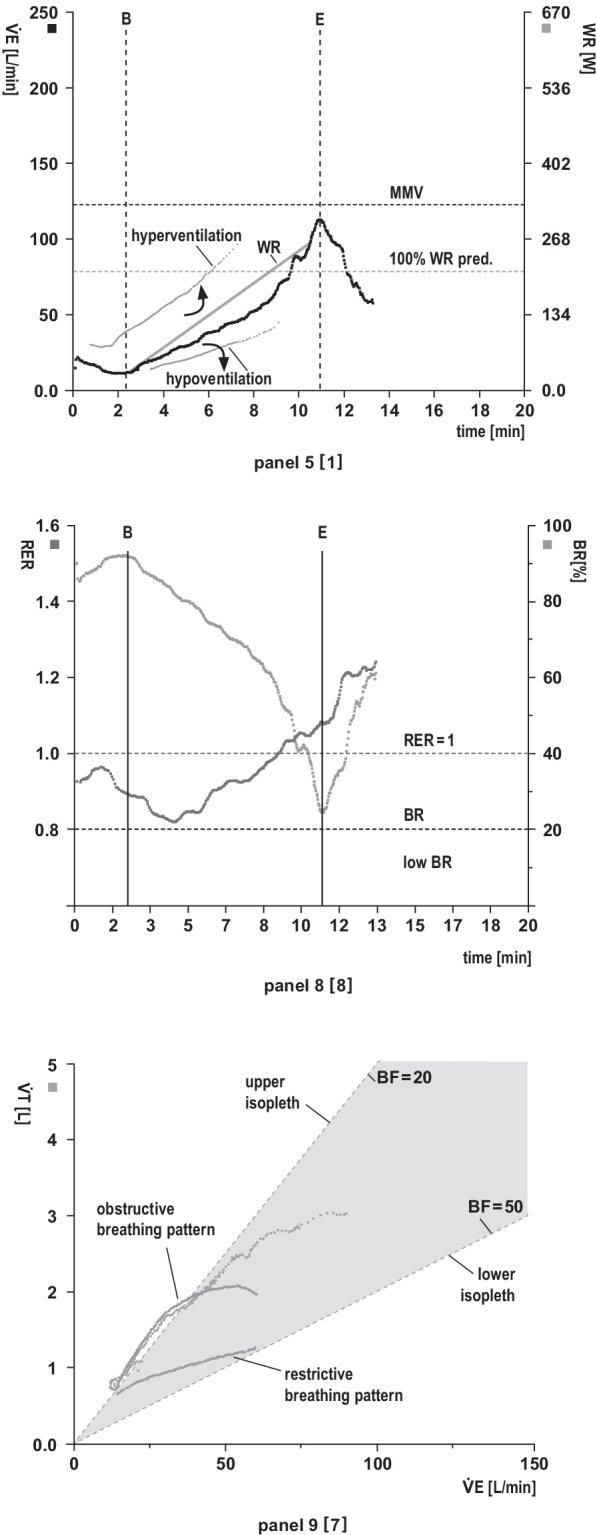
Ventilatory response panels Panel 5: Relationship between minute ventilation (V˙E) and work rate (WR) vs. time (x-axis). The maximum voluntary ventilation (MVV) is calculated indirectly as forced expiratory volume in 1 s (FEV1) × 40 or can be determined by direct measurement of MVV (preferred option in restrictive lung disease). Exercise is usually not limited by breathing. Analysis (target values and response kinetics): Is V˙E adequate relative to work rate (see main text: validity check, 9-point rule)? Is V˙E vs. work rate sharply increased at the start of exercise (suggestive of R-L shunting) or decreased (e.g., mask or mouthpiece leakage)? Impaired ability to increase V˙E in response to enhanced CO2 production and/or acidaemia (e.g., severe lung disease, obesity)? Panel 8: Respiratory exchange rate (RER) and breathing reserve (BR). RER describes the ratio of CO2 output to O2 uptake (V˙CO2/V˙O2) as a function of time and reflects patient effort (RER at least ≥ 1). RER depends on the rate of lactate increase during progressive exercise. BR indicates the actual percentage of the maximum ventilatory capacity (MVV-V̇E). Validity depends on adequate spirometry. Analysis (target values and response kinetics): RER values at rest: normal, high or low? RER > 1 at rest (indicative of hyperventilation). RER ≥ 1 achieved in early exercise (work rate already above lactate threshold) or in late exercise? An abrupt, persistent RER increase during early exercise suggests exercise-induced R-L shunt. RER < 1 during exercise (e.g., poor effort, severe lung disease [V˙E cannot be adequately increased], myopathy, PAD, hyperventilation prior to testing)? Delayed decrease in RER in early recovery (indicates delayed CO2 elimination, e.g., severe COPD) or rapid RER decrease in early recovery (indicates delayed recovery of V˙O2 vs. V˙CO2 due to a high O2 deficit during exercise)? BR normal or low? A low BR indicates reduced ventilatory capacity due to impaired lung mechanics and increased ventilatory demands during exercise. Panel 9: Breathing pattern. Relationships of tidal volume (VT) (y-axis), minute ventilation (V˙E) (x-axis) and breathing frequency (BF). BF is indirectly presented in the form of isopleths (= line with the same numerical values. Upper isopleth: low BF [= 20 breaths/min]. Lower isopleth: high BF [= 50 breaths/min]). Physiologically, V̇E increases until VT is fully utilised (≈ 60% of VC), thereafter V̇E increases with a rise in BF. Analysis (target values and response kinetics): Normal breathing pattern? The values in the area of the upper isopleths indicate a high VT and a low BF. Obstructive breathing pattern? The increase in ventilation during exercise is limited because VT is already fully utilised and eventually falls off. BF cannot be adequately increased due to the prolonged expiration time. This results in slow, deep breathing. Restrictive breathing pattern? The increase in ventilation during exercise is limited because VT cannot be sufficiently increased due to the reduced lung volume (VT/IC ratio ↑ [> 0.8]). Hence, ventilation can only be increased by elevated BF. VT runs low and flat in the direction of the lower isopleth. This results in rapid, shallow breathing.

References

    1. Sietsema KE, Sue DY, Stringer WW, Ward SA. Wasserman & Whipp’s principles of exercise testing and interpretation. 6. Philadelphia: Wolters Kluwer; 2021.
    1. O’Donnell DE, Elbehairy AF, Faisal A, et al. Exertional dyspnoea in COPD: the clinical utility of cardiopulmonary exercise testing. Eur Respir Rev. 2016;25:333–347. doi: 10.1183/16000617.0054-2016. - DOI - PMC - PubMed
    1. Datta D, Normandin E, Zuwallack R. Cardiopulmonary exercise testing in the assessment of exertional dyspnea. Ann Thoracic Med. 2015;10:77–86. doi: 10.4103/1817-1737.151438. - DOI - PMC - PubMed
    1. Puente-Maestu L, Palange P, Casaburi R, et al. Use of exercise testing in the evaluation of interventional efficacy: an official ERS statement. Eur Respir J. 2016;47:429–460. doi: 10.1183/13993003.00745-2015. - DOI - PubMed
    1. Albouani K, Egred A, Alahmar A, et al. Cardiopulmonary exercise testing and its application. Postgrad Med J. 2007;83:675–682. doi: 10.1136/hrt.2007.121558. - DOI - PMC - PubMed