. 2021 Dec;11(12):3847-3856.
doi: 10.1016/j.apsb.2021.05.023. Epub 2021 May 26.

Bile acid homeostasis in female mice deficient in Cyp7a1 and Cyp27a1

Affiliations

Bile acid homeostasis in female mice deficient in Cyp7a1 and Cyp27a1

Daniel Rizzolo et al. Acta Pharm Sin B. 2021 Dec.

Abstract

Bile acids (BAs) are amphipathic molecules important for metabolism of cholesterol, absorption of lipids and lipid soluble vitamins, bile flow, and regulation of gut microbiome. There are over 30 different BA species known to exist in humans and mice, which are endogenous modulators of at least 6 different membrane or nuclear receptors. This diversity of ligands and receptors play important roles in health and disease; however, the full functions of each individual BA in vivo remain unclear. We generated a mouse model lacking the initiating enzymes, CYP7A1 and CYP27A1, in the two main pathways of BA synthesis. Because females are more susceptible to BA related diseases, such as intrahepatic cholestasis of pregnancy, we expanded this model into female mice. The null mice of Cyp7a1 and Cyp27a1 were crossbred to create double knockout (DKO) mice. BA concentrations in female DKO mice had reductions in serum (63%), liver (83%), gallbladder (94%), and small intestine (85%), as compared to WT mice. Despite low BA levels, DKO mice had a similar expression pattern to that of WT mice for genes involved in BA regulation, synthesis, conjugation, and transport. Additionally, through treatment with a synthetic FXR agonist, GW4064, female DKO mice responded to FXR activation similarly to WT mice.

Keywords: ALP, alkaline phosphatase; ALT, alanine aminotransferase; ASBT, apical sodium-dependent BA transporter; AST, aspartate transaminase; BA, bile acid; BSEP, bile salt export pump; Bile acids; CA, cholic acid; CDCA, chenodeoxycholic acid; CYP27A1; CYP27A1, sterol 27-hydroxylase; CYP2C70, cytochrome P450 2C70; CYP7A1; CYP7A1, cholesterol 7α-hydroxylase; CYP7B1, 25-hydroxycholesterol 7-alpha-hydroxylase; CYP8B1, sterol 12α-hydroxylase; DCA, deoxycholic acid; DKO, double knockout; FXR, farnesoid X receptor; Farnesoid X receptor; Female; Fibroblast growth factor 15; IBABP, intestinal BA-binding protein; LCA, lithocholic acid; NTCP, sodium taurocholate cotransporting polypeptide; OATP, organic anion transporters; OSTα/β, organic solute transporters alpha and beta; WT, wild type; βMCA, beta muricholic acid.


Conflict of interest statement

The authors of this study have no conflict of interest.

Figures

Image 1
Graphical abstract
Figure 1
Figure 1
Serum BA concentration and composition in female WT, Cyp7a1−/−, Cyp27a1−/−, and DKO mice. BAs were measured using UPLC–ITMS from 90 μL of serum. (A) Mean total BA concentration ± SD in the serum of female WT, Cyp7a1−/−, Cyp27a1−/−, and DKO mice displayed in ng/mL. (B) Mean concentration ± SD of 23 individual BAs. (C) Percent composition of BA species in serum. An asterisk signifies significant difference from WT mice (P < 0.05).
Figure 2
Figure 2
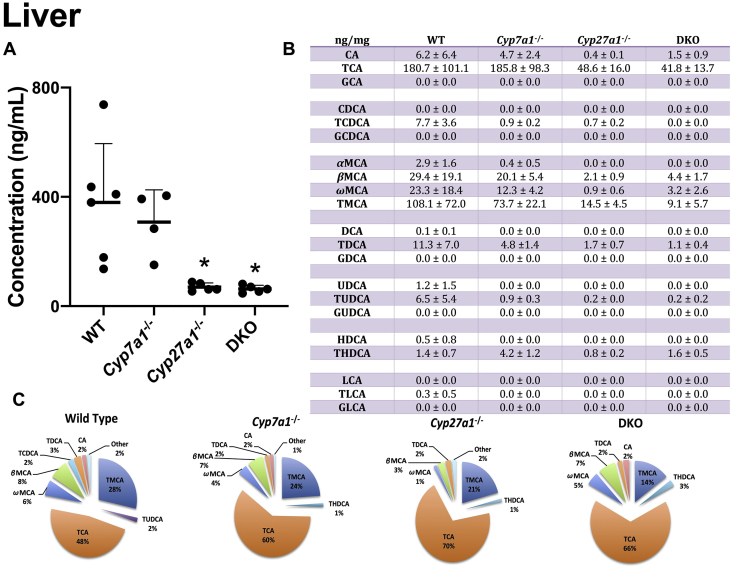
Liver BA concentration and composition in female WT, Cyp7a1−/−, Cyp27a1−/−, and DKO mice. BAs were measured using UPLC–ITMS from ∼50 mg of liver tissue. (A) Mean total BA concentration ± SD in the liver of female WT, Cyp7a1−/−, Cyp27a1−/−, and DKO mice displayed as ng of BA/mg liver tissue. (B) Mean concentration ± SD of 21 individual BAs. (C) Percent composition of BA species in liver tissue. An asterisk signifies significant difference from WT mice (P < 0.05).
Figure 3
Figure 3
Gallbladder BA concentration and composition in female WT, Cyp7a1−/−, Cyp27a1−/−, and DKO mice. BAs were measured using UPLC–ITMS from gallbladder content. (A) Mean total BA concentration ± SD in the gallbladder of female WT, Cyp7a1−/−, Cyp27a1−/−, and DKO mice displayed as μg of BA/100 g body weight ( × 1000). (B) Mean concentration ± SD of 23 individual BAs. (C) Percent composition of BA species in the gallbladder. An asterisk signifies significant difference from WT mice (P < 0.05).
Figure 4
Figure 4
Small intestine BA concentration and composition in female WT, Cyp7a1−/−, Cyp27a1−/−, and DKO mice. BAs were measured using UPLC–ITMS from homogenized small intestine. (A) Mean total BA concentration ± SD in the small intestine of female WT, Cyp7a1−/−, Cyp27a1−/−, and DKO mice displayed as μg of BA/100 g body weight (× 1000). (B) Mean concentration ± SD of 21 individual BAs. (C) Percent composition of BA species in the small intestine. An asterisk signifies significant difference from WT mice (P < 0.05).
Figure 5
Figure 5
Relative mRNA expression of BA synthesis, regulation, and transport genes. Gene expression at mRNA levels was measured by RT-qPCR and normalized to β-actin mRNA expression. All graphs display relative mRNA levels ± SD. An asterisk signifies significant difference from WT mice (P < 0.05). Hepatic relative mRNA expression of genes involved in BA synthesis (A), synthesis and conjugation (B), regulation and transport (C). (D) Ileal relative mRNA expression of genes involved in BA regulation and transport.
Figure 6
Figure 6
Hepatic relative mRNA expression following treatment with a synthetic FXR agonist, GW4064. Gene expression at mRNA levels was measured by RT-qPCR and normalized to β-actin mRNA expression. All graphs display relative mRNA expression ± SD. An asterisk signifies significant difference from vehicle-treated WT mice and a pound sign signifies a significant difference within genotypes between vehicle and GW4064 treatments (P < 0.05).
Figure 7
Figure 7
Ileal relative mRNA expression following treatment with a synthetic FXR agonist, GW4064. Gene expression at mRNA levels was measured by RT-qPCR and normalized to β-actin mRNA expression. All graphs display relative mRNA values ± SD. An asterisk signifies significant difference from vehicle-treated WT mice and a pound sign signifies a significant difference within genotypes between vehicle and GW4064 treatments (P < 0.05).

References

    1. Li T., Chiang J.Y. Bile acid signaling in metabolic disease and drug therapy. Pharmacol Rev. 2014;66:948–983. - PMC - PubMed
    1. Wong M.H., Oelkers P., Craddock A.L., Dawson P.A. Expression cloning and characterization of the hamster ileal sodium-dependent bile acid transporter. J Biol Chem. 1994;269:1340–1347. - PubMed
    1. Dawson P.A., Hubbert M., Haywood J., Craddock A.L., Zerangue N., Christian W.V., et al. The heteromeric organic solute transporter alpha-beta, Ostalpha-Ostbeta, is an ileal basolateral bile acid transporter. J Biol Chem. 2005;280:6960–6968. - PMC - PubMed
    1. Hagenbuch B., Meier P.J. Molecular cloning, chromosomal localization, and functional characterization of a human liver Na+/bile acid cotransporter. J Clin Invest. 1994;93:1326–1331. - PMC - PubMed
    1. Jacquemin E., Hagenbuch B., Stieger B., Wolkoff A.W., Meier P.J. Expression cloning of a rat liver Na+-independent organic anion transporter. Proc Natl Acad Sci U S A. 1994;91:133–137. - PMC - PubMed