. 2022 Jan 13;17(1):e0262285.
doi: 10.1371/journal.pone.0262285. eCollection 2022.

Th17 cell-mediated immune response in a subpopulation of dogs with idiopathic epilepsy

Affiliations

Th17 cell-mediated immune response in a subpopulation of dogs with idiopathic epilepsy

Anna Knebel et al. PLoS One. .

Abstract

Background: Canine idiopathic epilepsy (IE) is a common neurological disease with severe impact on the owner´s and the dog's quality of life. A subpopulation of dogs with IE does not respond to antiseizure drugs (non-responder). Th17 cells (T helper cells) and their proinflammatory Interleukin-17 (IL-17) are part of the immune system and previous studies showed their involvement in the pathogenesis of several autoimmune diseases. Non-responder might have an abnormal immune response against structures of the central nervous system. To discover a new aetiology of canine IE and thereby optimising the therapy of intractable IE, this prospective study aimed to investigate Th17 cells and IL-17 in dogs with IE. The underlying hypothesis was that in some dogs with IE a Th17 cell-mediated immune response could be detectable.

Methods: 57 dogs with IE and 10 healthy dogs (control group, C) were enrolled in the study. EDTA blood was taken to measure Th17 cells by flow cytometry. IL-17 was measured in 35 cerebrospinal fluid (CSF) and 33 serum samples using an enzyme-linked immunosorbent assay (ELISA). It was investigated whether there was a significant increase of stimulated Th17 cells in blood samples or of IL-17 in serum and CSF samples of dogs with IE in comparison to C. Correlations between the amount of Th17 cells/μL or IL-17 and different clinical parameters e.g. seizure frequency, seizure type, seizure severity or treatment response were evaluated. Additionally, Th17 cells/μL were randomly controlled of 17 dogs with IE and were examined for changes over time and in relation to treatment response.

Results: Ten dogs with IE had strongly elevated stimulated Th17 cells/μL within the blood (>100 Th17 cells/μL). A slight positive correlation between stimulated Th17 cells/μL and seizure severity (p = 0.046; rSpear = 0.27) was proven in these dogs. In addition, 4/10 dogs with elevated Th17 levels experienced cluster seizures and status epilepticus in comparison to 9% of the dogs with non-elevated Th17 levels (<100 Th17 cells/μL). Dogs with IE had significantly higher IL-17 values in CSF and serum samples compared to C (p<0.001; p<0.002; respectively).

Conclusion: In single dogs with IE, strongly increased amounts of Th17 cells were detectable and dogs with elevated Th17 cells seemed to have a greater risk for experiencing a combination of cluster seizures and status epilepticus. Therefore, an underlying Th17-cell mediated immune response was suspected and hence anti-inflammatory drugs could be indicated in these single cases with intractable epilepsy.


Conflict of interest statement

The authors have declared that no competing interests exist.

Figures
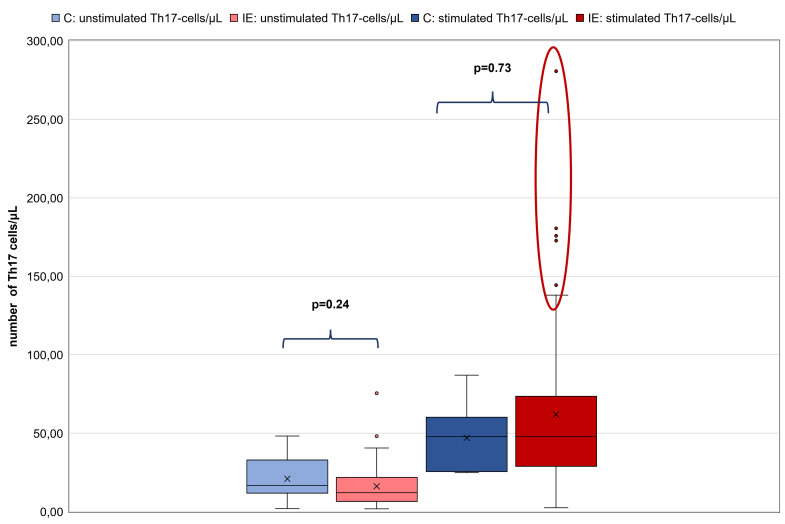
Fig 1
Fig 1. Comparison of the control group with dogs with IE regarding their amount of Th17 cells/μL.
Left pale blue box plot showing results of unstimulated Th17 cells/μL of the control group (C) (n = 10) and the second pale red box plot showing results of unstimulated Th17 cells/μL of dogs with IE (n = 57). The third dark blue box plot showing results of stimulated Th17 cells/μL of C (n = 10) and the fourth dark red box plot showing results of stimulated Th17 cells/μL of dogs with IE (n = 57). All box plots represent the maximum, the third quartile, the mean, the median, the first quartile and minimum of the measured Th17 cells/μL. Dots represent outliers. There is no significant difference between the dogs of C in comparison to the dogs with IE regarding their amount of unstimulated as well as stimulated Th17 cells/μL (p = 0.24; p = 0.73, respectively). But analysis demonstrates that there are some outliers (demonstrated within the red circle) in the population of dogs with IE with strongly increased numbers of Th17 cells/μL. Abbreviations: C: control group; IE: idiopathic epilepsy.
Fig 2
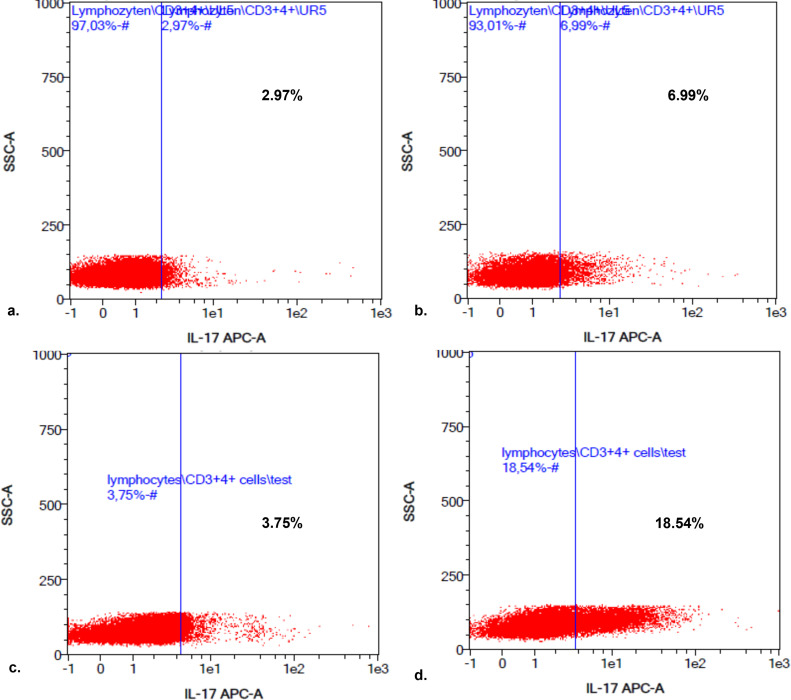
Fig 2. Presentation of a Th17 cell analysis after flow cytometry by MACSQuant Analysis Software of a healthy dog in comparison to a dog with IE.
The pictures represent the results of Th17 cell analysis using MACSQuant analysis software (a.-d.). The left-sided upper box (a.) showing percentage of unstimulated Th17 cells in percentage of one dog of C, the left-sided lower box (c.) showing percentage of unstimulated Th17 cells in percentage of one dog with IE. The right-sided boxes (b. and d.) showing corresponding stimulated Th17 cells in percentage of the dogs of a. and c. Therefore, box b. showing the stimulated Th17 cells in percentage of the dog of C and d. of the dog with IE (c.). There is no big difference in the number of unstimulated Th17 cells (2.97% versus 3.75%) but in the amount of stimulated Th17 cells of dogs with IE in comparison to the C (6.99% versus 18.54%). Caution should be given that results of the MACSQuant analysis software were displayed in percentage. For comparative analyses absolute numbers of Th17 cells/μL were used. Abbreviations: C: control group; IE: idiopathic epilepsy.
Fig 3
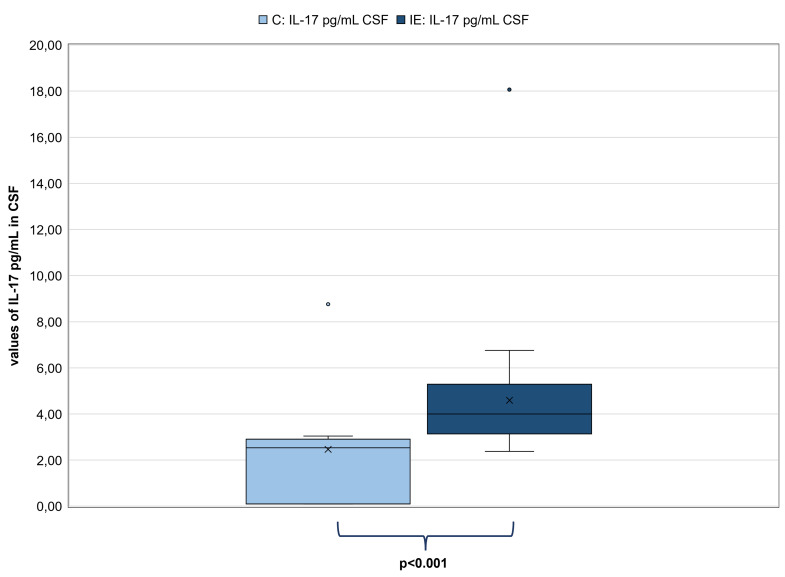
Fig 3. Comparison of the IL-17 values in pg/mL in CSF between dogs with IE and the control group (C).
Left pale blue box plot showing results of IL-17 values of C (n = 10) and the right dark blue box plot showing results of IL-17 values of dogs with IE (n = 35). Both box plots represent the maximum, the third quartile, the mean, the median, the first quartile and minimum of measured IL-17 in CSF (in pg/mL). The IL-17 values of dogs with IE were significantly higher than those of C (p<0.001). Abbreviations: C: control group; CSF: Cerebrospinal fluid; IE: idiopathic epilepsy.
Fig 4
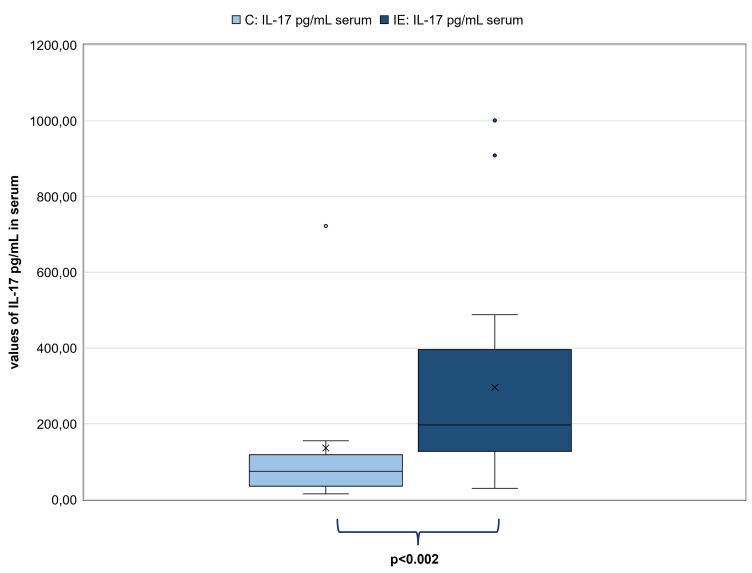
Fig 4. Comparison of the IL-17 values in pg/mL in serum samples between dogs with IE and the control group (C).
Left pale blue box plot showing results of IL-17 values of C (n = 10) and the right dark blue box plot showing results of IL-17 values of dogs with IE (n = 33). Both box plots represent the maximum, the third quartile, the mean, the median the first quartile and minimum of measured IL-17 in serum samples (in pg/mL). The IL-17 values of dogs with IE were significantly higher than those of C (p<0.002). Abbreviations: C: control group; IE: idiopathic epilepsy.

References

    1. Berendt M, Farquhar RG, Mandigers PJ, Pakozdy A, Bhatti SF, De Risio L, et al.. International veterinary epilepsy task force consensus report on epilepsy definition, classification and terminology in companion animals. BMC Vet Res. 2015;11:182. doi: 10.1186/s12917-015-0461-2 ; PubMed Central PMCID: PMC4552272. - DOI - PMC - PubMed
    1. Hulsmeyer VI, Fischer A, Mandigers PJ, DeRisio L, Berendt M, Rusbridge C, et al.. International Veterinary Epilepsy Task Force’s current understanding of idiopathic epilepsy of genetic or suspected genetic origin in purebred dogs. BMC Vet Res. 2015;11:175. doi: 10.1186/s12917-015-0463-0 ; PubMed Central PMCID: PMC4552344. - DOI - PMC - PubMed
    1. Kearsley-Fleet L, O’Neill DG, Volk HA, Church DB, Brodbelt DC. Prevalence and risk factors for canine epilepsy of unknown origin in the UK. Vet Rec. 2013;172(13):338. doi: 10.1136/vr.101133 . - DOI - PubMed
    1. Volk HA. Canine epilepsy: separating the wood from the trees. Vet Rec. 2016;178(16):394–6. Epub 2016/04/17. doi: 10.1136/vr.i1999 . - DOI - PubMed
    1. Packer RMA, Volk HA, Fowkes RC. Physiological reactivity to spontaneously occurring seizure activity in dogs with epilepsy and their carers. Physiol Behav. 2017;177:27–33. Epub 2017/04/17. doi: 10.1016/j.physbeh.2017.04.008 . - DOI - PubMed

Publication types

MeSH terms

Supplementary concepts