Review
. 2022 Mar:199:105244.
doi: 10.1016/j.antiviral.2022.105244. Epub 2022 Jan 11.

Immunobiology of Crimean-Congo hemorrhagic fever

Affiliations
Review

Immunobiology of Crimean-Congo hemorrhagic fever

Sergio E Rodriguez et al. Antiviral Res. 2022 Mar.

Abstract

Human infection with Crimean-Congo hemorrhagic fever virus (CCHFV), a tick-borne pathogen in the family Nairoviridae, can result in a spectrum of outcomes, ranging from asymptomatic infection through mild clinical signs to severe or fatal disease. Studies of CCHFV immunobiology have investigated the relationship between innate and adaptive immune responses with disease severity, attempting to elucidate factors associated with differential outcomes. In this article, we begin by highlighting unanswered questions, then review current efforts to answer them. We discuss in detail current clinical studies and research in laboratory animals on CCHF, including immune targets of infection and adaptive and innate immune responses. We summarize data about the role of the immune response in natural infections of animals and humans and experimental studies in vitro and in vivo and from evaluating immune-based therapies and vaccines, and present recommendations for future research.

Keywords: Animal models; Clinical studies; Crimean-Congo hemorrhagic fever virus; Hemorrhagic fever; Immunobiology; Immunology.


Conflict of interest statement

Potential conflicts of interest. All authors: no reported conflicts.

Figures

Figure 1.
Figure 1.
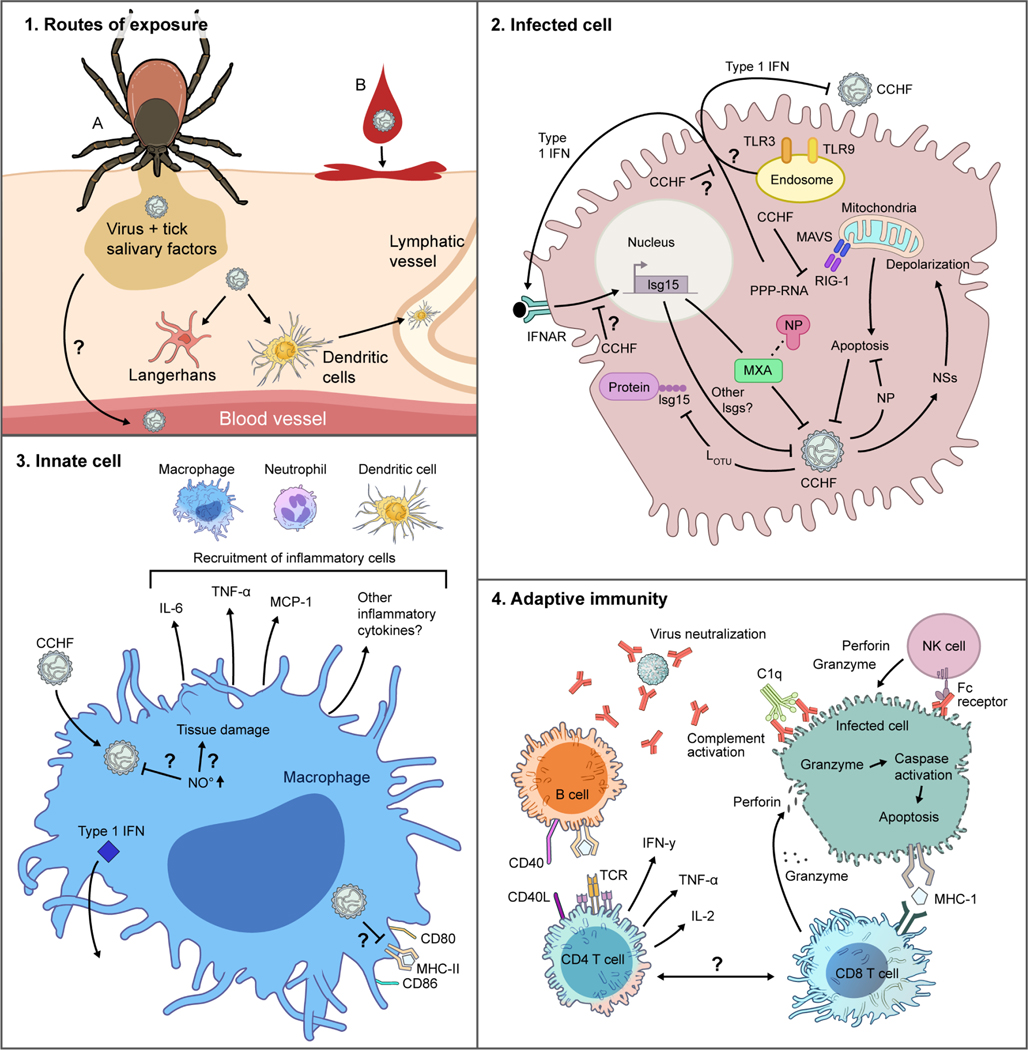
An overview of current knowledge of innate and adaptive responses in immunobiology of CCHFV infection (see accompanying Table 6). (1) Whether infection is via tick bite (A) or mucosal exposure (B), the initial events, including virus trafficking from the site of infection and dissemination to other organs, are poorly understood. Tissue damage is likely a combination of direct infection (2), inflammatory innate responses (3), and killing of infected cells by activated adaptive immune cells (4). Upon infection (2), many host and viral proteins are engaged to promote and limit viral replication. Host sensors that detect infection and initiate innate responses are not well understood and host proteins that act as restriction factors largely remain to be identified. Although type I IFN response is likely a key determinant of disease outcome and infection rapidly becomes resistant to type I IFN-mediated restriction, how virus blocks or resists type I IFN is largely unknown. Additionally, CCHFV possesses proteins with both pro- and anti-apoptotic function, suggesting apoptosis modulation may be a key factor in pathogenesis. Innate cell responses likely play a key early role in disease outcome (3). Infected innate cells can produce pro-inflammatory cytokines that recruit inflammatory cells, further contributing to tissue injury. Innate immune cells such as macrophages and dendritic cells can be infected, although whether they are important for controlling the virus through IFN production, antigen presentation, or reactive oxygen species production is unclear. Cells appear to only become partially activated in response to infection, and whether virus directly inhibits full activation resulting in improper antigen presentation requires further study. (4) Lastly, the role of adaptive immunity in controlling infection warrants further study. Neutralizing antibodies are not necessary for protection, yet other critical effector functions of antibody responses remain to be determined. The role of T-cells is even less clear. It is unknown if CD4 T-helper activity is required for support of B- and CD8-T-cell responses; cytotoxic activity of NK and/or CD8 T-cells is required for controlling virus; T-cells control CCHFV through production of antiviral cytokines; or virus-infected cells resist cytotoxic effector cells through actively blocking host cell apoptosis.

References

    1. Ahmed AA, McFalls JM, Hoffmann C, Filone CM, Stewart SM, Paragas J, Khodjaev S, Shermukhamedova D, Schmaljohn CS, Doms RW, Bertolotti- Ciarlet A, 2005. Presence of broadly reactive and group-specific neutralizing epitopes on newly described isolates of Crimean-Congo hemorrhagic fever virus. The Journal of General Virology 86, 3327–3336. 10.1099/vir.0.81175-0 - DOI - PubMed
    1. Akinci E, Yilmaz M, Bodur H, Ongürü P, Bayazit FN, Erbay A, Ozet G, 2009. Analysis of lymphocyte subgroups in Crimean-Congo hemorrhagic fever. International Journal of Infectious Diseases 13, 560–3. 10.1016/j.ijid.2008.08.027 - DOI - PubMed
    1. Aligholipour Farzani T, Földes K, Ergünay K, Gurdal H, Bastug A, Ozkul A, 2019a. Immunological analysis of a CCHFV mRNA vaccine candidate in mouse models. Vaccines 7, 115. 10.3390/vaccines7030115 - DOI - PMC - PubMed
    1. Aligholipour Farzani T, Földes K, Hanifehnezhad A, Yener Ilce B, Bilge Dagalp S, Amirzadeh Khiabani N, Ergünay K, Alkan F, Karaoglu T, Bodur H, Ozkul A, 2019b. Bovine herpesvirus type 4 (BoHV-4) vector delivering nucleocapsid protein of Crimean-Congo hemorrhagic fever virus induces comparable protective immunity against lethal challenge in IFNα/β/γR−/− mice models. Viruses 11. 10.3390/v11030237 - DOI - PMC - PubMed
    1. Aligholipour Farzani T., Hanifehnezhad A, Földes K, Ergünay K, Yilmaz E, Hashim Mohamed Ali H, Ozkul A, 2019c. Co-delivery effect of CD24 on the immunogenicity and lethal challenge protection of a DNA vector expressing nucleocapsid protein of Crimean-Congo hemorrhagic fever virus. Viruses 11. 10.3390/v11010075 - DOI - PMC - PubMed

Publication types