. 2022 Jan:75:103776.
doi: 10.1016/j.ebiom.2021.103776. Epub 2022 Jan 10.

Predicting sepsis severity at first clinical presentation: The role of endotypes and mechanistic signatures

Affiliations

Predicting sepsis severity at first clinical presentation: The role of endotypes and mechanistic signatures

Arjun Baghela et al. EBioMedicine. 2022 Jan.

Abstract

Background: Inter-individual variability during sepsis limits appropriate triage of patients. Identifying, at first clinical presentation, gene expression signatures that predict subsequent severity will allow clinicians to identify the most at-risk groups of patients and enable appropriate antibiotic use.

Methods: Blood RNA-Seq and clinical data were collected from 348 patients in four emergency rooms (ER) and one intensive-care-unit (ICU), and 44 healthy controls. Gene expression profiles were analyzed using machine learning and data mining to identify clinically relevant gene signatures reflecting disease severity, organ dysfunction, mortality, and specific endotypes/mechanisms.

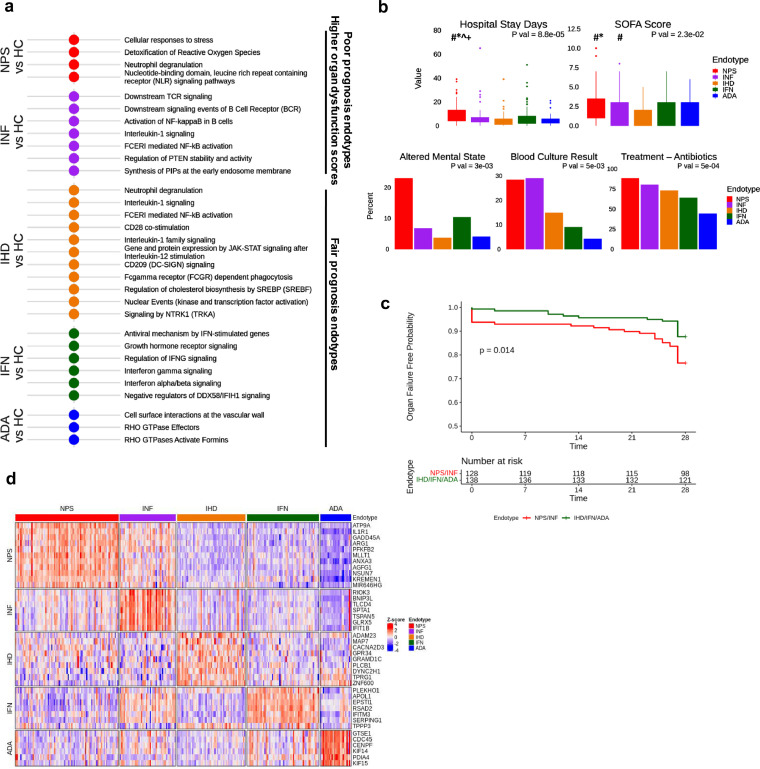
Findings: Gene expression signatures were obtained that predicted severity/organ dysfunction and mortality in both ER and ICU patients with accuracy/AUC of 77-80%. Network analysis revealed these signatures formed a coherent biological program, with specific but overlapping mechanisms/pathways. Given the heterogeneity of sepsis, we asked if patients could be assorted into discrete groups with distinct mechanisms (endotypes) and varying severity. Patients with early sepsis could be stratified into five distinct and novel mechanistic endotypes, named Neutrophilic-Suppressive/NPS, Inflammatory/INF, Innate-Host-Defense/IHD, Interferon/IFN, and Adaptive/ADA, each based on ∼200 unique gene expression differences, and distinct pathways/mechanisms (e.g., IL6/STAT3 in NPS). Endotypes had varying overall severity with two severe (NPS/INF) and one relatively benign (ADA) groupings, consistent with reanalysis of previous endotype studies. A 40 gene-classification tool (accuracy=96%) and several gene-pairs (accuracy=89-97%) accurately predicted endotype status in both ER and ICU validation cohorts.

Interpretation: The severity and endotype signatures indicate that distinct immune signatures precede the onset of severe sepsis and lethality, providing a method to triage early sepsis patients.

Keywords: Cellular reprogramming; Endotypes; Gene signatures & biomarkers; Sepsis; Severe sepsis; Translational medicine.


Conflict of interest statement

Declaration of interests RH has filed the CR and endotype signatures for patent protection and licenced this to Sepset Biotherapeutics Inc., a Vancouver company in which he has a significant ownership position. AB and GCF have filed the endotype signatures for patent protection and licenced this to Sepset Biotherapeutics Inc. Other authors have nothing to disclose.

Figures
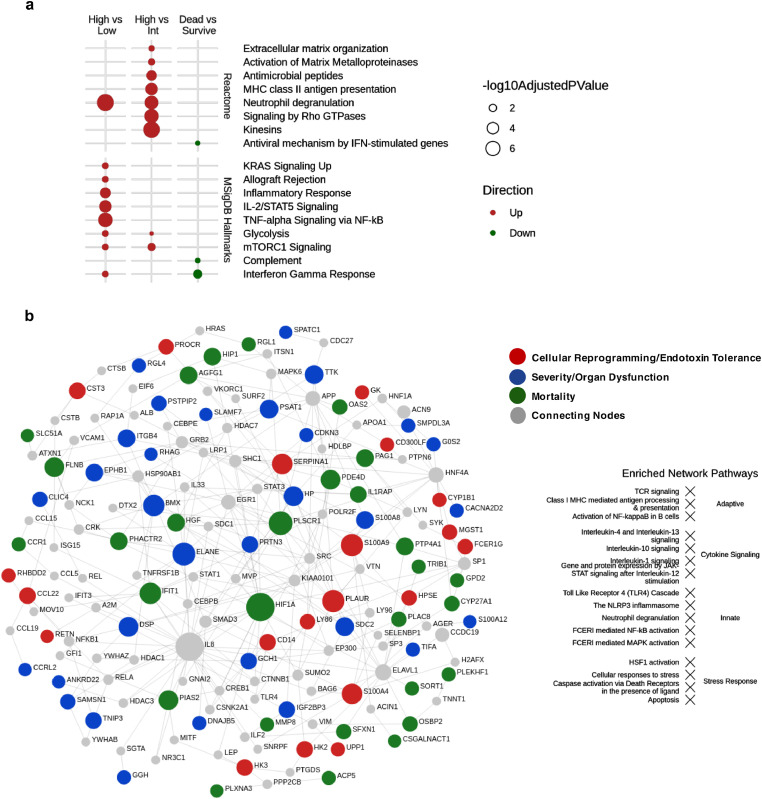
Fig 1
Figure 1
Biological characterization of SOFA-based severity groups and mortality in all ER and ICU patients. (a) Functional enrichment of up and downregulated DE genes (displaying ≥ ±1.25-fold change; adjusted p ≤ 0·05) comparing severity and mortality. SOFA scores were dichotomized into High (n = 82), Intermediate (n = 125), and Low (n = 138) groups. Functional characterization of DE genes was performed using an overrepresentation analysis of Reactome pathways or MSigDB sets (adjusted p-value≤0·05). (b) A combined PPI network (drawn using NetworkAnalyst45) of the severity (52 genes/proteins), mortality (38 genes/proteins), and cellular reprogramming (31 genes) biological signatures. PPI represent function-based interactions in cells. Thus the formation of a cohesive network indicated that the products of the genes involved are functionally related and collectively regulate or play key roles in one or more related biological mechanisms. The nodes (coloured circles) represent the signature genes and the edges (lines connecting the nodes) represent a curated (i.e. known) interaction between the genes (or rather their protein equivalents). The size of the node represents its connectivity (i.e. how many other proteins it interconnects with), whereby highly connected genes (or hubs) are larger. The mortality signature shared no genes in common with the severity signature but shared one gene with the CR signature (DHRS9). The severity signature shared three genes in common with the CR signature (PSTPIP2, RAB13, S100A12).
Fig 2
Figure 2
Biological and clinical characterization of Neutrophilic-Suppressive (NPS), Inflammatory (INF), Innate-Host-Defence (IHD), Interferon (IFN), and Adaptive ADA) endotypes and their respective signatures. (a) Functional enrichment of up and downregulated DE genes (displaying ≥ ±1.5-fold change; adjusted p ≤ 0.05) comparing each endotype to healthy controls (n = 39). (b) Selected clinical symptomology and outcomes of endotypes and their distributions. Dunn's Posthoc test indicated by: # p < 0·05 cf. IHD; * p < 0·05 cf. IFN; + p < 0·05 cf. ADA; ^ p < 0·05 cf. INF. (c) Kaplan-Meier curves describing 28-day organ failure free days. Organ failure free days was compared between endotypes by combining the low prognosis endotypes (NPS and INF) and the fair prognosis endotypes (IFN, IHD, and ADA). The combined endotypes shared many molecular and clinical features, so this scheme made biological sense and increased statistical power to detect a significant difference. (d) Heat map showing the expression of 40 classification genes (used to drive the endotype classification model) in all patients (arrayed left to right). NB this signature delivered excellent performance in the discovery group (AUC/accuracy: 96%; Sensitivity: 81%; Specificity: 95%).
Fig 3
Figure 3
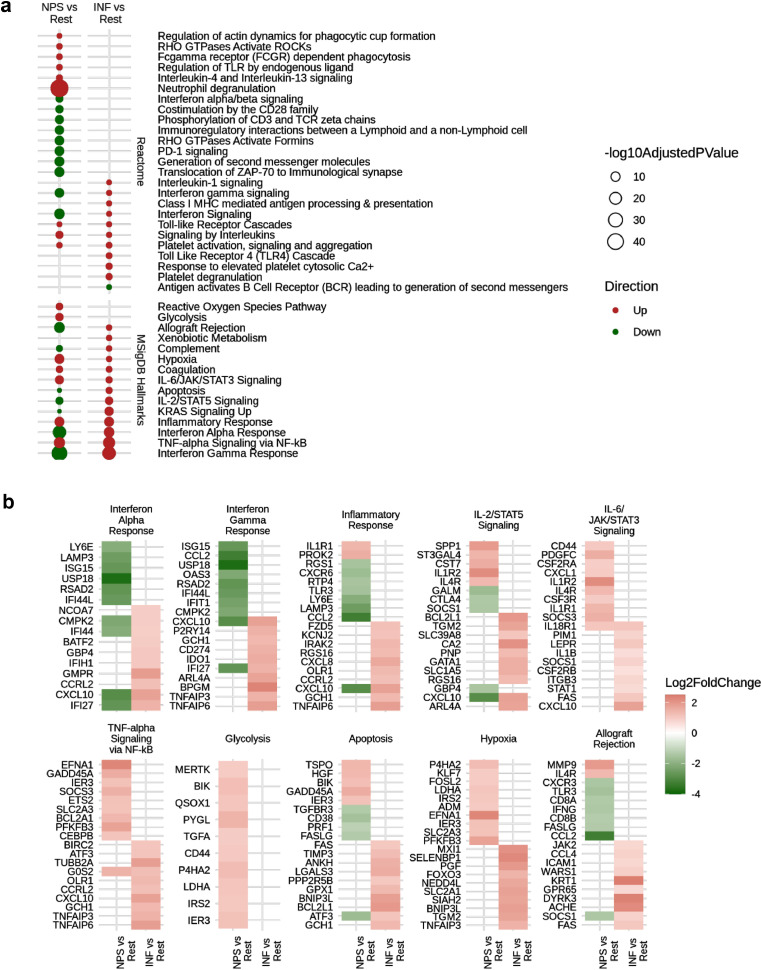
Detailed mechanistic characterization of the poor prognosis NPS and INF endotypes. (a) Functional enrichment of up- and down- regulated DE genes when comparing the NPS endotype to all other endotypes combined and the INF endotype to all others. (b) Fold changes of genes associated to NPS and INF related processes, which reflect potential mediators and regulators of the endotype. The NPS endotype is clearly immunosuppressed as indicated by the downregulation of several processes, including inflammation, interferon processes, and PD-1 signaling among others.
Fig 4
Figure 4
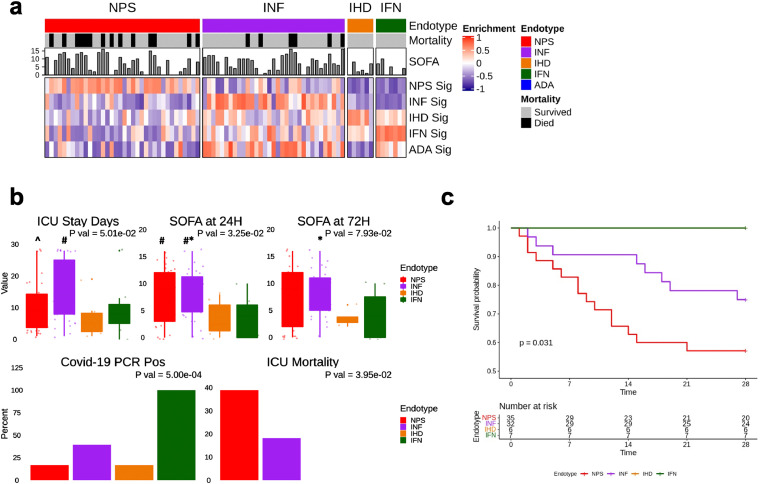
Endotype classification of ICU patients. (a) Heatmap depicting GSVA enrichment statistics in ICU patients (n = 82) for each endotype signature. Each 200-gene endotype was significantly upregulated in the patients classified to the endotype for which it defines. (b) Selected clinical symptomology and outcomes for predicted endotypes; Dunn's Posthoc test indicated by: # p < 0.05 cf. IHD; * p < 0·05 cf. IFN; ^ p < 0·05 cf. INF. (c) Kaplan-Meier curves describing 28-day mortality.

References

    1. Rudd K.E., Johnson S.C., Agesa K.M., et al. Global, regional, and national sepsis incidence, and mortality, 1990–2017: analysis for the global burden of disease study. Lancet. 2020;395(10219):200–211. - PMC - PubMed
    1. Gotts J.E., Matthay M.A. Sepsis: pathophysiology and clinical management. BMJ. 2016;353:i1585. doi: 10.1136/bmj.i1585. - DOI - PubMed
    1. Singer M., Deutschman C.S., Seymour C.W., et al. The third international consensus definitions for sepsis and septic shock (Sepsis-3) JAMA. 2016;315:801. doi: 10.1001/jama.2016.0287. - DOI - PMC - PubMed
    1. Seymour C.W., Gesten F., Prescott H.C., et al. Time to treatment and mortality during mandated emergency care for sepsis. NEJM. 2017;376:2235–2244. doi: 10.1056/NEJMoa1703058. - DOI - PMC - PubMed
    1. Prescott H.C., Iwashyna T.J. Improving sepsis treatment by embracing diagnostic uncertainty. Ann Am Thorac. 2019;16:426–429. doi: 10.1513/AnnalsATS.201809-646PS. - DOI - PMC - PubMed