


Bone-related polymorphisms and dental status in older men and women. Results of the longitudinal Pro.V.A. study
- PMID: 35028080
- PMCID: PMC8740094
- DOI: 10.1016/j.jds.2021.06.023
Bone-related polymorphisms and dental status in older men and women. Results of the longitudinal Pro.V.A. study
Abstract
Background/purpose: Genetics plays a role in the susceptibility to periodontitis and tooth loss. Several studies examined the involvement of polymorphisms in candidate genes. We hypothesize that bone metabolism-related polymorphisms could be associated with the number of remaining teeth.
Materials and methods: Participants in the Pro.V.A. longitudinal Study: 3099 Italians (aged 65+ at baseline), 2196 at follow-up 1 (5yrs), 1641 at follow-up 2 (7yrs) underwent detailed interview and clinical-instrumental examination. Subjects, grouped by remaining teeth number (0, 1-7, 8-19, 20+), were genotyped for six different bone-related polymorphisms: collagen type Iα1 (COL1A1, Sp1, Ss alleles, n = 1068), vitamin D receptor (VDR, Fok I, Ff alleles, n = 300), calcitonin receptor (CALCR, Alu I, CT alleles, n = 1430), estrogen receptor alpha (ESR1, Pvu II and Xba I, Pp and Xx alleles, n = 1335 and n = 1324).
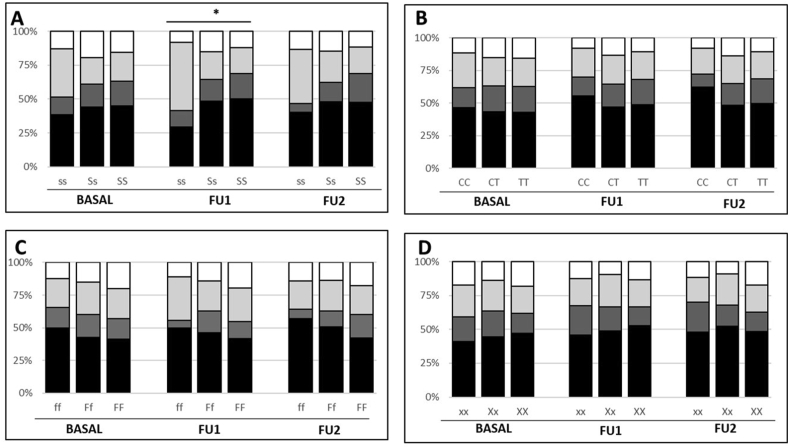
Results: COL1A1 associated with dental status: ss carriers had reduced incident tooth loss (p < 0.05). The low frequency of this genotype, 3.6% in the whole population, didn't grant sufficient statistical power to other findings, such as the lower prevalence of edentulism, consistent throughout the study. In men, CC genotype of CALCR was associated with higher tooth loss between follow ups (p < 0.05). Biochemical markers of inflammation didn't differ by genotype. Confounders such as diabetes, neoplasms, and smoking hampered the detrimental effect of S allele in the logistic regression analysis (OR = 0.67, 95% CI 0.4-1.0, p = 0.06).
Conclusion: The present study, demonstrating an association between tooth loss and COL1A1 and -in men- CALCR, contributes to the identification of genes involved in tooth loss and, possibly, susceptibility to periodontitis.
Keywords: Bone; Genetic polymorphisms; Oral health; Tooth loss; Type I collagen.
© 2021 Association for Dental Sciences of the Republic of China. Publishing services by Elsevier B.V.
Figures

Similar articles
-
Association of bone metabolism related genes polymorphisms with the effect of raloxifene hydrochloride on bone mineral density and bone turnover markers in postmenopausal women with osteoporosis.Zhonghua Yi Xue Yi Chuan Xue Za Zhi. 2006 Apr;23(2):129-33. Zhonghua Yi Xue Yi Chuan Xue Za Zhi. 2006. PMID: 16604479 Clinical Trial.
-
Association between bone mineral density and polymorphisms of the VDR, ERalpha, COL1A1 and CTR genes in Spanish postmenopausal women.J Endocrinol Invest. 2005 Apr;28(4):312-21. doi: 10.1007/BF03347196. J Endocrinol Invest. 2005. PMID: 15966503
-
Association between Single Nucleotide Polymorphisms in Vitamin D Receptor Gene Polymorphisms and Permanent Tooth Caries Susceptibility to Permanent Tooth Caries in Chinese Adolescent.Biomed Res Int. 2017;2017:4096316. doi: 10.1155/2017/4096316. Epub 2017 Nov 12. Biomed Res Int. 2017. PMID: 29259981 Free PMC article.
-
Genetic control of bone density and turnover: role of the collagen 1alpha1, estrogen receptor, and vitamin D receptor genes.J Bone Miner Res. 2001 Apr;16(4):758-64. doi: 10.1359/jbmr.2001.16.4.758. J Bone Miner Res. 2001. PMID: 11316004
-
Association between osteoporosis and polymorphisms of the bone Gla protein, estrogen receptor 1, collagen 1-A1 and calcitonin receptor genes in Turkish postmenopausal women.Gene. 2013 Feb 15;515(1):167-72. doi: 10.1016/j.gene.2012.10.041. Epub 2012 Nov 5. Gene. 2013. PMID: 23137636
Cited by
-
Polymorphisms in Genes Involved in Inflammation and Periodontitis: A Narrative Review.Biomolecules. 2022 Apr 7;12(4):552. doi: 10.3390/biom12040552. Biomolecules. 2022. PMID: 35454140 Free PMC article. Review.
References
-
- WHO . Vol. 47. 1994. Oral Health. World Health Stat Q; pp. 42–94.http://www.who.int/mediacentre/factsheets/fs318/en/ WHO 2012.
-
- Total tooth loss among persons aged > or =65 years--selected states, 1995-1997. MMWR Morb Mortal Wkly Rep. 1999;48:206–210. - PubMed
-
- Musacchio E., Perissinotto E., Binotto P., et al. Tooth loss in the elderly and its association with nutritional status, socio-economical and lifestyle factors. Acta Odontol Scand. 2007;65:78–86. - PubMed
-
- Reich E., Hiller K.A. Reasons for tooth extraction in the western states of Germany. Community Dent Oral Epidemiol. 1993;21:379–383. - PubMed
-
- Cahen P.M., Frank R.M., Turlot J.C. A survey of the reasons for dental extractions in France. J Dent Res. 1985;64:1087–1093. - PubMed
LinkOut - more resources
Full Text Sources
Miscellaneous
