


An analysis of the HIV testing cascade of a group of HIV-exposed infants from birth to 18 months in peri-urban Khayelitsha, South Africa
- PMID: 35030227
- PMCID: PMC8759686
- DOI: 10.1371/journal.pone.0262518
An analysis of the HIV testing cascade of a group of HIV-exposed infants from birth to 18 months in peri-urban Khayelitsha, South Africa
Abstract
Background: Despite the reduction of HIV mother-to-child transmission, there are concerns regarding transmission rate in the breastfeeding period. We describe the routine uptake of 6 or 10 (6/10) weeks, 9 months and 18 months testing, with and without tracing, in a cohort of infants who received HIV PCR testing at birth (birth PCR) (with and without point of care (POC) testing) in a peri-urban primary health care setting in Khayelitsha, South Africa.
Methods: In this cohort study conducted between November 2014 and February 2018, HIV-positive mothers and their HIV-exposed babies were recruited at birth and all babies were tested with birth PCR. Results of routine 6/10 weeks PCR, 9 months and 18 months testing were followed up by a patient tracer. We compared testing at 6/10 weeks with a subgroup from historical cohort who was not tested with birth PCR.
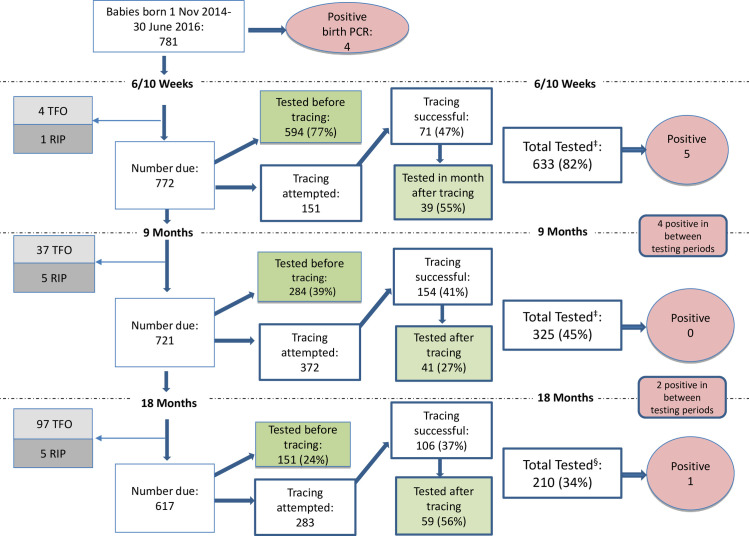
Results: We found that the uptake of 6/10 weeks testing was 77%, compared to 82% with tracing. When including all infants in the cascade and comparing to a historical cohort without birth testing, we found that infants who tested a birth were 22% more likely to have a 6/10 weeks test compared to those not tested at birth. There was no significant difference between the uptake of 6/10 weeks testing after birth PCR POC versus birth PCR testing without POC. Uptake of 9 months and 18 months testing was 39% and 24% respectively. With intense tracing efforts, uptake increased to 45% and 34% respectively.
Conclusion: Uptake of HIV testing for HIV-exposed uninfected infants in the first 18 months of life shows good completion of the 6/10 weeks PCR but suboptimal uptake of HIV testing at 9 months and 18 months, despite tracing efforts. Birth PCR testing did not negatively affect uptake of the 6/10 weeks HIV test compared to no birth PCR testing.
Conflict of interest statement
Aurelie Kennedy Nelson, Tali Cassidy, Laura Trivino Duran, Vivian Cox, Catherine J Wedderburn, Tabitha Mutseyekwa, Bulelwa Rorwana, Beryl Sibanda, Jonathan Bernheimer, Nopinky Matise, Petros Isaakidis, were employed by MSF at the time of the study. The authors have declared that no competing interests exist. This does not alter our adherence to PLOS ONE policies on sharing data and materials.
Figures
References
-
- UNAIDS. Communities at the centre. Defending rights, breaking barriers, reaching people with HIV services. 2019.
-
- World Health Organization. Policy Brief: Consolidated guidelines on the use of antiretroviral therapy and preventing HIV infection. What’s new. WHO Guidel. 2015;(2):20.
Publication types
MeSH terms
Substances
LinkOut - more resources
Full Text Sources
Medical
