. 2022 Jan 14;12(1):753.
doi: 10.1038/s41598-022-04815-w.

Exceptional phonon point versus free phonon coupling in Zn1-xBexTe under pressure: an experimental and ab initio Raman study

Affiliations

Exceptional phonon point versus free phonon coupling in Zn1-xBexTe under pressure: an experimental and ab initio Raman study

M B Shoker et al. Sci Rep. .

Abstract

Raman scattering and ab initio Raman/phonon calculations, supported by X-ray diffraction, are combined to study the vibrational properties of Zn1-xBexTe under pressure. The dependence of the Be-Te (distinct) and Zn-Te (compact) Raman doublets that distinguish between Be- and Zn-like environments is examined within the percolation model with special attention to x ~ (0,1). The Be-like environment hardens faster than the Zn-like one under pressure, resulting in the two sub-modes per doublet getting closer and mechanically coupled. When a bond is so dominant that it forms a matrix-like continuum, its two submodes freely couple on crossing at the resonance, with an effective transfer of oscillator strength. Post resonance the two submodes stabilize into an inverted doublet shifted in block under pressure. When a bond achieves lower content and merely self-connects via (finite/infinite) treelike chains, the coupling is undermined by overdamping of the in-chain stretching until a «phonon exceptional point» is reached at the resonance. Only the out-of-chain vibrations «survive» the resonance, the in-chain ones are «killed». This picture is not bond-related, and hence presumably generic to mixed crystals of the closing-type under pressure (dominant over the opening-type), indicating a key role of the mesostructure in the pressure dependence of phonons in mixed crystals.


Conflict of interest statement

The authors declare no competing interests.

Figures
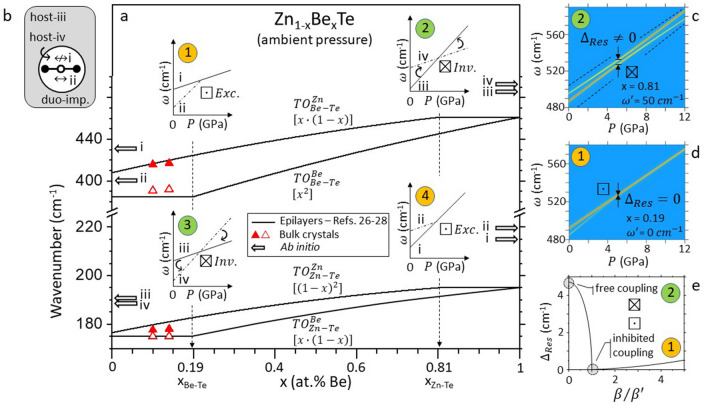
Figure 1
Figure 1
Zn1−xBexTe Percolation scheme at ambient pressure. (a) Composition dependence of the Zn1−xBexTe TO branches (plain lines) schematically derived from Raman frequencies obtained with epitaxial layers (available in Refs.). The current data obtained with bulk crystals are superimposed (triangles), for comparison. A distinction is done between vibrations in Zn- (upper branches, full symbols) and Cd-like (lower branches, hollow symbols) environments, defined at the first-neighbor scale. The related fractions of 1D-oscillators, impacting the TO Raman intensities, are specified in square brackets. The pressure-induced closing processes of various doublets depending on bond content are schematically indicated (①-to-④), emphasizing the free (⊠) or inhibited (⊡) coupling at the resonance (Res.), resulting in inversion (Inv.) of the doublet, or extinction (Ext.) of one submode, respectively. In each panel the dominant/minor modes are distinguised using full/dashed-dotted lines. In the free-coupling regimes ➁ and ➂ an effective transfert of oscillator strength is indicated by curved arrows, further specifying the sense of transfert. In the inhibited-coupling regimes ① and ④, the absence of arrows reflects an absence of transfert. (b) Ab initio (AIMPRO) insight (large arrows) into the four asymptotic TOZn-TeBe,TOZn-TeZn,TOBe-TeBe,TOZn-TeZn frequencies due to parent-like supercells containing a duo of impurities (x ~ 0,1), referring to an impurity bond (i,ii) or a host bond (iii,iv) vibrating in their like (ii,iii) or foreign (i,iv) environment, as sketched out. (c,d) Raman cross sections reflecting the pressure-induced closure of the Be-Te doublet in the inhibited ① and free ➁ coupling regimes, respectively. In the latter case, dotted lines help visualize (qualitatively) the cone-shape frequency domain in which the coupling takes place (see text). In both panels red/yellow glows reflect large/small Raman intensities. (e) The two regimes refer to extreme cases in the overdamping vs. coupling competition (captured via β/β), impacting the frequency gap between the normal modes of the coupled system at the resonance (ΔRes), as indicated (shaded areas).
Figure 2
Figure 2
Selection of high-pressure Zn0.86Be0.14Te Raman spectra. The upstroke regime is emphasized (up-pointing arrow). The spectrum taken with pressure fully released (down-pointing arrow) is shown (top/thick curve), for reference purpose. The pressure-induced inversion (➂, ⊠, Inv.) and extinction (①, ⊡, Ext.) processes of the Zn–Te and Be–Te doublets are emphasized by curved arrows indicating the upward shift of the minor mode across (Zn–Te range) and up to (Be–Te range) the dominant one, using the same notation as in Fig. 1. Flat baselines are materialized (dashed lines) for a better resolution by eye of the Zn–Te and Be–Te TO doublets.
Figure 3
Figure 3
Ab initio (AIMPRO) high-pressure Raman spectra at (x ~ 0,1). Large (216-atom) parent-like zincblende-type supercells containing the prototypical percolation-type impurity motif, i.e., a duo of connected impurities, are used. The six vibration patterns of the impurity-duo (right hand side of the main panel) are regrouped in terms of percolation-type vibrations in foreign (i) and like (ii) environments (in reference to Fig. 1b). (a–d) Direct insights into the pressure-induced free/inhibited-coupling regimes per bond taken as the dominant/minor species, using the same symbolic ①-to-④ terminology (together with all related descriptive features, e.g., ⊠ and Inv.) as in Fig. 1.

References

    1. Waag A, et al. Novel beryllum containing II-VI compounds: Basic properties and potential applications. J. Cryst. Growth. 1998;184(185):1–10. doi: 10.1016/S0022-0248(98)80283-2. - DOI
    1. Vérié C. Beryllium substitution-mediated covalency engineering of II-VI alloys for lattice elastic rigidity reinforcement. J. Cryst. Growth. 1998;184(185):1061–1066.
    1. Christensen NE, Satpathy S, Pawlowska Z. Bonding and ionicity in semiconductors. Phys. Rev. B. 1987;36:1032–1050. doi: 10.1103/PhysRevB.36.1032. - DOI - PubMed
    1. Taylor DW. Phonon response theory and the infrared and Raman experiments. In: Elliott RJ, Ipatova IP, editors. Optical properties of Mixed Crystals. Elsevier; 1988. pp. 35–131.
    1. Adachi S. Lattice dynamics properties. In: Adachi S, editor. Properties of Semiconductor Alloys: Group-IV, III-V and II-VI. Wiley; 2009. pp. 99–124.
