


Efficacy of melatonin in the treatment of patients with COVID-19: A systematic review and meta-analysis of randomized controlled trials
- PMID: 35032042
- PMCID: PMC9015545
- DOI: 10.1002/jmv.27595
Efficacy of melatonin in the treatment of patients with COVID-19: A systematic review and meta-analysis of randomized controlled trials
Abstract
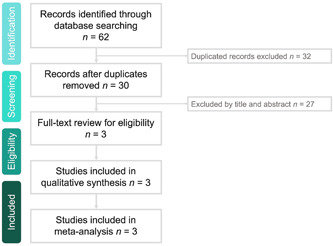
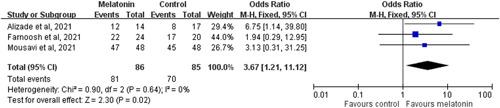
This study investigated the effect of melatonin on clinical outcomes in patients with coronavirus disease 2019 (COVID-19). We searched PubMed, the Web of Science, the Cochrane Library, Ovid MEDLINE, and Clinicaltrials.gov for randomized controlled trials (RCTs) published before September 11, 2021. Only RCTs that compared the clinical efficacy of melatonin with a placebo in the treatment of patients with COVID-19 were included. The primary outcome measure was the clinical recovery rate. We included three RCTs in this meta-analysis. Melatonin 3 mg three times daily was administered in one RCT, and 3 or 6 mg daily before bedtime in the other two trials. Treatment duration was 14 days in two RCTs and 7 days in one trial. The clinical recovery rates were 94.2% (81/86) and 82.4% (70/85) in the melatonin and control groups, respectively. Overall, patients receiving melatonin had a higher clinical recovery rate than did the controls (odds ratio [OR]: 3.67; 95% CI: 1.21-11.12; I2 = 0%, p = 0.02). The risk of intensive care unit admission was numerically lower in the melatonin group than in the control group (8.3% [6/72] vs. 17.6% [12/68], OR: 0.45; 95% CI: 0.16-1.25; I2 = 0%, p = 0.13), and the risk of mortality was numerically lower in the melatonin group than in the control group (1.4% [1/72] vs. 4.4% [3/68], OR: 0.32; 95% CI: 0.03-3.18; I2 = 0%, p = 0.33). In conclusion, melatonin may help improve the clinical outcomes of patients with COVID-19.
Keywords: COVID-19; SARS-CoV-2; melatonin; outcome.
© 2022 Wiley Periodicals LLC.
Conflict of interest statement
The authors declare that there are no conflict of interests.
Figures
Comment in
-
Melatonin use for SARS-CoV-2 infection: Time to diversify the treatment portfolio.J Med Virol. 2022 Jul;94(7):2928-2930. doi: 10.1002/jmv.27740. Epub 2022 Apr 12. J Med Virol. 2022. PMID: 35338491 Free PMC article. No abstract available.
References
-
- WHO. Accessed September 10, 2021. https://covid19.who.int/
Publication types
MeSH terms
Substances
LinkOut - more resources
Full Text Sources
Miscellaneous
