


Review
doi: 10.1016/j.cpsurg.2021.101030.
Epub 2021 Jul 7.
Malignant melanoma: evolving practice management in an era of increasingly effective systemic therapies
Affiliations
- PMID: 35033317
- PMCID: PMC9798450
- DOI: 10.1016/j.cpsurg.2021.101030
Item in Clipboard
Review
Malignant melanoma: evolving practice management in an era of increasingly effective systemic therapies
Curr Probl Surg.
2022 Jan.
No abstract available
Figures
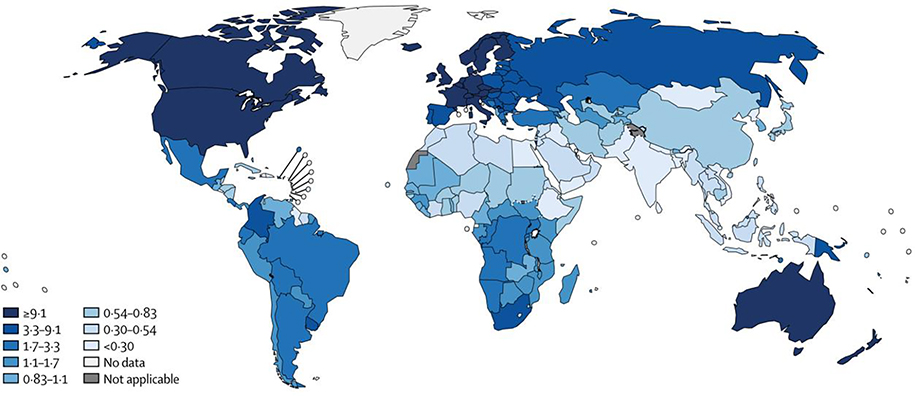
Melanoma incidence by country (per 100,000 person-years) (with permission from Schadendorf D, van Akkooi ACJ, Berking C, et al. Melanoma. Lancet. 2018;392(10151):971–984).

Melanoma incidence and mortality in the United States by sex compared to other cancers 1975 to 2017 (with permission from Siegel RL, Miller KD, Fuchs HE, et al. Cancer statistics, 2021. CA Cancer J Clin 2021;71:7–33).

Melanoma oncogenes that promote constitutive cell growth. Most cellular growth factors activate mitogen-activated protein kinase (MAPK) signaling pathways (green) and AKT signaling (yellow) through receptor tyrosine kinases. Variants in BRAF or NRAS (red) are able to function in the absence of external stimuli to activate MAPK signaling. Through another pathway, PTEN inactivation (red) causes accumulation of PIP3, which mediates recruitment of AKT and its activating kinases. AKT activation strongly promotes cell growth. These growth pathways are overactive in melanoma. RAS, rat sarcoma virus (v-Ras) homologs such as KRAS, NRAS, HRAS; RAF, rat accelerated fibrosarcoma (v-RAF) homologs such as BRAF; MEK, MAPK/Erk kinase 1; Erk, extracellular signal-related kinase 1; PI3K, phosphatidylinositol 3-kinase; PTEN, phosphatase and tensin homolog; PIP2/PIP3, phosphatidylinositol 4,5-bisphosphate or 3,4,5-trisphosphate; PDK1, 3-phosphoinositide dependent kinase 1; mTOR, mammalian target of rapamycin; AKT, v-Akt murine thymoma homolog or protein kinase B.

Canonical cell cycle regulatory pathways that are disrupted by CDKN2A mutation. Transition from the G1 phase of the cell cycle to S phase is controlled by retinoblastoma protein (Rb). Phosphorylation of Rb is required for progression. p16INK4a controls this tightly regulated transition by inhibiting Rb phosphorylation. CDKN2A encodes a second tumor suppressor protein on an alternate reading frame, hence the name ARF. p14ARF regulates the function of MDM2 and MDM4, which inhibit p53 and promote its ubiquitin-mediated degradation. Without p14ARF, p53 is unable to function as a critical regulator of cell proliferation and DNA damage repair. Rb, retinoblastoma; CDK4/6, cyclin dependent protein kinases 4 and 6; INK4a, inhibitor of cyclin-dependent kinase 4; MDM2/4, mouse double minute 2 homolog and mouse double minute 4 homolog.

American Academy of Dermatology ABCDE criteria (with permission from American Academy of Dermatology Ad Hoc Task Force for the ABCDEs of Melanoma, Tsao H, Olazagasti JM, et al. Early detection of melanoma: reviewing the ABCDEs. J Am Acad Dermatol. 2015;72(4):717–723).

Melanoma arising within a nevus. Note the characteristics of this lesion, such as variegated color, irregular borders, and distinct appearance compared to neighboring nevi (with permission from Rivers JK. Is there more than one road to melanoma? Lancet 2004;363(9410):728–730).

Trends in mortality rate for cutaneous melanoma. (With permission from Berk-Krauss J, Stein JA, Weber J, Polsky D, Geller AC. New Systematic Therapies and Trends in Cutaneous Melanoma Deaths Among US Whites, 1986–2016. Am J Public Health. 2020;110(5):731–733).

The MAP kinase pathway. Points of action for current targeted therapy agents are indicated. (With permission from Kainthla R, Kim KB, Falchook GS. Dabrafenib for treatment of BRAF-mutant melanoma. Pharmgenomics Pers Med. 2014;7:21–29).
References
-
- Schadendorf D, van Akkooi ACJ, Berking C, et al. Melanoma. Lancet. 2018;392(10151):971–984. - PubMed
-
- SEER Cancer Statistics Review (CSR) 1975–2017. National Cancer Institute website. https://seer.cancer.gov/csr/1975_2017/ based on November 2019 SEER data submission. Accessed July 29, 2020.
-
- Australian Institute of Health and Welfare. Cancer data in Australia. June 2020. website. https://www.aihw.gov.au/reports/cancer/cancer-data-in-australia. Accessed July 29, 2020.
-
- Miller KD, Nogueira L, Mariotto AB, et al. Cancer treatment and survivorship statistics, 2019. CA Cancer J Clin. 2019;69(5):363–385. - PubMed
Publication types
MeSH terms
Substances
Grants and funding
LinkOut - more resources
Full Text Sources
Medical
