


A sub-group evaluation of the multi-month dispensing strategy for differentiated HIV care: is personalization of care guidelines warranted in Haiti?
- PMID: 35034656
- PMCID: PMC8761104
- DOI: 10.1186/s12913-022-07475-8
A sub-group evaluation of the multi-month dispensing strategy for differentiated HIV care: is personalization of care guidelines warranted in Haiti?
Erratum in
-
Correction to: A sub-group evaluation of the multi-month dispensing strategy for differentiated HIV care: is personalization of care guidelines warranted in Haiti?BMC Health Serv Res. 2022 Jan 29;22(1):124. doi: 10.1186/s12913-022-07534-0. BMC Health Serv Res. 2022. PMID: 35093059 Free PMC article. No abstract available.
Abstract
Background: Differentiated care strategies are rapidly becoming the norm for HIV care delivery globally. Building upon an interest in tailoring antiretroviral therapy (ART) delivery for client-centered needs, the Ministry of Health and Population in Haiti formally endorsed multiple-month dispenses (MMD) in the 2016 national ART guidelines This study explores heterogeneity in retention in care with MMD for specific Haitian populations living with HIV and evaluates if a targeted algorithm for optimal ART prescription intervals is warranted in Haiti.
Methods: This study included ART-naïve individuals who started ART on or after January 1st, 2017 in Haiti. To identify subgroups in which to explore heterogeneity of retention, we implemented a double-lasso regression method to determine which individual characteristics would define the subgroups. Characteristics evaluated for potential subgroup definition included: sex, age category, WHO clinical stage, and body mass index category. We employed instrumental variable models to estimate the causal effect of increasing ART dispensing length on ART retention, by client subgroup. The outcome of interest was retention in care after one year in treatment. We then estimated the marginal effect of a 30-day increase to ART dispensing length to retention in care for each of these subgroups.
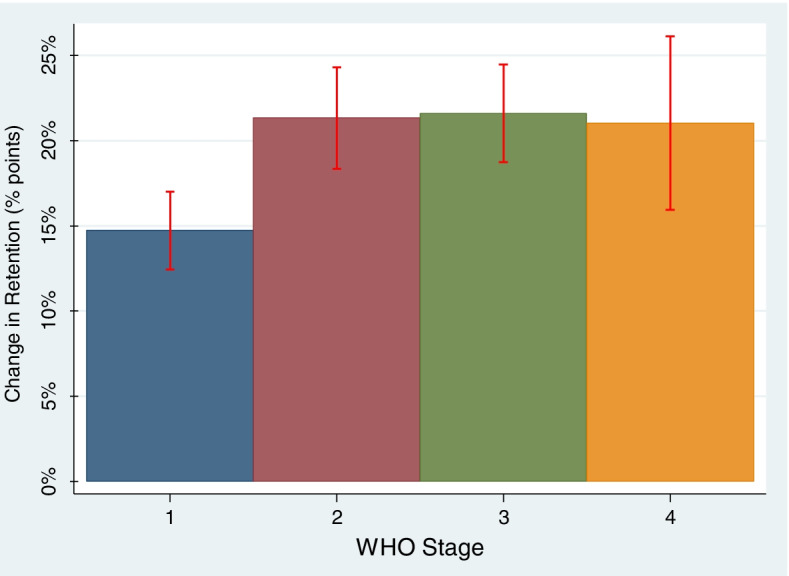
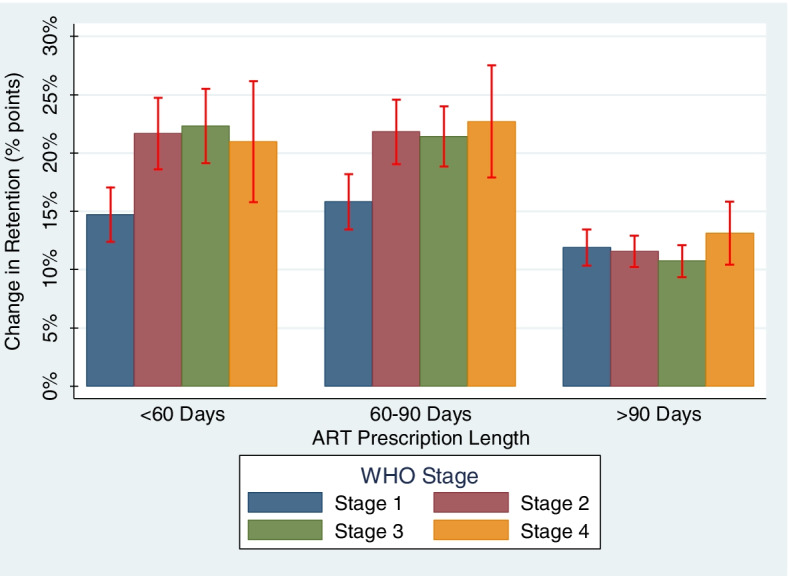
Results: There was evidence for heterogeneity in the effect of extending ART dispensing intervals on retention by WHO clinical stage. We observed significant improvements to retention in care at one year with a 30-day increase in ART dispense length for all subgroups defined by WHO clinical stages 1-4. The effects ranged from a 14.7% increase (95% CI: 12.4-17.0) to the likelihood of retention for people with HIV in WHO stage 1 to a 21.6% increase (95% CI: 18.7-24.5) to the likelihood of retention for those in WHO stage 3.
Conclusions: All the subgroups defined by WHO clinical stage experienced a benefit of extending ART intervals to retention in care at one year. Though the effect did differ slightly by WHO stage, the effects went in the same direction and were of similar magnitude. Therefore, a standardized recommendation for MMD among those living with HIV and new on ART is appropriate for Haiti treatment guidelines.
Keywords: Care guidelines; HIV service delivery; Haiti.
© 2022. The Author(s).
Conflict of interest statement
No competing interests to declare. The findings and conclusions in this report are those of the authors and do not necessarily represent the official position of the funding agencies.
Figures
References
-
- Fatti G, Ngorima-Mabhena N, Mothibi E, Muzenda T, Choto R, Kasu T, et al. Outcomes of three- versus six-monthly dispensing of antiretroviral treatment (ART) for stable HIV patients in community ART refill groups: a cluster-randomized trial in Zimbabwe. J Acquir Immune Defic Syndr. 2020;84(2):162–172. doi: 10.1097/QAI.0000000000002333. - DOI - PMC - PubMed
MeSH terms
Substances
LinkOut - more resources
Full Text Sources
Medical
