Review
. 2022 Jul;30(7):632-642.
doi: 10.1016/j.tim.2021.12.009. Epub 2022 Jan 13.

Do gastrointestinal microbiomes play a role in bats' unique viral hosting capacity?

Affiliations
Review

Do gastrointestinal microbiomes play a role in bats' unique viral hosting capacity?

Devin N Jones et al. Trends Microbiol. 2022 Jul.

Abstract

Bats are reservoirs for zoonotic viruses, which they tolerate without experiencing disease. Research focused on deciphering mechanisms of virus tolerance in bats has rarely considered the influence of their gastrointestinal tract (GIT) microbiome. In mammals, GIT microbiomes influence infections through their effect on host physiology, immunity, nutrition, and behavior. Bat GIT microbiomes more closely resemble the Proteobacteria-dominated GIT microbiomes of birds than those of other mammals. As an adaptation to flight, bats have rapid GIT transit times which may reduce the stability of their microbiome, constrain nutrient uptake, and affect pathogen exposure and evolution of tolerance mechanisms. Experimental and longitudinal studies are needed to understand the function of bats' GIT microbiomes and their role in modulating viral infection dynamics.

Keywords: Chiroptera; bacteriome; bats; microbiome.


Conflict of interest statement

Declaration of interests No interests are declared.

Figures
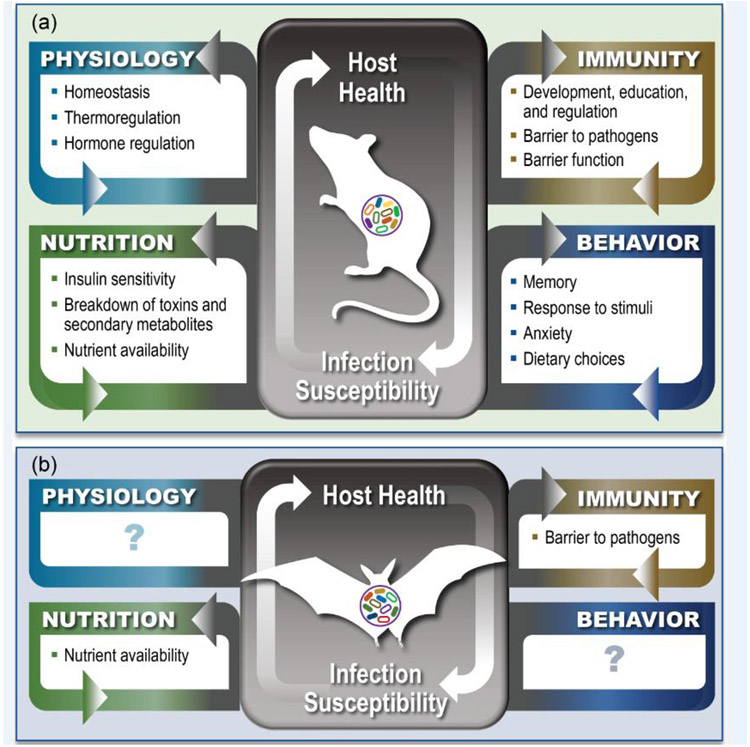
Figure 1.
Figure 1.. Microbiomes contribute to host health through several mechanisms.
Panel a shows known bidirectional communication between the model and well-studied system hosts (e.g., mice and humans) and their host-associated microbiomes. Host-associated microbiomes are known to contribute to host health by influencing or modulating host physiological processes, immune function, nutritional status, and behavior. Panel b shows that in bats, GIT microbes have been shown to contribute to host nutrition and skin microbes can serve as a barrier to external pathogens (Box 1). However, relative to mice and humans, much less is known about the specific contributions of microbiomes to their chiropteran hosts, highlighting a need for future research in these areas.
Figure 2.
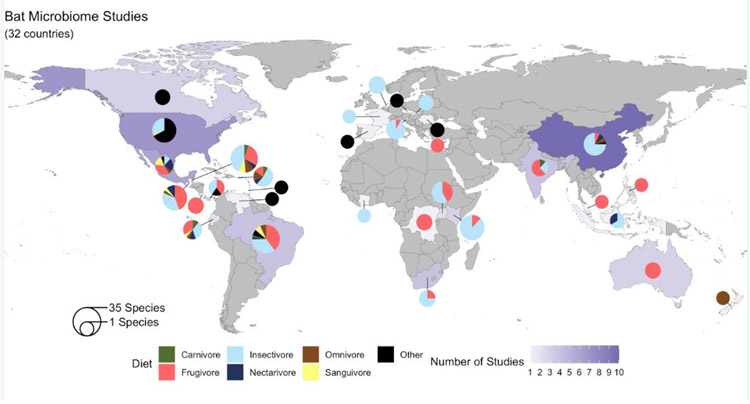
Figure 2.. Map of the current bat microbiome studies.
Shading of the countries shows the global distribution of bat microbiome studies, where darker shading indicates a greater number of studies from that country. The pie charts show the number of bat species sampled from each country (as indicated by the circumference of the pie) where smaller pies indicate fewer number of species sampled. The corresponding proportions of the pie show the diet types of the bats for which there are GIT microbiome studies; studies focused on non-GIT microbiomes (e.g., skin, urine, or other organs or fluids) are shown in black as “other.”

References

    1. Kunz TH et al. (2011) Ecosystem services provided by bats. Ann. N.Y. Acad. Sci 1223, 1–38 - PubMed
    1. Irving AT et al. (2021) Lessons from the host defences of bats, a unique viral reservoir. Nature. 589, 363–370 - PubMed
    1. Li D et al. (2016) Anti-viral effect of Bifidobacterium adolescentis against Noroviruses. Front. Microbiol 7, 864. - PMC - PubMed
    1. Pabst R et al. (1988) Postnatal development and lymphocyte production of jejunal and ileal Peyer’s patches in normal and gnotobiotic pigs. Immunology. 64, 539–544 - PMC - PubMed
    1. Schachtschneider KM et al. (2013) Modulation of systemic immune responses through commensal gastrointestinal microbiota. PLoS ONE. 8, e53969. - PMC - PubMed

Publication types