


Defining obesity hypoventilation syndrome
- PMID: 35035556
- PMCID: PMC8753617
- DOI: 10.1183/20734735.0089-2021
Defining obesity hypoventilation syndrome
Abstract
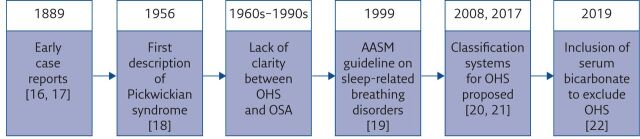
With increasing prevalence of obesity, the substantial contribution of obesity hypoventilation syndrome (OHS) to morbidity and mortality is likely to increase. It is therefore crucial that the condition has a clear definition to allow timely identification of patients. OHS was first described as "Pickwickian syndrome" in the 1950s; in subsequent decades, case reports did not clearly delineate between patients suffering from OHS and those suffering from obstructive sleep apnoea. In 1999, the American Academy of Sleep Medicine published a guideline that delineated the cause of daytime hypercapnia as either predominantly upper airway or predominantly hypoventilation. This was the first formal definition of OHS as the presence of daytime alveolar hypoventilation (arterial carbon dioxide tension >45 mmHg) in patients with body mass index >30 kg·m-2 in the absence of other causes of hypoventilation. This definition is reflected in the most recent guidelines published on OHS. Recent developments in defining OHS include proposed classification systems of severity and demonstrating the value of using serum bicarbonate to exclude OHS in patients with a low index of suspicion.
Educational aims: To provide an overview of the historical basis of the definition of obesity hypoventilation syndrome.To explain the rationale for the current definition of obesity hypoventilation syndrome.To demonstrate areas that need further investigation in defining obesity hypoventilation syndrome.
Copyright ©ERS 2021.
Conflict of interest statement
Conflict of interest: N.M. Shah has nothing to disclose. Conflict of interest: S. Shrimanker has nothing to disclose. Conflict of interest: G. Kaltsakas has nothing to disclose.
Figures
References
Publication types
LinkOut - more resources
Full Text Sources