Meta-Analysis
. 2022 Jul;33(7):1719-1763.
doi: 10.1007/s00192-021-05015-2. Epub 2022 Jan 17.

Parameters associated with unsuccessful pessary fitting for pelvic organ prolapse up to three months follow-up: a systematic review and meta-analysis

Affiliations
Meta-Analysis

Parameters associated with unsuccessful pessary fitting for pelvic organ prolapse up to three months follow-up: a systematic review and meta-analysis

Claudia Manzini et al. Int Urogynecol J. 2022 Jul.

Abstract

Objectives: To clarify which parameters are associated with unsuccessful pessary fitting for pelvic organ prolapse (POP) at up to 3 months follow-up.

Methods: Embase, PubMed and Cochrane CENTRAL library were searched in May 2020. Inclusion criteria were: (1) pessary fitting attempted in women with symptomatic POP; (2) pessary fitting success among the study outcomes with a maximal follow-up of 3 months; (3) baseline parameters compared between successful and unsuccessful group. A meta-analysis was performed using the random effects model.

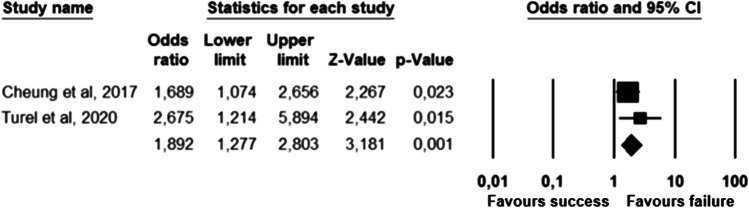
Main results: Twenty-four studies were included in the meta-analysis. Parameters associated with unsuccessful pessary fitting were: age (OR 0.70, 95% CI 0.56-0.86); BMI (OR 1.35, 95% CI 1.08-1.70); menopause (OR 0.65 95% CI 0.47-0.88); de novo stress urinary incontinence (OR 5.59, 95% CI 2.24-13.99); prior surgery, i.e. hysterectomy (OR 1.88, 95% CI 1.48-2.40), POP surgery (OR 2.13, 95% CI 1.34-3.38), pelvic surgery (OR 1.81, 05% CI 1.01-3.26) and incontinence surgery (OR 1.87, 95% CI 1.08-3.25); Colorectal-Anal Distress Inventory-8 scores (OR 1.92, 95% CI 1.22-3.02); solitary predominant posterior compartment POP (OR 1.59, 95% CI 1.08-2.35); total vaginal length (OR 0.56, 95% CI 0.32-0.97); wide introitus (OR 4.85, 95% CI 1.60-14.68); levator ani avulsion (OR 2.47, 95% CI 1.35-4.53) and hiatal area on maximum Valsalva (OR 1.89, 95% CI 1.27-2.80).

Conclusion: During counselling for pessary treatment a higher risk of failure due to the aforementioned parameters should be discussed and modifiable parameters should be addressed. More research is needed on the association between anatomical parameters and specific reasons for unsuccessful pessary fitting.

Keywords: Patients’ characteristics; Pelvic organ prolapse; Pessary fitting; Predictive factors; Predictive parameters; Vaginal pessaries.


Conflict of interest statement

Authors declare no conflicts of interest.

Figures
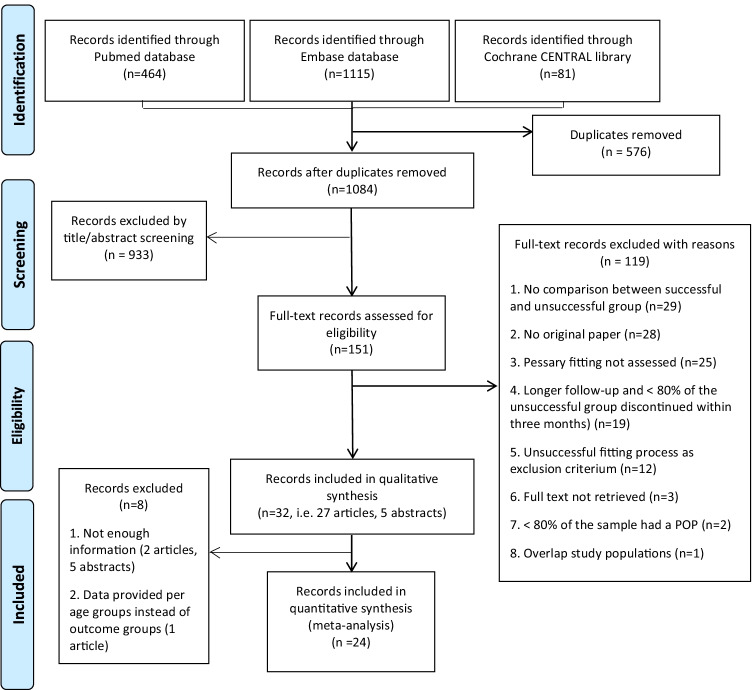
Fig. 1
Fig. 1
Records identification, inclusions and exclusions with reasons
Fig. 2
Fig. 2
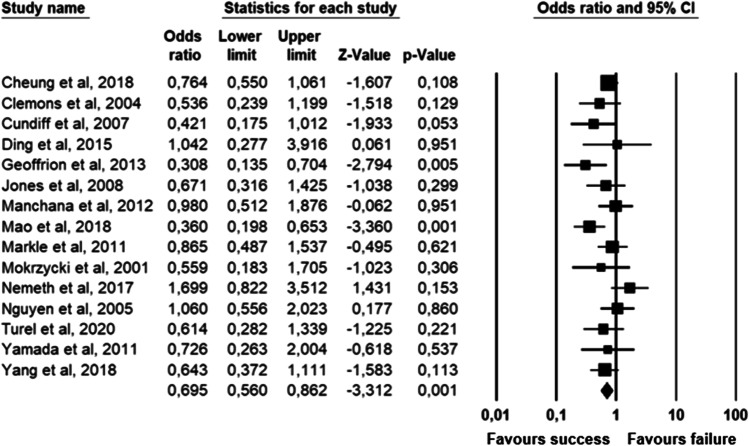
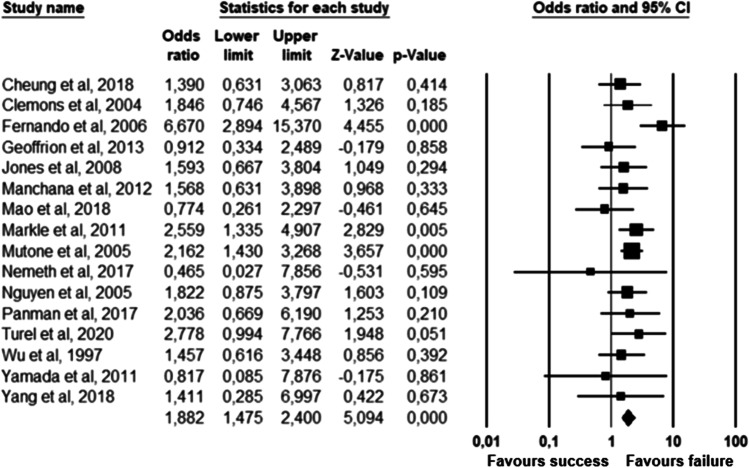
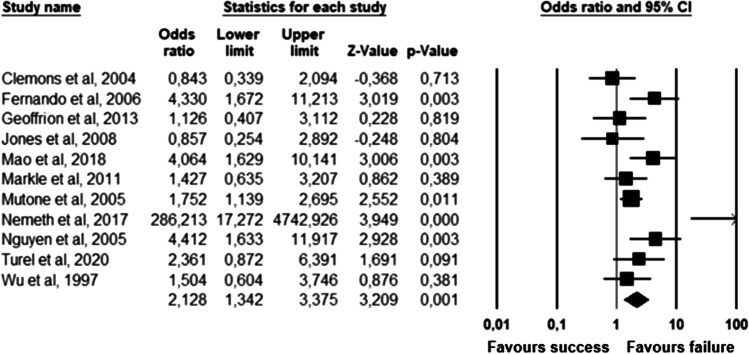
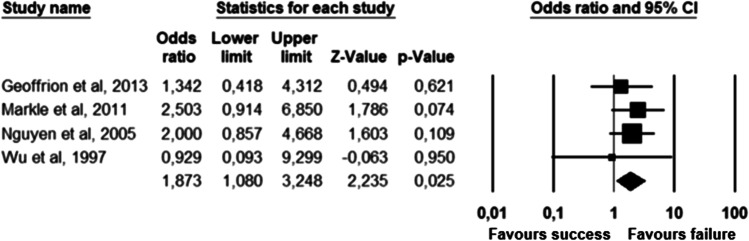
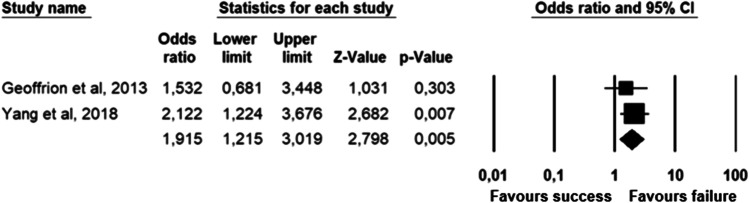
Forest plots of the significant parameters (results of the meta-analysis excluding imputed data)
Fig. 3
Fig. 3
Forest plot for the association of age with successful pessary fitting up to 3-month follow-up (N = 2901)
Fig. 4
Fig. 4
Forest plot for the association of BMI with unsuccessful pessary fitting up to 3-month follow-up (N = 2244)
Fig. 5
Fig. 5
Forest plot for the association of menopausal status with successful pessary fitting up to 3-month follow-up (N = 1338)
Fig. 6
Fig. 6
Forest plot for the association of Stress urinary incontinence (SUI) (i.e. pre-existing or de novo SUI) with unsuccessful pessary fitting up to 3-month follow-up (N = 1065)
Fig. 7
Fig. 7
Forest plot for the association of prior hysterectomy with unsuccessful pessary fitting up to 3-month follow-up (N = 3431)
Fig. 8
Fig. 8
Forest plot for the association of prior prolapse surgery with unsuccessful pessary fitting up to 3-month follow-up (N = 2330)
Fig. 9
Fig. 9
Forest plot for the association of prior pelvic surgery with unsuccessful pessary fitting up to 3-month follow-up (N = 230)
Fig. 10
Fig. 10
Forest plot for the association of prior incontinence surgery with unsuccessful pessary fitting up to 3-month follow-up (N = 497)
Fig. 11
Fig. 11
Forest plot for the association of “CRADI-8” (i.e. Colorectal-Anal Distress Inventory-8) scores with unsuccessful pessary fitting up to 3-month follow-up (N = 401)
Fig. 12
Fig. 12
Forest plot for the association of TVL (i.e. total vaginal length) with successful pessary fitting up to 3-month follow-up (N = 1135)
Fig. 13
Fig. 13
Forest plot for the association of wide introitus (i.e. ≥ 4 fingerbreadths) with unsuccessful pessary fitting up to 3-month follow-up (N = 200)
Fig. 14
Fig. 14
Forest plot for the association of levator ani muscle avulsion with unsuccessful pessary fitting up to 3-month follow-up (N = 339)

References

    1. Gorti M, Hudelist G, Simons A. Evaluation of vaginal pessary management: a UK-based survey. J Obs Gynaecol. 2009;29:129–131. doi: 10.1080/01443610902719813. - DOI - PubMed
    1. Cundiff GW, Weidner AC, Visco AG, Bump RC, Addison WA. A survey of pessary use by members of the American Urogynecologic Society. Obstet Gynecol. 2000;95:931–935. doi: 10.1016/s0029-7844(00)00788-2. - DOI - PubMed
    1. Clemons JL, Aguilar VC, Tillinghast TA, Jackson ND, Myers DL. Patient satisfaction and changes in prolapse and urinary symptoms in women who were fitted successfully with a pessary for pelvic organ prolapse. Am J Obs Gynecol. 2004;190:1025–1029. doi: 10.1016/j.ajog.2003.10.711. - DOI - PubMed
    1. Ding J, Chen C, Song XC, Zhang L, Deng M, Zhu L. Changes in prolapse and urinary symptoms after successful fitting of a ring pessary with support in women with advanced pelvic organ prolapse: a prospective study. Urology. 2016;87:70–75. doi: 10.1016/j.urology.2015.07.025. - DOI - PubMed
    1. Bugge C, Adams EJ, Gopinath D, Reid F. Pessaries (mechanical devices) for pelvic organ prolapse in women. Cochrane Database Syst Rev. 2013. 10.1002/14651858.CD004010.pub3. - PMC - PubMed

Publication types