


Nicotine/tobacco use disparities among transgender and gender diverse adults: Findings from wave 4 PATH data
- PMID: 35038608
- PMCID: PMC8885914
- DOI: 10.1016/j.drugalcdep.2022.109268
Nicotine/tobacco use disparities among transgender and gender diverse adults: Findings from wave 4 PATH data
Abstract
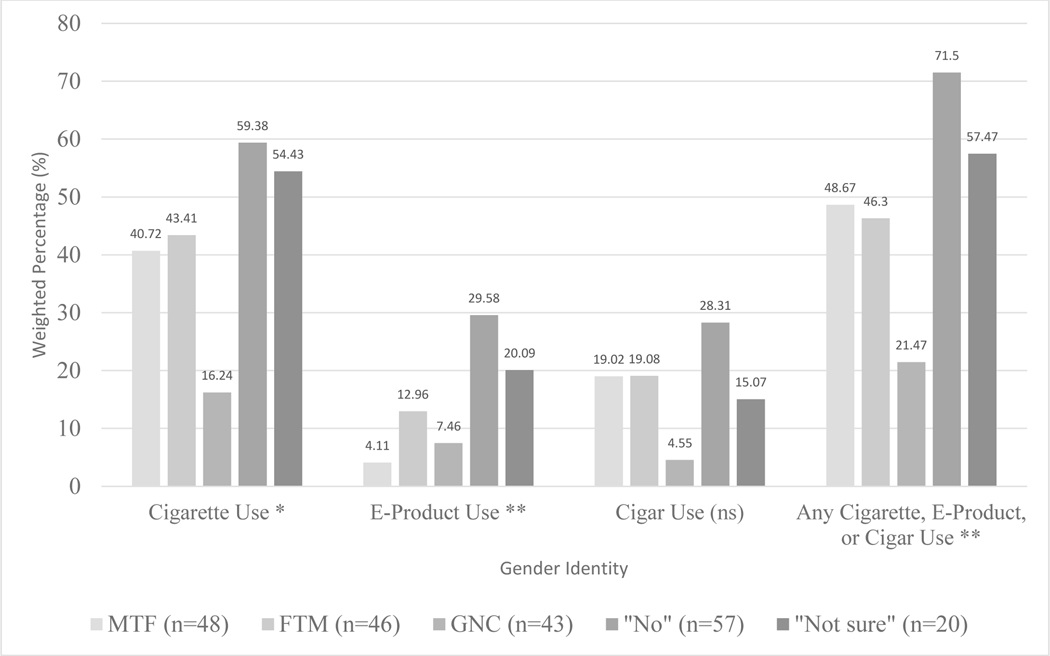
Background: Transgender and Gender Diverse (TGD) populations have current cigarette/e-cigarette/cigar use rates ranging from 32.6% to 39.7%. Importantly, while some studies have reported tobacco use as significantly higher among TGD versus cisgender individuals in multivariate analyses, others have reported no significant differences. The present study used data from wave 4 of the Population Assessment of Tobacco and Health (PATH) study, a large, nationally representative U.S. study, to examine relationships among sociodemographic characteristics, internal and external factors, and tobacco use behaviors, with a focus on TGD individuals.
Methods: Data were from 33,628 adults from the PATH study's wave 4 (collected December 2016-January 2018). Multivariable logistic regression models examined differences in current tobacco use (cigarettes, electronic nicotine products, and cigars) between TGD and cisgender individuals through the replication of previous work using PATH data, as well as evaluating the role of other internal and external factors.
Results: TGD individuals were 2-3 times more likely than cisgender individuals to report current nicotine/tobacco use, even after adjustment for potential confounders. TGD individuals tended to have lower income and education and be more likely to endorse a sexual minority identity than their cisgender counterparts; meanwhile, lower income, less education, and lesbian/gay and bisexual identities were significant predictors of nicotine/tobacco use, independent of TGD identity.
Conclusions: Present findings underscore the high rates of nicotine/tobacco use in the TGNC community and emphasize the necessity of TGD-focused research methods and measures, access to quality medical care, and policy aimed at minimizing marginalization and nicotine/tobacco use disparities experienced by TGD communities.
Keywords: Adults; Gender minorities; Nicotine and tobacco use; Population Assessment of Tobacco and Health (PATH) study; Transgender and gender diverse (TGD); Transgender and gender non-conforming (TGNC).
Published by Elsevier B.V.
Conflict of interest statement
Conflict of Interest:
The authors declare no conflict of interest. The funders had no role in the design of the study; in the collection, analysis, or interpretation of data; in the writing of the manuscript, or in the decision to publish the results.
Figures
References
-
- American Cancer Society [ACS]. (2003). Tobacco and the LGBT community. Oklahoma City, OK: Author, from http://www.glbthealth.org/documents/GLBTTobacco.pdf.
-
- American Lung Association [ALA]. (2020). The LGBT community: A priority population for tobacco control. Retrieved December 27, 2020, from https://www.lung.org/getmedia/d843353c2609-4554-9daf-f4b629c99503/lgbt-i...
-
- Azagba S, Latham K, Shan L. (2019). Cigarette, smokeless tobacco, and alcohol use among transgender adults in the United States. International Journal of Drug Policy, 73, 163–169. - PubMed
-
- Battle S. Wheeler TE (2017). Dear colleague letter on transgender students. U.S. Department of Justice, Civil Rights Division & U.S. Department of Education, Office for Civil Rights. Retrieved from: https://www2.ed.gov/about/offices/list/ocr/letters/colleague-201702-titl...
-
- Bradford J, Reisner SL, Honnold JA, Xavier J. (2013). Experiences of transgender-related discrimination and implications for health: Results from the Virginia Transgender Health Initiative study. American Journal of Public Health, 103(10), 1820–1829. doi:10.2105/AJPH.2012.300796. - DOI - PMC - PubMed
Publication types
MeSH terms
Substances
Grants and funding
LinkOut - more resources
Full Text Sources
Medical
