. 2022 Jan 18;14(1):6.
doi: 10.1186/s13073-021-01004-8.

ClinGen Variant Curation Interface: a variant classification platform for the application of evidence criteria from ACMG/AMP guidelines

Affiliations

ClinGen Variant Curation Interface: a variant classification platform for the application of evidence criteria from ACMG/AMP guidelines

Christine G Preston et al. Genome Med. .

Abstract

Background: Identification of clinically significant genetic alterations involved in human disease has been dramatically accelerated by developments in next-generation sequencing technologies. However, the infrastructure and accessible comprehensive curation tools necessary for analyzing an individual patient genome and interpreting genetic variants to inform healthcare management have been lacking.

Results: Here we present the ClinGen Variant Curation Interface (VCI), a global open-source variant classification platform for supporting the application of evidence criteria and classification of variants based on the ACMG/AMP variant classification guidelines. The VCI is among a suite of tools developed by the NIH-funded Clinical Genome Resource (ClinGen) Consortium and supports an FDA-recognized human variant curation process. Essential to this is the ability to enable collaboration and peer review across ClinGen Expert Panels supporting users in comprehensively identifying, annotating, and sharing relevant evidence while making variant pathogenicity assertions. To facilitate evidence-based improvements in human variant classification, the VCI is publicly available to the genomics community. Navigation workflows support users providing guidance to comprehensively apply the ACMG/AMP evidence criteria and document provenance for asserting variant classifications.

Conclusions: The VCI offers a central platform for clinical variant classification that fills a gap in the learning healthcare system, facilitates widespread adoption of standards for clinical curation, and is available at https://curation.clinicalgenome.org.

Keywords: Clinical Genome Resource Consortium; Clinical genetics; Precision medicine; Variant curation.


Conflict of interest statement

S.E.P. is a member of the Baylor Genetics Scientific Advisory Panel. A.M. is an employee of Baylor College of Medicine (BCM) and performs integration consulting services for BCM-developed software including Genboree through IP Genesis Inc. C.D.B. is on the scientific advisory boards (SAB) of AncestryDNA, Arc Bio LLC, Etalon DX, Liberty Biosecurity, and Personalis. C.D.B. is on the board of EdenRoc Sciences LLC. C.D.B. is also a founder and SAB chair of ARCBio. J.L.M. is an employee of GeneDx/BioReference Laboratories, Inc./OPKO Health and has a salary as the only disclosure. None of these entities played a role in the design, execution, interpretation, or presentation of this study. The remaining authors declare that they have no competing interests.

Figures
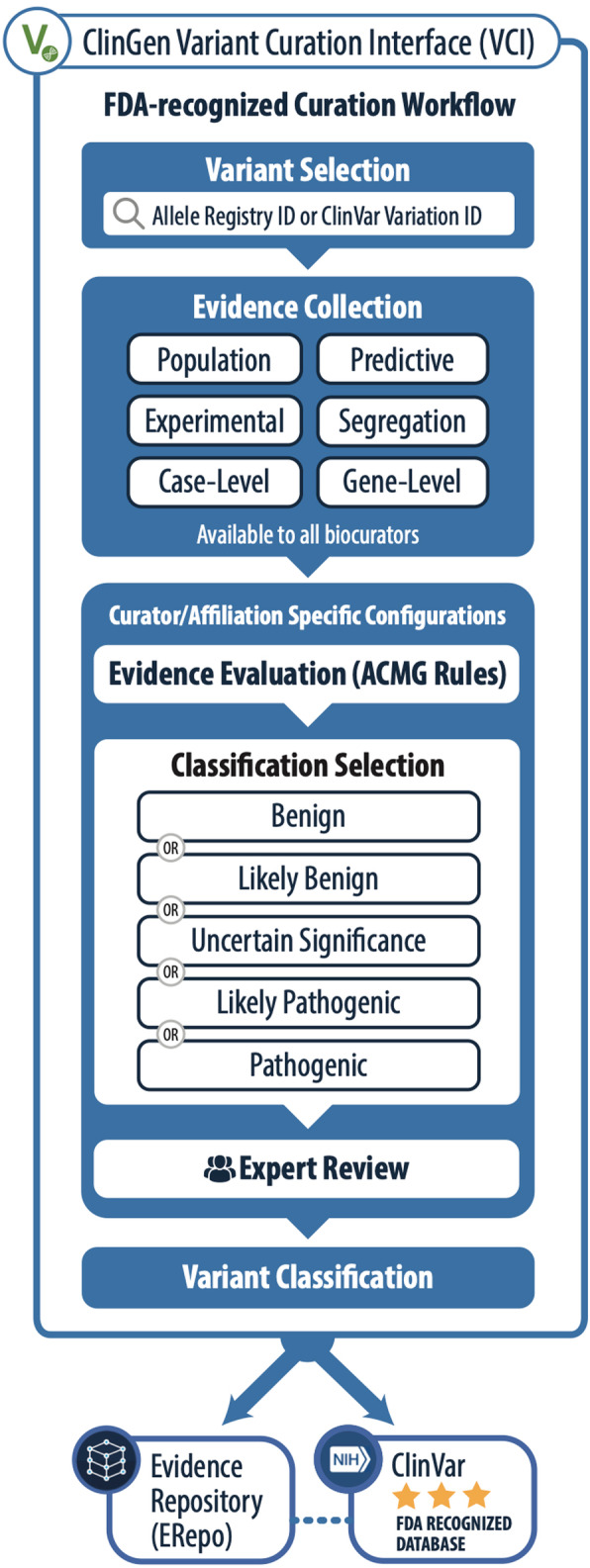
Fig. 1
Fig. 1
ClinGen FDA-recognized variant curation process and VCI. Overview of the ClinGen variant curation process using the VCI, an FDA-recognized workflow. Biocurators select a variant and evaluate evidence that falls into six categories. VCI viewers may view all evidence available for any variant using the VCI. The VCI supports users in making a final pathogenicity classification keeping with the ACMG/AMP guidelines. ClinGen expert panels then disseminate their variant classifications through two community resources: the Evidence Repository (ERepo) and ClinVar
Fig. 2
Fig. 2
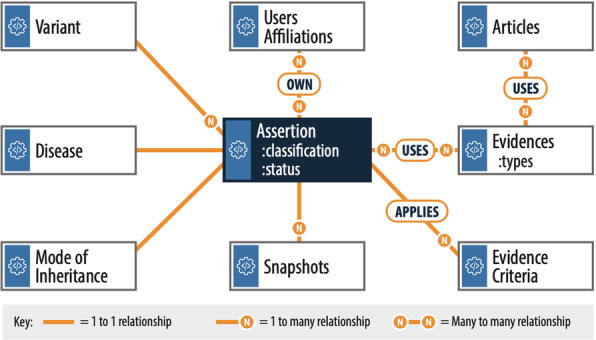
Core VCI data model used for storing and retrieving data as JSON documents. The VCI uses a data model centered on a classification (dark blue center box), with relationships to other data models (white boxes). Each assertion is uniquely defined by the Variant, Disease and Mode of Inheritance models and is owned by a user or affiliation. It has two core attributes A status indicating its state in the current workflow cycle and B selected classification (Fig. 1). It uses different types of evidence (see Evidence Collection in Fig. 1) and applies an evidence criteria to arrive at the selected classification. Each evidence type can use articles as supplementary evidence. As an interpretation progresses through review statuses (such as provisional, approved, and published), snapshots of the full data at each review step are created. The relationships between data models are represented here, with 1:1 (solid green lines), 1 to many (N), or many to many (N to N) indicated
Fig. 3
Fig. 3
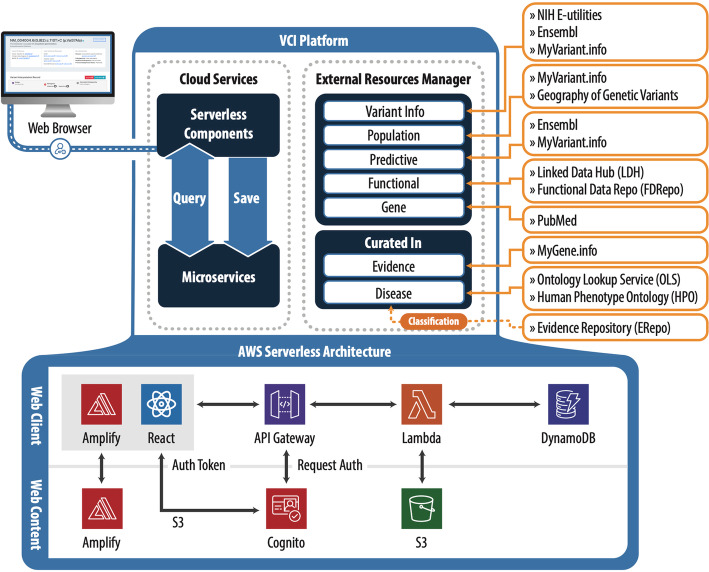
VCI platform components overview including schema and serverless architecture. The platform is web-browser based and uses AWS cloud services. An External Resources Manager retrieves population, predictive, functional, and other variant and gene-level data from external sources (Table 1) via APIs. In addition, the user can add in curated evidence, evaluate against ACMG/AMP guidelines, and save the classification for review and approval. The approved classifications are then submitted to the ClinGen Evidence Repository. All data are saved in a database via microservices and can be accessed via queries. The Amazon Cloud Services provide the microservices to store and retrieve data adopting a Serverless Architecture utilizing the following components and services: Amplify, Cognito, API Gateway, Lambda, DynamoDB, S3, and the user-facing web interface is created using React JavaScript Library
Fig. 4
Fig. 4
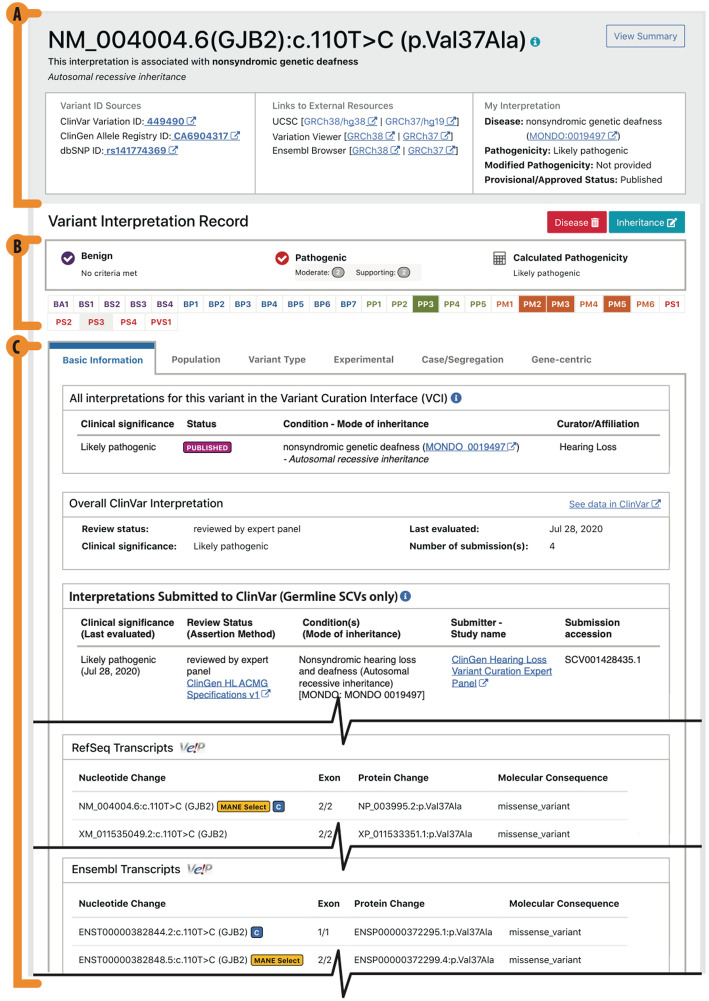
The basic information view. The VCI has six-tab views that collate and display variant information from external and internal sources to biocurators. A The top title view is always viewable and shows the variant title, links to the variant in external resources, and key curation information for the record. B The criteria bar displays evaluated criteria and the calculated pathogenicity. C The basic information tab displays any curations available for the variant in the VCI and ClinVar and transcript information from RefSeq and Ensembl
Fig. 5
Fig. 5
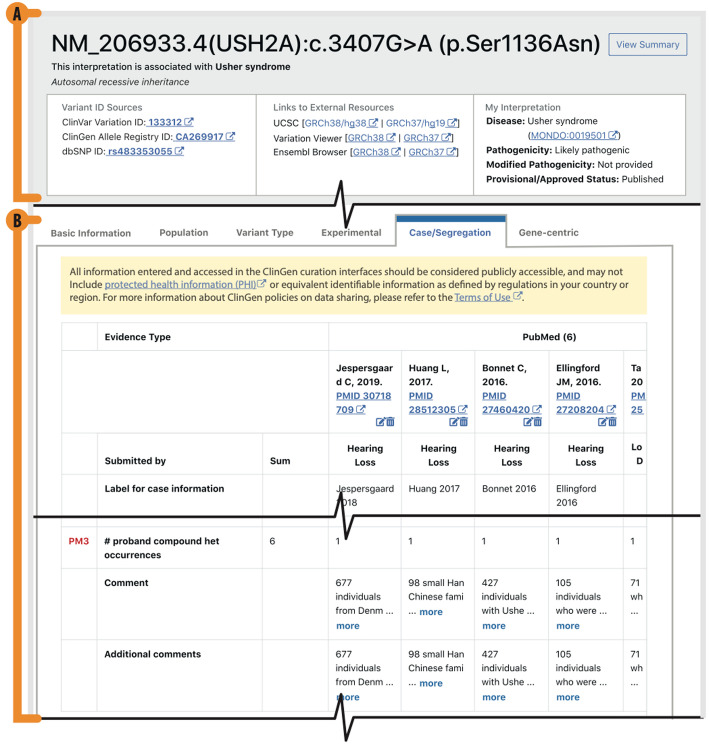
Case and Segregation Evidence Capture. The structured data capture for the case/segregation view in the VCI, including the A top title view B evidence sources are captured and structured so that users can quickly see all sources and the summed individual counts from the pooled evidence for specific ACMG/AMP criteria (shown here is PM3)
Fig. 6
Fig. 6
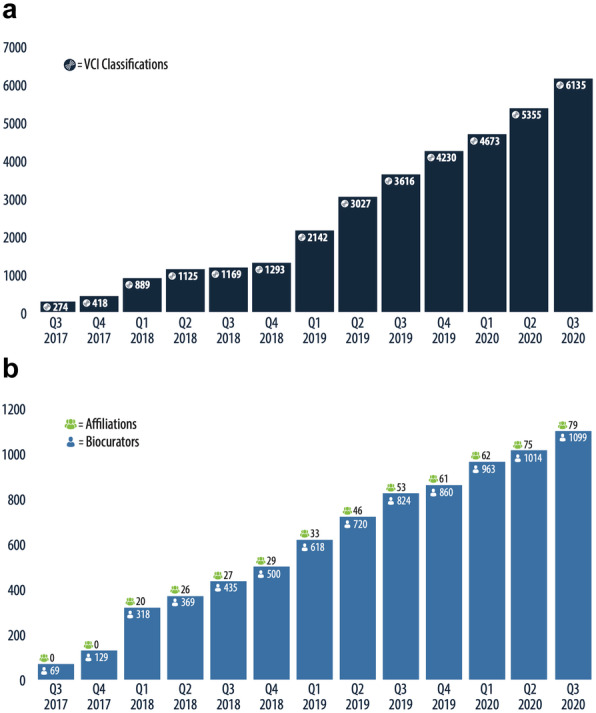
VCI platform growth over time. A Number of curated variant classifications performed in the VCI over time. B The number of biocurators and biocurator affiliations accumulated over time are noted at the top of each bar

References

    1. Richards S, et al. Standards and guidelines for the interpretation of sequence variants: a joint consensus recommendation of the American College of Medical Genetics and Genomics and the Association for Molecular Pathology. Genet Med. 2015;17(5):405–424. doi: 10.1038/gim.2015.30. - DOI - PMC - PubMed
    1. Niehaus A, Azzariti DR. A survey assessing adoption of the ACMG-AMP guidelines for interpreting sequence variants and identification of areas for continued improvement. Genet Med. 2019;21(8):1699–1701. doi: 10.1038/s41436-018-0432-7. - DOI - PMC - PubMed
    1. Rehm HL, Berg JS. ClinGen--the clinical genome resource. N Engl J Med. 2015;372(23):2235–2242. doi: 10.1056/NEJMsr1406261. - DOI - PMC - PubMed
    1. Amendola LM, Jarvik GP. Performance of ACMG-AMP variant-interpretation guidelines among nine laboratories in the clinical sequencing exploratory research consortium. Am J Hum Genet. 2016;98(6):1067–1076. doi: 10.1016/j.ajhg.2016.03.024. - DOI - PMC - PubMed
    1. Abou Tayoun AN, Pesaran T. Recommendations for interpreting the loss of function PVS1 ACMG/AMP variant criterion. Hum Mutat. 2018;39(11):1517–1524. doi: 10.1002/humu.23626. - DOI - PMC - PubMed

Publication types