Artificial Intelligence for Detection of Cardiovascular-Related Diseases from Wearable Devices: A Systematic Review and Meta-Analysis
- PMID: 35040610
- PMCID: PMC8790582
- DOI: 10.3349/ymj.2022.63.S93
Artificial Intelligence for Detection of Cardiovascular-Related Diseases from Wearable Devices: A Systematic Review and Meta-Analysis
Abstract
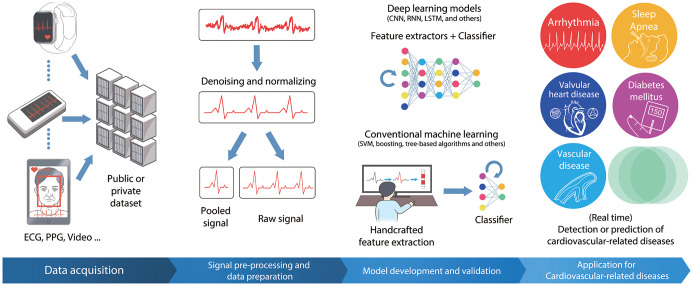
Purpose: Several artificial intelligence (AI) models for the detection and prediction of cardiovascular-related diseases, including arrhythmias, diabetes, and sleep apnea, have been reported. This systematic review and meta-analysis aimed to identify AI models developed for or applicable to wearable and mobile devices for diverse cardiovascular-related diseases.
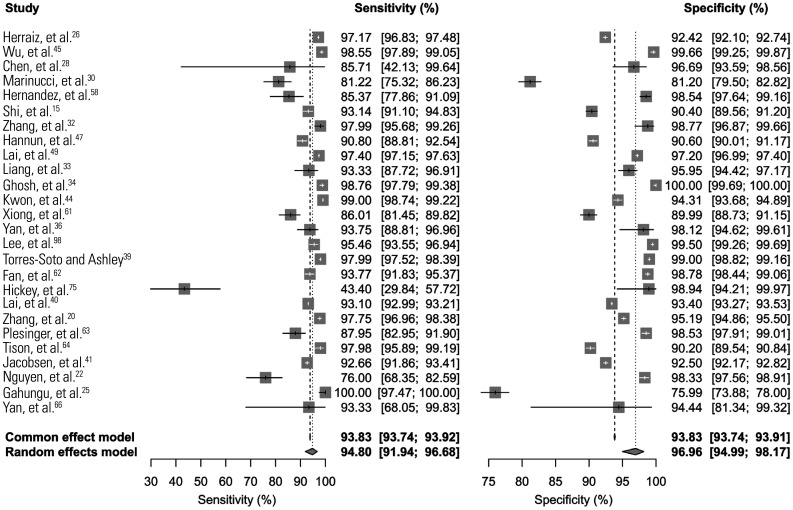
Materials and methods: The searched databases included Medline, Embase, and Cochrane Library. For AI models for atrial fibrillation (AF) detection, a meta-analysis of diagnostic accuracy was performed to summarize sensitivity and specificity.
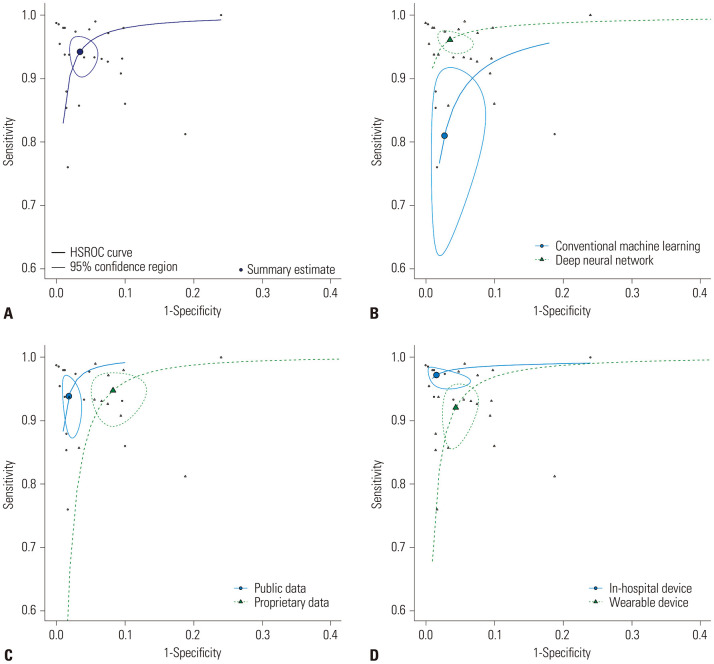
Results: A total of 102 studies were included in the qualitative review. There were AI models for the detection of arrythmia (n=62), followed by sleep apnea (n=11), peripheral vascular diseases (n=6), diabetes mellitus (n=5), hyper/hypotension (n=5), valvular heart disease (n=4), heart failure (n=3), myocardial infarction and cardiac arrest (n=2), and others (n=4). For quantitative analysis of 26 studies reporting AI models for AF detection, meta-analyzed sensitivity was 94.80% and specificity was 96.96%. Deep neural networks showed superior performance [meta-analyzed area under receiver operating characteristics curve (AUROC) of 0.981] compared to conventional machine learning algorithms (meta-analyzed AUROC of 0.961). However, AI models tested with proprietary dataset (meta-analyzed AUROC of 0.972) or data acquired from wearable devices (meta-analyzed AUROC of 0.977) showed inferior performance than those with public dataset (meta-analyzed AUROC of 0.986) or data from in-hospital devices (meta-analyzed AUROC of 0.983).
Conclusion: This review found that AI models for diverse cardiovascular-related diseases are being developed, and that they are gradually developing into a form that is suitable for wearable and mobile devices.
Keywords: Electrocardiography; artificial intelligence; cardiovascular disease; deep learning; machine learning; photoplethysmography.
© Copyright: Yonsei University College of Medicine 2022.
Conflict of interest statement
The authors have no potential conflicts of interest to disclose.
Figures

References
-
- Turakhia MP, Desai SA, Harrington RA. The outlook of digital health for cardiovascular medicine: challenges but also extraordinary opportunities. JAMA Cardiol. 2016;1:743–744. - PubMed
-
- Centers for Disease Control and Prevention. Underlying Cause of Death, 1999-2019. [Internet] [accessed on 2021 October 1]. Available at: https://wonder.cdc.gov/ucd-icd10.html.
-
- Virani SS, Alonso A, Aparicio HJ, Benjamin EJ, Bittencourt MS, Callaway CW, et al. Heart disease and stroke statistics-2021 update: a report from the American Heart Association. Circulation. 2021;143:e254–e743. - PubMed
Publication types
MeSH terms
Grants and funding
LinkOut - more resources
Full Text Sources
Medical