


The association between olfactory and gustatory dysfunction and chronic kidney disease
- PMID: 35042465
- PMCID: PMC8767746
- DOI: 10.1186/s12882-021-02659-6
The association between olfactory and gustatory dysfunction and chronic kidney disease
Abstract
Background: Olfactory and gustatory changes may contribute to poor appetite and food aversion in chronic kidney disease (CKD), though the prevalence of olfactory and gustatory dysfunction is not known in the CKD population.
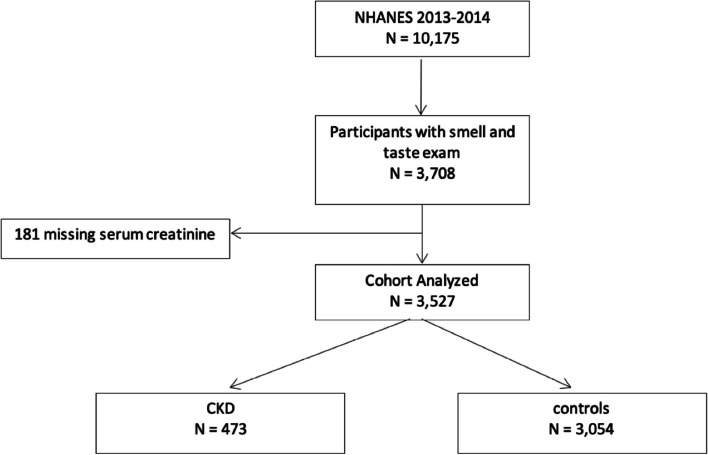
Methods: We conducted a cross-sectional study among 3527 US adults aged ≥40 years old in the National Health and Nutrition Examination Survey (NHANES) between 2013 and 2014. We measured the prevalence of olfactory and gustatory dysfunction among patients with CKD defined as eGFR < 60 ml/min/1.73m2 using the "scratch and sniff" NHANES Pocket Smell Test and quinine whole-mouth test. We also examined the association between CKD and olfactory/gustatory dysfunction, and nutritional markers.
Results: The prevalence of olfactory dysfunction was 30% among CKD and 15% among non-CKD (p < 0.001). The prevalence of gustatory dysfunction was 13% among CKD and 17% among non-CKD (p = 0.10). After adjusting for confounders, CKD was significantly associated with olfactory dysfunction (OR = 1.47, 95% CI [1.07, 2.01]; p = 0.02) but not gustatory dysfunction (OR = 1.76, 95%CI [0.99, 3.11]; p = 0.05). Among the CKD population, the odds of olfactory dysfunction was 72% higher for every 10 kg decrease in grip strength (OR = 1.72, 95% CI [1.39, 2.13]; adjusted p = 0.005).
Conclusion: CKD was associated with higher odds of olfactory but not gustatory dysfunction. Olfactory dysfunction was associated with lower grip strength among those with CKD. Screening and early intervening on olfactory dysfunction among CKD may preserve muscle strength and improve nutritional status in this vulnerable population.
© 2022. The Author(s).
Conflict of interest statement
None.
References
Publication types
MeSH terms
Grants and funding
LinkOut - more resources
Full Text Sources
Medical
Research Materials
Miscellaneous
