


Demographic, morphologic, hormonal and metabolic factors associated with the rate of improvement from equine hyperinsulinaemia-associated laminitis
- PMID: 35042535
- PMCID: PMC8764787
- DOI: 10.1186/s12917-022-03149-z
Demographic, morphologic, hormonal and metabolic factors associated with the rate of improvement from equine hyperinsulinaemia-associated laminitis
Abstract
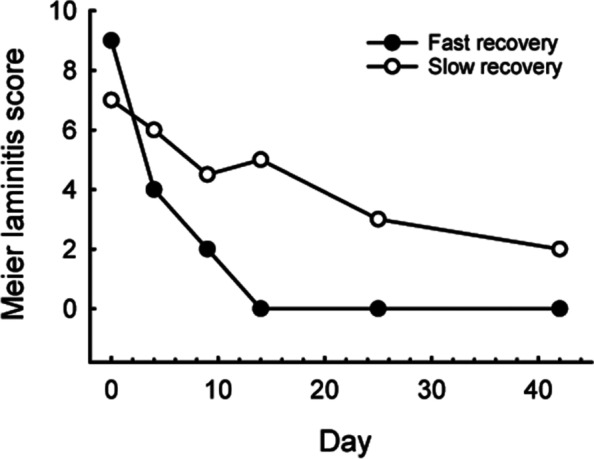
Background: Although several studies have investigated factors associated with the onset and occurrence of hyperinsulinaemia-associated laminitis (HAL), few have examined the factors associated with the rate of improvement during recovery from an acute bout of the disease. This observational study sought to discover if a range of demographic, morphologic, hormonal and metabolic variables are associated with the improvement rate from HAL in 37 naturally-occurring cases identified by 16 clinics across Germany. Each case was evaluated for laminitis severity on the day of inclusion in the trial (d 0), then after 4, 9, 14, 25 and 42 d. The horses were managed according to best clinical practice including restricting exercise and prescribing a diet of hay-only, for a minimum of 9 d. Blood samples were also collected during each evaluation, except on d 9, and analysed for glucose, insulin, ACTH and leptin.
Results: Based on individual clinical laminitis scores plotted against time, most horses improved markedly within 2 weeks, with a 'fast group' (n = 27) having a median (interquartile range) score on a 12-point scale of 0 (0-2) by d 14. However, there was a clear disparity within the total cohort, as ~ 1 in 4 horses demonstrated much slower improvement, with a median score of 5 (4-7) by d 14, or a marked relapse thereafter ('slow group', n = 10). Horses in the slow improvement group were younger (12.5 (8.8-16.3) vs 17 (14-24) yr; P = 0.008), but were not more likely to be heavier, male, very fat, to have presented with a previous history of laminitis or elevated ACTH concentrations, or to be receiving pergolide treatment. Of the hormonal and metabolic parameters measured, glucose and insulin concentrations were within the normal range following transition to the hay-only diet, but were higher in the group that failed to improve quickly, with a small but significant difference being evident on d 4, 14 and 25 for glucose (11 to 16%; P < 0.05), and a larger difference for insulin on d 14 and 25 (51 to 55%; P < 0.05). There was no difference between the groups in ACTH or leptin concentrations throughout the study. The main limitations of this study were the small number of slow-improvement horses and an inability to control or measure certain variables, such as feed quality.
Conclusions: Young age and a modest increase in blood glucose and insulin concentrations are associated with delayed laminitis improvement.
Keywords: Diagnosis; Endocrinopathic; Equine metabolic syndrome; Insulin; Recovery.
© 2022. The Author(s).
Conflict of interest statement
RK, and DR are employees of the company that funded this research: Boehringer Ingelheim Vetmedica GmbH. None of the other authors have any competing interests.
Figures


References
-
- Pollitt CC. The illustrated Horse's foot: a comprehensive guide. St Louis. MO: 492 Elsevier; 2015.
-
- Luthersson N, Mannfalk M, Parkin T, Harris P. Laminitis risk factors and outcome in a group of Danish horses. J Equine Veterinary Sci. 2017;53:68–73. doi: 10.1016/j.jevs.2016.03.006. - DOI
Publication types
MeSH terms
Substances
LinkOut - more resources
Full Text Sources
Medical
