This is a preprint.
Outcomes of laboratory-confirmed SARS-CoV-2 infection in the Omicron-driven fourth wave compared with previous waves in the Western Cape Province, South Africa
- PMID: 35043121
- PMCID: PMC8764730
- DOI: 10.1101/2022.01.12.22269148
Outcomes of laboratory-confirmed SARS-CoV-2 infection in the Omicron-driven fourth wave compared with previous waves in the Western Cape Province, South Africa
Update in
-
Outcomes of laboratory-confirmed SARS-CoV-2 infection in the Omicron-driven fourth wave compared with previous waves in the Western Cape Province, South Africa.Trop Med Int Health. 2022 Jun;27(6):564-573. doi: 10.1111/tmi.13752. Epub 2022 May 10. Trop Med Int Health. 2022. PMID: 35411997 Free PMC article.
Abstract
Objectives: We aimed to compare COVID-19 outcomes in the Omicron-driven fourth wave with prior waves in the Western Cape, the contribution of undiagnosed prior infection to differences in outcomes in a context of high seroprevalence due to prior infection, and whether protection against severe disease conferred by prior infection and/or vaccination was maintained.
Methods: In this cohort study, we included public sector patients aged ≥20 years with a laboratory confirmed COVID-19 diagnosis between 14 November-11 December 2021 (wave four) and equivalent prior wave periods. We compared the risk between waves of the following outcomes using Cox regression: death, severe hospitalization or death and any hospitalization or death (all ≤14 days after diagnosis) adjusted for age, sex, comorbidities, geography, vaccination and prior infection.
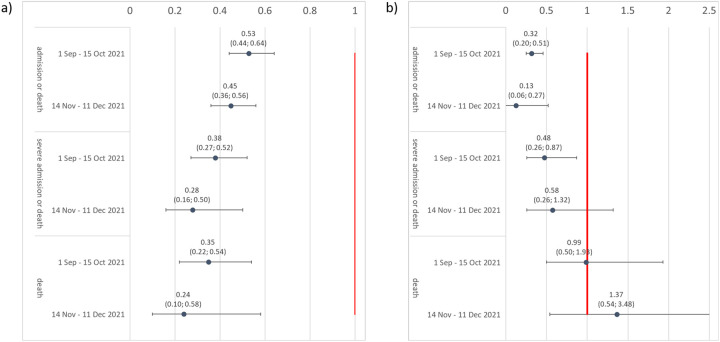
Results: We included 5,144 patients from wave four and 11,609 from prior waves. Risk of all outcomes was lower in wave four compared to the Delta-driven wave three (adjusted Hazard Ratio (aHR) [95% confidence interval (CI)] for death 0.27 [0.19; 0.38]. Risk reduction was lower when adjusting for vaccination and prior diagnosed infection (aHR:0.41, 95% CI: 0.29; 0.59) and reduced further when accounting for unascertained prior infections (aHR: 0.72). Vaccine protection was maintained in wave four (aHR for outcome of death: 0.24; 95% CI: 0.10; 0.58).
Conclusions: In the Omicron-driven wave, severe COVID-19 outcomes were reduced mostly due to protection conferred by prior infection and/or vaccination, but intrinsically reduced virulence may account for an approximately 25% reduced risk of severe hospitalization or death compared to Delta.
Figures
References
-
- Scott L, Hsiao N-y, Moyo S, Singh L, Tegally H, Dor G, et al. Track Omicron’s spread with molecular data. Science. 2021;374(6574):1454–5. - PubMed
-
- Cele S, Jackson L, Khan K, Khoury DS, Moyo-Gwete T, Tegally H, et al. SARS-CoV-2 Omicron has extensive but incomplete escape of Pfizer BNT162b2 elicited neutralization and requires ACE2 for infection. MedRxiv. 2021. doi: 10.1101/2021.12.19.21268028. Accessed 31 December 2021. - DOI
-
- Pearson CAB, Silal SP, Li MWZ, Dushoff J, Bolker BM, Abbott S, et al. Bounding the levels of transmissibility and immune evasion of the Omicron variant in South Africa. MedRxiv. 2021. doi: 10.1101/2021.12.19.21268038. Accessed 31 December 2021. - DOI
Publication types
Grants and funding
LinkOut - more resources
Full Text Sources
Miscellaneous