. 2022 Jan 19;12(1):998.
doi: 10.1038/s41598-021-03968-4.

Abnormal whole-body energy metabolism in iron-deficient humans despite preserved skeletal muscle oxidative phosphorylation

Affiliations

Abnormal whole-body energy metabolism in iron-deficient humans despite preserved skeletal muscle oxidative phosphorylation

Matthew C Frise et al. Sci Rep. .

Erratum in

Abstract

Iron deficiency impairs skeletal muscle metabolism. The underlying mechanisms are incompletely characterised, but animal and human experiments suggest the involvement of signalling pathways co-dependent upon oxygen and iron availability, including the pathway associated with hypoxia-inducible factor (HIF). We performed a prospective, case-control, clinical physiology study to explore the effects of iron deficiency on human metabolism, using exercise as a stressor. Thirteen iron-deficient (ID) individuals and thirteen iron-replete (IR) control participants each underwent 31P-magnetic resonance spectroscopy of exercising calf muscle to investigate differences in oxidative phosphorylation, followed by whole-body cardiopulmonary exercise testing. Thereafter, individuals were given an intravenous (IV) infusion, randomised to either iron or saline, and the assessments repeated ~ 1 week later. Neither baseline iron status nor IV iron significantly influenced high-energy phosphate metabolism. During submaximal cardiopulmonary exercise, the rate of decline in blood lactate concentration was diminished in the ID group (P = 0.005). Intravenous iron corrected this abnormality. Furthermore, IV iron increased lactate threshold during maximal cardiopulmonary exercise by ~ 10%, regardless of baseline iron status. These findings demonstrate abnormal whole-body energy metabolism in iron-deficient but otherwise healthy humans. Iron deficiency promotes a more glycolytic phenotype without having a detectable effect on mitochondrial bioenergetics.


Conflict of interest statement

PAR has received grant funding from Vifor Pharma for basic science studies of iron biology, including in support of work by MKC outside that presented here. PJR was previously chair of the Research Advisory Board of GlaxoSmithKline. The remaining authors declare no competing interests.

Figures
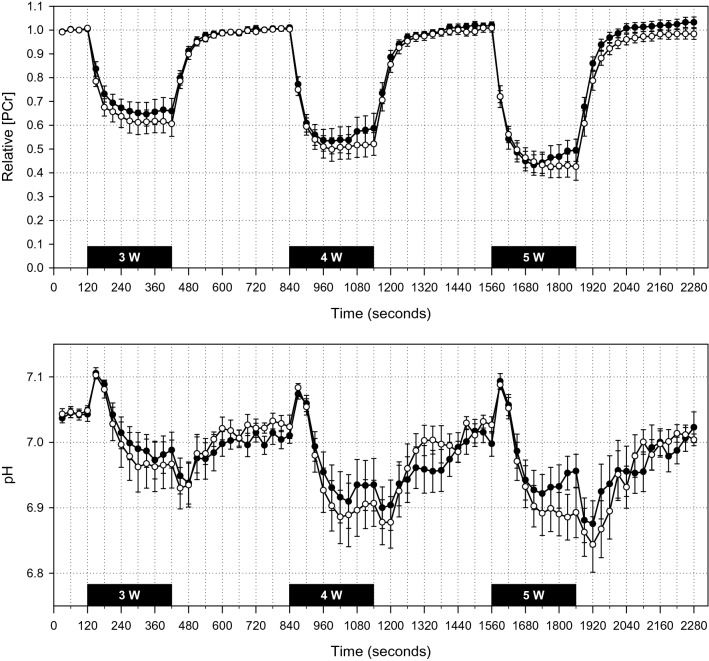
Figure 1
Figure 1
31P-MRS data from first study visit. [PCr] is expressed as a fraction of the mean value during the initial 2-min rest period. Data for ID participants appear as white circles; those for IR participants, black circles. Solid black bars indicate 5-min exercise periods. All participants completed the 3-W exercise bout. Subsequently, several participants ceased exercise prematurely due to fatigue: during the 4-W bout, one IR participant after 1050 s; during the 5-W bout, one ID participant after 1820s, one IR participant after 1720s, and another IR participant after 1775s. For illustrative purposes, recovery data for these participants are shifted to align with cessation of exercise in the other participants; an ‘early recovery’ artefact is thus apparent in the IR group near the end of the 4-W and 5-W bouts. The rest periods include data for all participants. Values are 30-s means; error bars show SE.
Figure 2
Figure 2
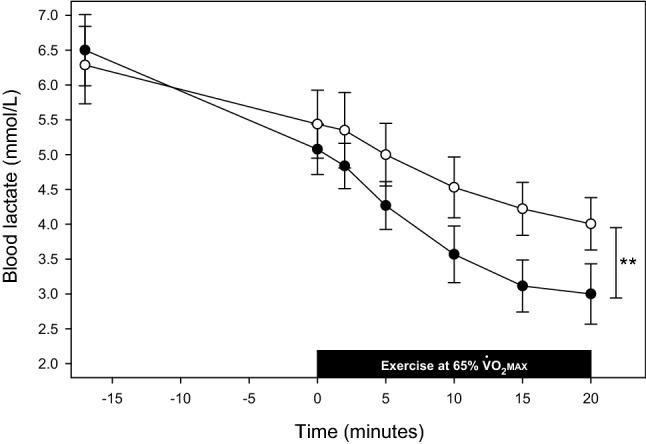
Blood lactate following volitional fatigue and during submaximal exercise at first study visit. Data for ID participants appear as white circles; those for IR participants, black circles. The initial venous lactate value was measured at volitional fatigue during the preceding maximal CPET. Following a 15-min interval, participants returned to the ergometer and measurements were made during two minutes seated at rest. The solid black bar indicates the period of submaximal exercise. A single lactate value was missing for one ID participant at the 2-min timepoint due to a technical issue. Values are means; error bars show SE. **, P = 0.005 for interaction of iron status and time.
Figure 3
Figure 3
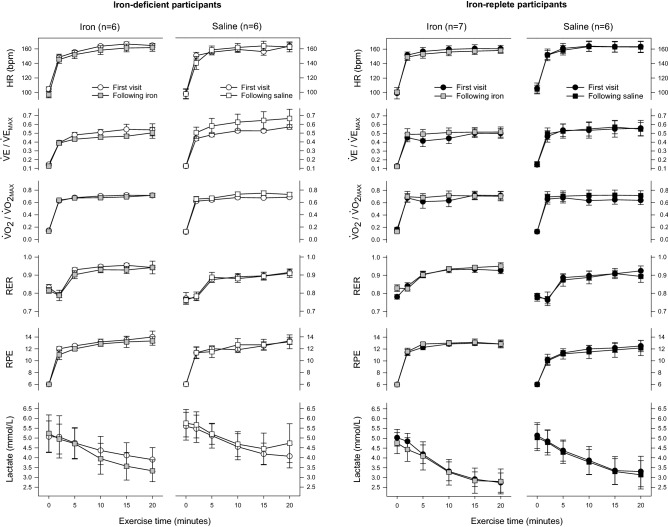
Cardiorespiratory variables during submaximal exercise at each study visit. Data for ID participants appear as white symbols; those for IR participants, black symbols. Data from the first visit appear as circles; those for the second, squares. Data for the second visit in participants receiving IV iron are shown in grey. V˙E and V˙o2 values for both visits are expressed relative to maximal values at the first visit. Values for parameters other than lactate are means for the previous 30 s; error bars show SE. One ID participant became presyncopal after volitional fatigue at the second visit and did not perform submaximal exercise; data for this individual are excluded from the figure (but not the statistical analysis). Data at the first visit for V˙E, V˙o2 and RER at the 10, 15 and 20-min time points were missing for one IR participant randomised to receive saline due to a technical issue. P = 0.028 for differential effect of IV iron according to baseline iron status; comparisons for all other variables NS. HR, heart rate; V˙E, minute ventilation; RER, respiratory exchange ratio; RPE, rating of perceived exertion.

References

    1. Hawley JA, Hargreaves M, Joyner MJ, Zierath JR. Integrative biology of exercise. Cell. 2014;159:738–749. doi: 10.1016/j.cell.2014.10.029. - DOI - PubMed
    1. Ohira Y, et al. Work capacity, heart rate and blood lactate responses to iron treatment. Br. J. Haematol. 1979;41:365–372. doi: 10.1111/j.1365-2141.1979.tb05869.x. - DOI - PubMed
    1. Schoene RB, et al. Iron repletion decreases maximal exercise lactate concentrations in female athletes with minimal iron-deficiency anemia. J. Lab. Clin. Med. 1983;102:306–312. - PubMed
    1. Sim M, et al. Iron considerations for the athlete: A narrative review. Eur. J. Appl. Physiol. 2019;119:1463–1478. doi: 10.1007/s00421-019-04157-y. - DOI - PubMed
    1. Zimmermann MB, Hurrell RF. Nutritional iron deficiency. Lancet (London, England) 2007;370:511–520. doi: 10.1016/S0140-6736(07)61235-5. - DOI - PubMed

Publication types