Review
. 2021 Nov 19;13(6):931-941.
doi: 10.1007/s12551-021-00890-x. eCollection 2021 Dec.

Location, location, location: subcellular protein partitioning in proteostasis and aging

Affiliations
Review

Location, location, location: subcellular protein partitioning in proteostasis and aging

Anita V Kumar et al. Biophys Rev. .

Abstract

Somatic maintenance and cell survival rely on proper protein homeostasis to ensure reliable functions across the cell and to prevent proteome collapse. Maintaining protein folding and solubility is central to proteostasis and is coordinated by protein synthesis, chaperoning, and degradation capacities. An emerging aspect that influences proteostasis is the dynamic protein partitioning across different subcellular structures and compartments. Here, we review recent literature related to nucleocytoplasmic partitioning of proteins, nuclear and cytoplasmic quality control mechanisms, and their impact on the development of age-related diseases. We also highlight new points of entry to modulate spatially-regulated proteostatic mechanisms to delay aging.

Keywords: C. elegans; Nucleocytoplasmic partitioning; Proteostasis.


Conflict of interest statement

Conflict of interestThe authors declare no competing interests.

Figures
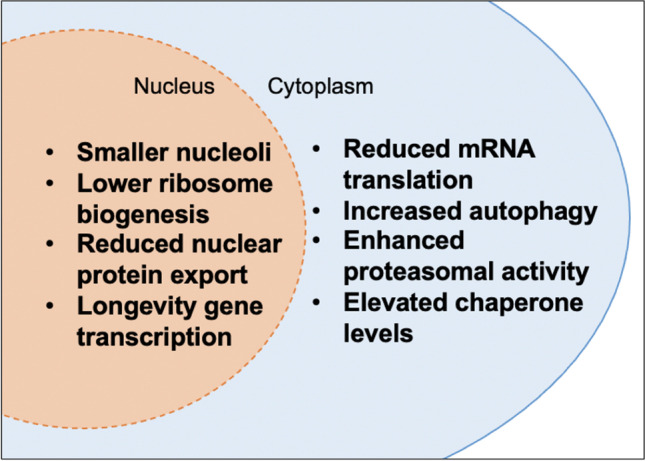
Fig. 1
Fig. 1
Key proteostatic mechanisms associated with longevity
Fig. 2
Fig. 2
Subcellular locations relevant for proteostasis
Fig. 3
Fig. 3
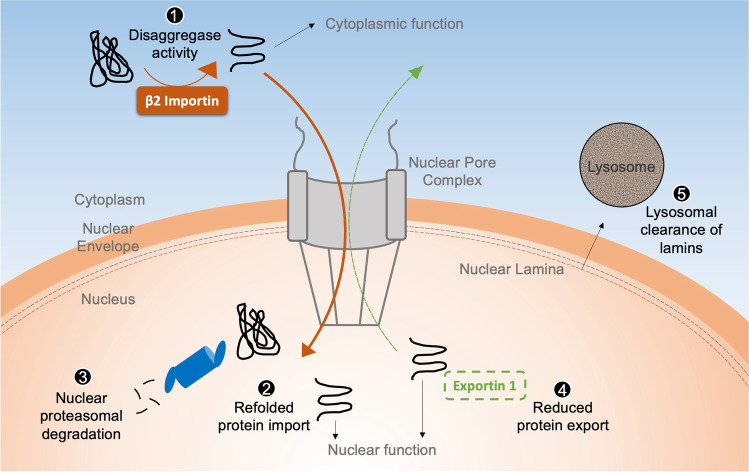
Coordination of nucleocytoplasmic protein partitioning and proteostatic mechanisms
Fig. 4
Fig. 4
Nucleocytoplasmic proteostatic inter-relationship during aging

References

    1. Albert S, Schaffer M, Beck F, Mosalaganti S, Asano S, Thomas HF, Plitzko JM, Beck M, Baumeister W, Engel BD. Proteasomes tether to two distinct sites at the nuclear pore complex. Proc Natl Acad Sci U S A. 2017;114:13726–13731. doi: 10.1073/pnas.1716305114. - DOI - PMC - PubMed
    1. An H, Harper JW. Ribosome abundance control via the ubiquitin-proteasome system and autophagy. J Mol Biol. 2020;432:170–184. doi: 10.1016/j.jmb.2019.06.001. - DOI - PMC - PubMed
    1. Azkanaz M, Rodriguez Lopez A, de Boer B, Huiting W, Angrand PO, Vellenga E, Kampinga HH, Bergink S, Martens JH, Schuringa JJ, et al (2019) Protein quality control in the nucleolus safeguards recovery of epigenetic regulators after heat shock. eLife 8. 10.7554/eLife.45205 - PMC - PubMed
    1. Bai B, Moore HM, Laiho M. CRM1 and its ribosome export adaptor NMD3 localize to the nucleolus and affect rRNA synthesis. Nucleus. 2013;4:315–325. doi: 10.4161/nucl.25342. - DOI - PMC - PubMed
    1. Beck M, Hurt E. The nuclear pore complex: understanding its function through structural insight. Nat Rev Mol Cell Biol. 2017;18:73–89. doi: 10.1038/nrm.2016.147. - DOI - PubMed

LinkOut - more resources