


Lessons Learned: Recruiting Research Participants from an Underrepresented Patient Population at a Safety Net Hospital
- PMID: 35048288
- PMCID: PMC8769800
- DOI: 10.1007/s11606-021-07258-7
Lessons Learned: Recruiting Research Participants from an Underrepresented Patient Population at a Safety Net Hospital
Abstract
Background: Recruiting participants to clinical research studies is challenging, especially when conducted in safety net settings. We sought to compare the efficacy of different recruitment strategies in an NIH-funded study assessing treatment burden in patients with multiple chronic conditions (MCCs).
Methods: Targeted mailing, in-person table-based recruitment ("tabling") in the waiting room, and telephone calling were used to enroll subjects into one of two studies of treatment burden: a survey study to validate a brief measure of treatment burden for quality assessment (study 1) or a qualitative study to develop a treatment burden clinical communication tool (study 2).
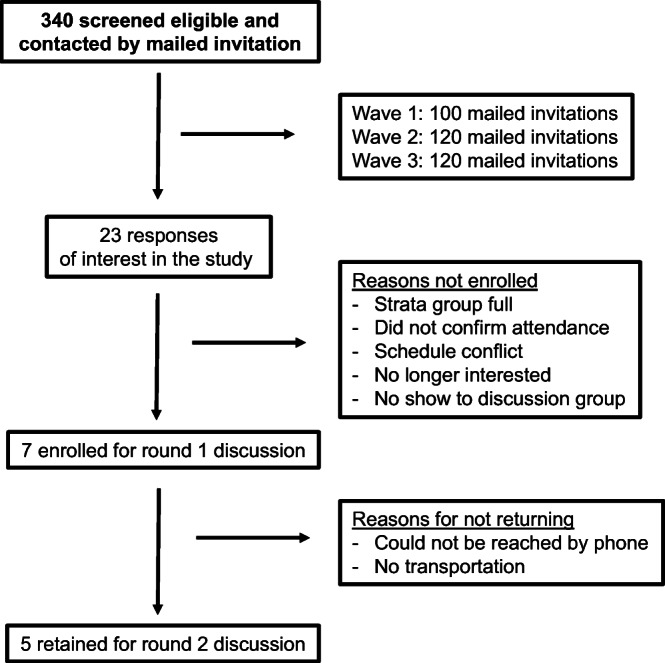
Results: Over 50% of subjects in each study were African American or African immigrants. In study 1, the enrollment goal of 200 was reached within 4 months. Tabling enrolled 78.5% of patients, while the remainder (21.5%) were enrolled from phone calls to eligible patients identified through the electronic medical record (EMR). In study 2, 340 eligible patients were identified through the EMR, and 7 (2.1%) were successfully enrolled via mailed invitations and responses. Retention rates (66% in study 1 and 71% in study 2) were reasonable in all groups.
Conclusions: Study recruiting goals in our safety net population were rapidly reached using the tabling method, which had substantively higher enrollment rates than mailings or telephone calls based on EMR reports. Future trials could compare recruitment strategies across settings and clinical populations.
Keywords: Burden of treatment; Recruitment methods; Underrepresented patient population.
© 2021. Society of General Internal Medicine.
Conflict of interest statement
The authors declare that they do not have any meaningful conflicts of interest. Dr. Linzer is supported through Hennepin Healthcare for training and research in physician burnout prevention by the American Medical Association (AMA), Institute for Healthcare Improvement (IHI), American Board of Internal Medicine (ABIM), American College of Physicians (ACP), the Optum Office for Provider Advancement, and the Agency for Healthcare Research and Quality (AHRQ). He consults on a grant for Harvard University on work conditions and diagnostic accuracy. Ms. Audi was supported through Hennepin Healthcare Research Institute for her work in burnout prevention research and training in burnout reduction by the AMA, IHI, and ABIM.
Figures

References
Publication types
MeSH terms
Grants and funding
LinkOut - more resources
Full Text Sources
