


Relative letter-position coding revisited
- PMID: 35048332
- PMCID: PMC9166833
- DOI: 10.3758/s13423-021-02039-z
Relative letter-position coding revisited
Abstract
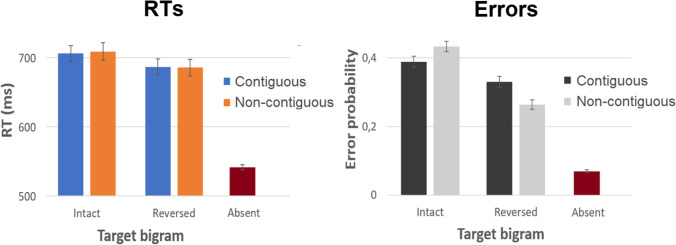
The notion that the brain achieves visual word recognition by encoding the relative positions of letters with open-bigram representations (e.g., 'h-e', 'h-r' and 'e-r' driving recognition of 'her') has been successful in accounting for many behaviors and phenomena. However, one characteristic of open-bigrams has remained unexplored: How is the activation of a bigram modulated by the distance between its constituents in the visual field? On the one hand, contiguous letters (e.g., 'at' in 'father') may allow for a clearer percept of the bigram. On the other hand, an increasing distance between letters (e.g., 'ae' in 'father') should create more certainty about their relative positions, which is precisely what the bigram is meant to convey. This matter was investigated with two experiments in which participants indicated whether target pairs of letters occurred in random letter strings. They were instructed that letter order mattered (i.e., 'a-b' does not occur in 'kbac'), while letter contiguity did not (i.e., 'a-b' occurs in 'akcb'). Controlling for crowding and eccentricity, bigrams were recognized faster upon decreasing the letter distance. However, when switching the target letter order (meaning the string should be met by a 'no' response), shorter letter distances yielded slower responses and more false positives. Neither relative position-coding models nor absolute position-coding models accommodate both these patterns at once. We discuss how a complete account of our effects may instead combine elements from both model types.
Keywords: Letter position coding; Orthographic processing; Reading.
© 2022. The Author(s).
Figures


References
-
- Andrews S. Lexical retrieval and selection processes: Effects of transposed-letter confusability. Journal of Memory and Language. 1996;35:775–800. doi: 10.1006/jmla.1996.0040. - DOI
MeSH terms
LinkOut - more resources
Full Text Sources
Miscellaneous
