Review
. 2022 Jan 3;63(1):25.
doi: 10.1167/iovs.63.1.25.

Is Genetic Risk for Sleep Apnea Causally Linked With Glaucoma Susceptibility?

Affiliations
Review

Is Genetic Risk for Sleep Apnea Causally Linked With Glaucoma Susceptibility?

Nathan Ingold et al. Invest Ophthalmol Vis Sci. .

Abstract

Purpose: Observational studies have suggested that individuals with pre-existing sleep apnea (SA) have up to double the risk of developing glaucoma than individuals without SA. Understanding risk factors for glaucoma is important to assist with well-structured screening, early intervention, and efficient allocation of specialist consultation. The objective of this study is therefore to use genetic data to determine whether SA is a causal risk factor for glaucoma.

Methods: Two-sample Mendelian randomization (MR) analyses were performed to assess the association between genetically predicted SA and glaucoma susceptibility using genome-wide association study (GWAS) of 25,062 SA cases, 313,372 controls derived from 23andMe and summary data from a glaucoma GWAS meta-analysis (20,582 cases, 119,318 controls), including individuals of European descent, mainly from the UK Biobank.

Results: Inverse variance weighted regression of genetic susceptibility for SA on risk of glaucoma revealed no strong evidence for an association between SA and glaucoma (OR = 0.95, 95% confidence intervals = 0.84-1.07), results were consistent across all MR predictors.

Conclusions: We found little genetic evidence supporting a causal association between SA and glaucoma. Our results refute the possibility of a large effect (glaucoma OR > 1.5 per doubling of odds on SA) between SA and glaucoma.


Conflict of interest statement

Disclosure: N. Ingold, None; A.I. Campos, None; X. Han, None; J.-S. Ong, None; P. Gharahkhani, None; D.A. Mackey, None; M.E. Rentería, None; M.H. Law, None; S. MacGregor, None

Figures

Figure 1.
Figure 1.
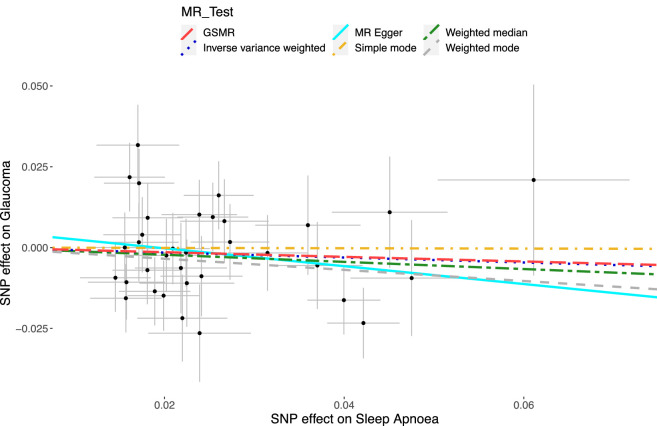
Scatter plot of each SNP's respective effect size for sleep apnea and glaucoma. The X-axis refers to the estimated magnitude of association (log(OR)) of each of the 34 IV single nucleotide polymorphisms (SNPs) on sleep apnea, whereas the Y axis refers to the magnitude of association (log(OR)) of each IV on glaucoma risk. The SEs are plotted for each point. The regression lines represent (1) inverse variance weighted (blue dots; IVW), which is the primary regression with no adjustment for pleiotropic effect; (2) MR Egger (turquoise full line; Mendelian randomization Egger), which accounts for directional pleiotropy; (3) weighted median (green long-dash dot), which provides robust point estimates even when up to 50% of the IVs are invalid instruments; (4) simple mode (yellow short-dash dot), providing the effect estimate based on the mode of the Wald-type estimates; (5) weighted mode (gray short-dash), assigns SE-based weightings to each SNP of the simple mode method; and (6) GSMR (red long-dash), which is similar to IVW after removing the HEIDI outliers. Note: Because of the similar effect estimates between IVW and GSMR, the lines overlap and maybe misconstrued as one “dot-dash” line; they are in fact two separate lines.
Figure 2.
Figure 2.
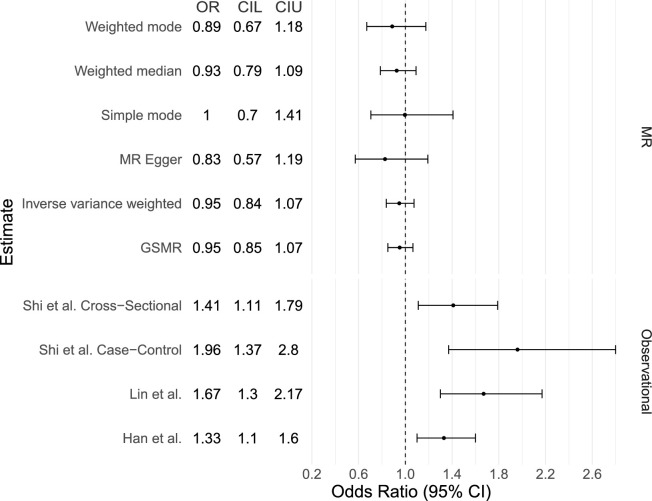
Forest Plot of the estimated odds ratios from our Mendelian randomization analysis and from previously reported observational studies. Forest plot presenting OR (representing a doubling of odds of SA on glaucoma) and lower (L) and Upper (U) 95% CI estimates for both the MR results (per doubling of odds) and observational findings (from logistic regression; Shi et al.6) and a hazard ratio (HR) estimate for glaucoma from Han et al., based on time-to-event analysis using UKBB data and a population-based matched-cohort study.

References

    1. Heinzer R, Vat S, Marques-Vidal P, et al. .. Prevalence of sleep-disordered breathing in the general population: the HypnoLaus study. Lancet Respir Med. 2015; 3: 310–318. - PMC - PubMed
    1. Fraser CL. Obstructive sleep apnea and optic neuropathy: is there a link? Curr Neurol Neurosci Rep. 2014; 14: 465. - PubMed
    1. Bilgin G. Normal-tension glaucoma and obstructive sleep apnea syndrome: a prospective study. BMC Ophthalmol . 2014; 14: 27. - PMC - PubMed
    1. Quigley HA, Broman AT.. The number of people with glaucoma worldwide in 2010 and 2020. Br J Ophthalmol. 2006; 90: 262–267. - PMC - PubMed
    1. Pérez-Rico C, Gutiérrez-Díaz E, Mencía-Gutiérrez E, Díaz-de-Atauri MJ, Blanco R.. Obstructive sleep apnea–hypopnea syndrome (OSAHS) and glaucomatous optic neuropathy. Graefes Arch Clin Exp Ophthalmol. 2014; 252: 1345–1357. - PubMed

MeSH terms