Review
. 2021 Dec 28;10(1):59.
doi: 10.3390/biomedicines10010059.

The Cardiovascular System in Space: Focus on In Vivo and In Vitro Studies

Affiliations
Review

The Cardiovascular System in Space: Focus on In Vivo and In Vitro Studies

Ronni Baran et al. Biomedicines. .

Abstract

On Earth, humans are subjected to a gravitational force that has been an important determinant in human evolution and function. During spaceflight, astronauts are subjected to several hazards including a prolonged state of microgravity that induces a myriad of physiological adaptations leading to orthostatic intolerance. This review summarises all known cardiovascular diseases related to human spaceflight and focusses on the cardiovascular changes related to human spaceflight (in vivo) as well as cellular and molecular changes (in vitro). Upon entering microgravity, cephalad fluid shift occurs and increases the stroke volume (35-46%) and cardiac output (18-41%). Despite this increase, astronauts enter a state of hypovolemia (10-15% decrease in blood volume). The absence of orthostatic pressure and a decrease in arterial pressures reduces the workload of the heart and is believed to be the underlying mechanism for the development of cardiac atrophy in space. Cellular and molecular changes include altered cell shape and endothelial dysfunction through suppressed cellular proliferation as well as increased cell apoptosis and oxidative stress. Human spaceflight is associated with several cardiovascular risk factors. Through the use of microgravity platforms, multiple physiological changes can be studied and stimulate the development of appropriate tools and countermeasures for future human spaceflight missions in low Earth orbit and beyond.

Keywords: cardiovascular disease; cosmic radiation; microgravity; simulated microgravity; spaceflight.


Conflict of interest statement

The authors declare no conflict of interest.

Figures
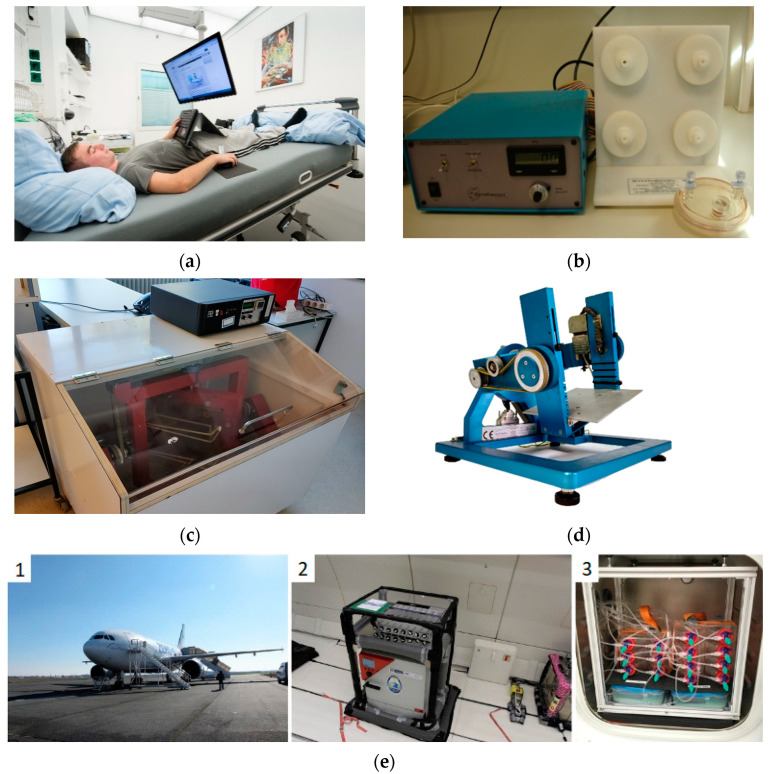
Figure 1
Figure 1
An overview of microgravity analogues. (a) The head-down bed rest experiment configuration (taken from the National Aeronautics and Space Administration (NASA) and Deutsches Zentrum für Luft-und Raumfahrt (DLR), CC BY-NC-ND 3.0 [56]); (b) a commercially available rotating wall vessel; (c) a commercially available three-dimensional clinostat; (d) a commercially available desktop random positioning machine; and (e) experimental setup for a parabolic flight, where image (1) shows the Airbus 310 aircraft used for the parabolic flight, picture (2) shows the incubator used for the experiment, and image (3) gives an impression of the inside of the incubator prior to take off of the flight. The images of (e) were published by Nassef et al. in [57].
Figure 2
Figure 2
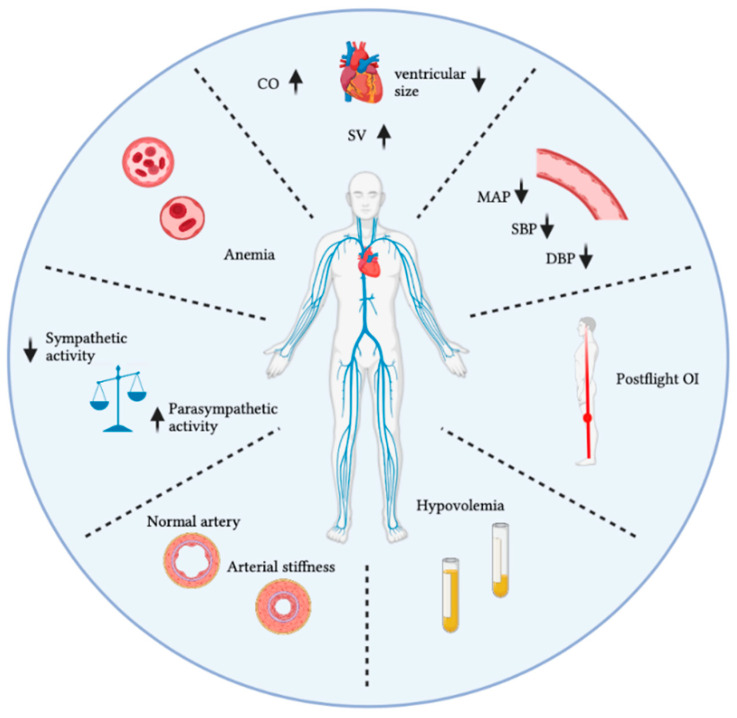
A summary of spaceflight-induced cardiovascular diseases. Abbreviations: cardiac output (CO); stroke volume (SV); mean arterial pressure (MAP); systolic blood pressure (SBP); diastolic blood pressure (DBP); orthostatic intolerance (OI); increase (↑); decrease ().
Figure 3
Figure 3
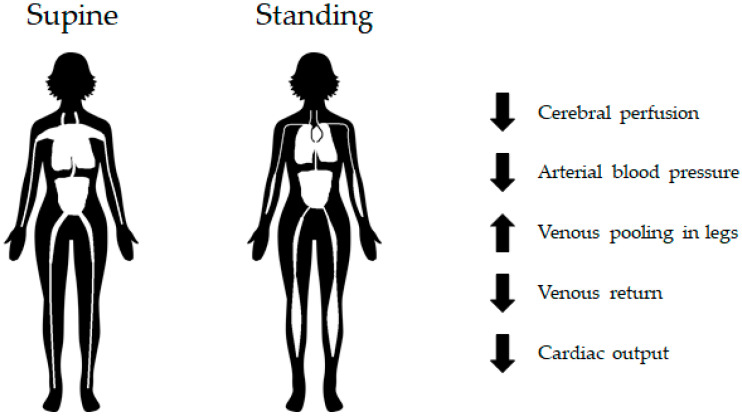
Orthostatic stress diagram. In a standing position, gravitational stress induces a downward shift in blood volume. This figure illustrates the result of cardiovascular deconditioning; that is, the inability of the cardiovascular system to maintain adequate blood pressure and brain perfusion. Increase (↑); decrease ().
Figure 4
Figure 4
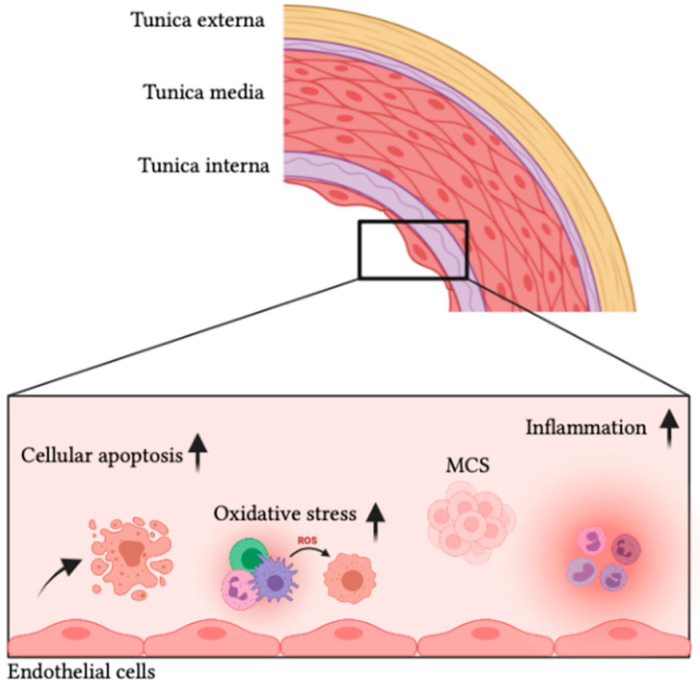
The endothelial cell response to microgravity. Multicellular spheroids (MCS); reactive oxygen species (ROS); increase (↑).

References

    1. Meck J.V., Reyes C.J., Perez S.A., Goldberger A.L., Ziegler M.G. Marked Exacerbation of Orthostatic Intolerance after Long- vs. Short-Duration Spaceflight in Veteran Astronauts. Psychosom. Med. 2001;63:865–873. doi: 10.1097/00006842-200111000-00003. - DOI - PubMed
    1. Vernice N.A., Meydan C., Afshinnekoo E., Mason C.E. Long-Term Spaceflight and the Cardiovascular System. Precis. Clin. Med. 2020;3:284–291. doi: 10.1093/pcmedi/pbaa022. - DOI - PMC - PubMed
    1. DiFrancesco J.M., Olson J.M. The Economics of Microgravity Research. NPJ Microgravity. 2015;1:15001. doi: 10.1038/npjmgrav.2015.1. - DOI - PMC - PubMed
    1. Grimm D., Egli M., Krüger M., Riwaldt S., Corydon T.J., Kopp S., Wehland M., Wise P., Infanger M., Mann V., et al. Tissue Engineering under Microgravity Conditions-Use of Stem Cells and Specialized Cells. Stem Cells Dev. 2018;27:787–804. doi: 10.1089/scd.2017.0242. - DOI - PubMed
    1. Grimm D., Wehland M., Corydon T.J., Richter P., Prasad B., Bauer J., Egli M., Kopp S., Lebert M., Krüger M. The Effects of Microgravity on Differentiation and Cell Growth in Stem Cells and Cancer Stem Cells. Stem Cells Transl. Med. 2020;9:882–894. doi: 10.1002/sctm.20-0084. - DOI - PMC - PubMed

LinkOut - more resources