Review
. 2021 Dec 30;10(1):76.
doi: 10.3390/biomedicines10010076.

Neurogenic Inflammation: The Participant in Migraine and Recent Advancements in Translational Research

Affiliations
Review

Neurogenic Inflammation: The Participant in Migraine and Recent Advancements in Translational Research

Eleonóra Spekker et al. Biomedicines. .

Abstract

Migraine is a primary headache disorder characterized by a unilateral, throbbing, pulsing headache, which lasts for hours to days, and the pain can interfere with daily activities. It exhibits various symptoms, such as nausea, vomiting, sensitivity to light, sound, and odors, and physical activity consistently contributes to worsening pain. Despite the intensive research, little is still known about the pathomechanism of migraine. It is widely accepted that migraine involves activation and sensitization of the trigeminovascular system. It leads to the release of several pro-inflammatory neuropeptides and neurotransmitters and causes a cascade of inflammatory tissue responses, including vasodilation, plasma extravasation secondary to capillary leakage, edema, and mast cell degranulation. Convincing evidence obtained in rodent models suggests that neurogenic inflammation is assumed to contribute to the development of a migraine attack. Chemical stimulation of the dura mater triggers activation and sensitization of the trigeminal system and causes numerous molecular and behavioral changes; therefore, this is a relevant animal model of acute migraine. This narrative review discusses the emerging evidence supporting the involvement of neurogenic inflammation and neuropeptides in the pathophysiology of migraine, presenting the most recent advances in preclinical research and the novel therapeutic approaches to the disease.

Keywords: animal model; dura mater; immune system; inflammatory soup; migraine; migraine treatment; neurogenic inflammation; neuropeptides; primary headache; trigeminal system.


Conflict of interest statement

The authors have no other relevant affiliations or financial involvement with any organization or entity with a financial interest in or financial conflict with the subject matter or materials discussed in the manuscript apart from those disclosed.

Figures
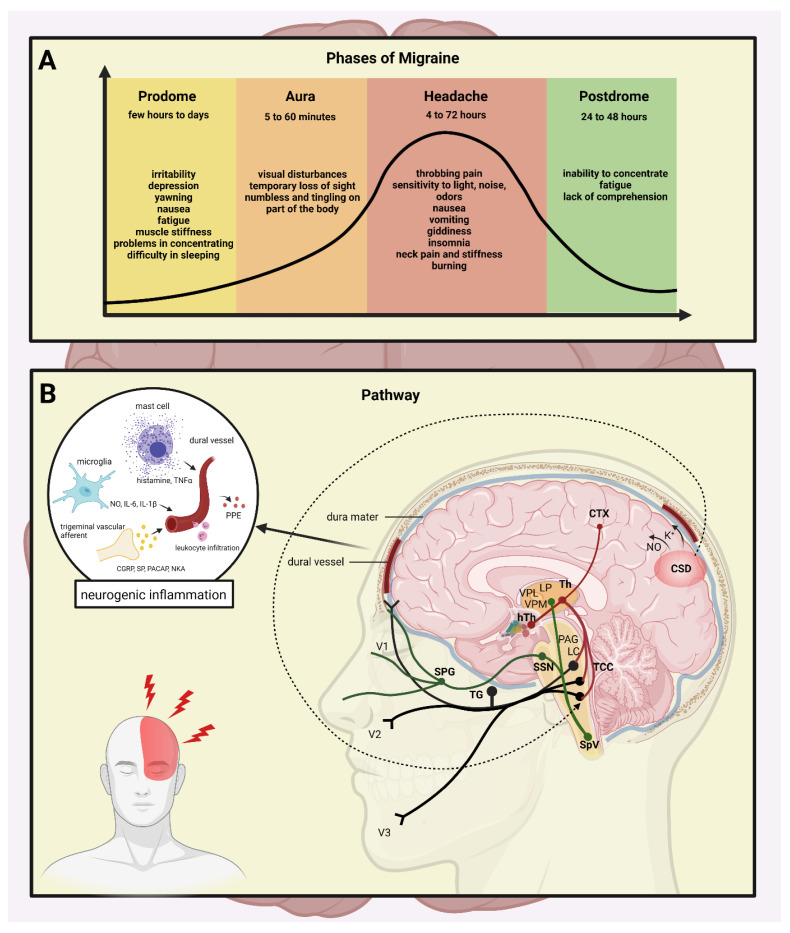
Figure 1
Figure 1
The stages and the pathways of migraine. (A) The stages of migraine attack: the prodrome phase, a possible aura, followed by the headache, and subsequently the postdrome. A strong headache is frequently accompanied with nausea, vomiting, and sensitivity to light, which lasts 4 to 72 h. (B) Mechanisms and structures involved in the pathogenesis of migraine: CTX, cortex; NO, nitric-oxide; CSD, cortical spreading depression; Th, thalamus; hTh, hypothalamus; LP, lateral posterior nucleus; VPM, ventral posteromedial nucleus; VPL, ventral posterolateral nucleus; PAG, periaqueductal grey matter; LC, locus coeruleus; TCC, trigeminocervical complex; SSN, superior salivatory nucleus; SpV, spinal trigeminal nucleus caudalis; TG, trigeminal ganglion; SPG, sphenopalatine ganglion; V1, ophthalmic nerve; V2, maxillary nerve; V3, mandibular nerve; CGRP, calcitonin gene-related peptide; SP, substance P; PACAP, pituitary adenylate cyclase-activating polypeptide; NKA, neurokinin A; PPE, plasma protein extravasation; TNFα, tumour necrosis factor alpha; IL, interleukin.
Figure 2
Figure 2
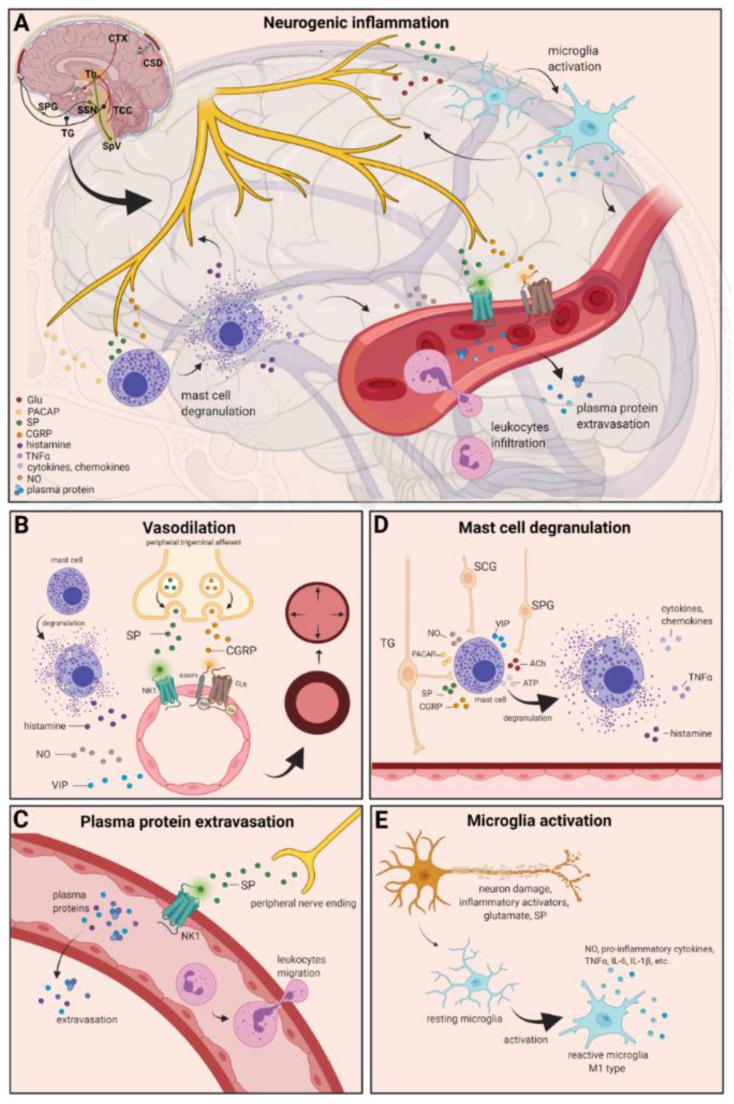
Neurogenic inflammation and its main features. (A) Stimulation of the trigeminal nerve causes the release of neuropeptides, including CGRP, SP, NO, VIP, and 5-HT, leading to neurogenic inflammation, which has four main features: the increased vascular permeability, leukocyte infiltration, glial cell activation, and increased production of inflammatory mediators, such as cytokines and chemokines. (B) Vasoactive peptides, such as CGRP and SP, bind their receptors on smooth muscle of dural vessels and cause vasodilation. The released neuropeptides induce mast cell degranulation, resulting in the release of histamine, which leads endothelium-dependent vasodilation. (C) Binding of the released SP to the NK1 receptors expressed on the microvascular blood vessels disrupts the membrane and causes plasma protein leakage and leukocyte extravasation. (D) Mast cells are in close association with neurons, especially in the dura, where they can be activated following trigeminal nerve and cervical or sphenopalatine ganglion stimulation. Release of neuropeptides causes mast cell degranulation, which leads to release of histamine and serotonin and selectively can cause the release of pro-inflammatory cytokines, such as TNF-α, IL-1, and IL-6. (E) Under the influence of inflammatory stimuli, microglia can become reactive microglia. Microglia activation leads to the production of inflammatory mediators and cytotoxic mediators.
Figure 3
Figure 3
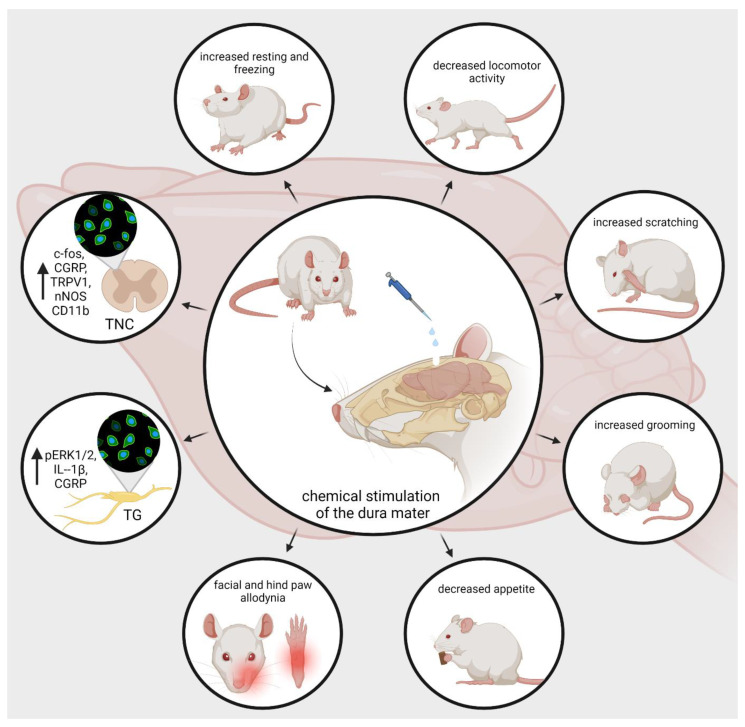
nNOS, pERK, ILs, increase the resting and freezing behavior, and decrease the appetite and locomotor activity of the animals. In addition, it can enhance grooming and scratching behavior and elicit mechanical and thermal hypersensitivity. CGRP, calcitonin gene-related peptide; TRPV1, transient receptor potential vanilloid receptor; nNOS, neuronal nitric-oxide synthase; IL, interleukins; pERK, phosphorylated extracellular signal-regulated kinase.
Figure 4
Figure 4
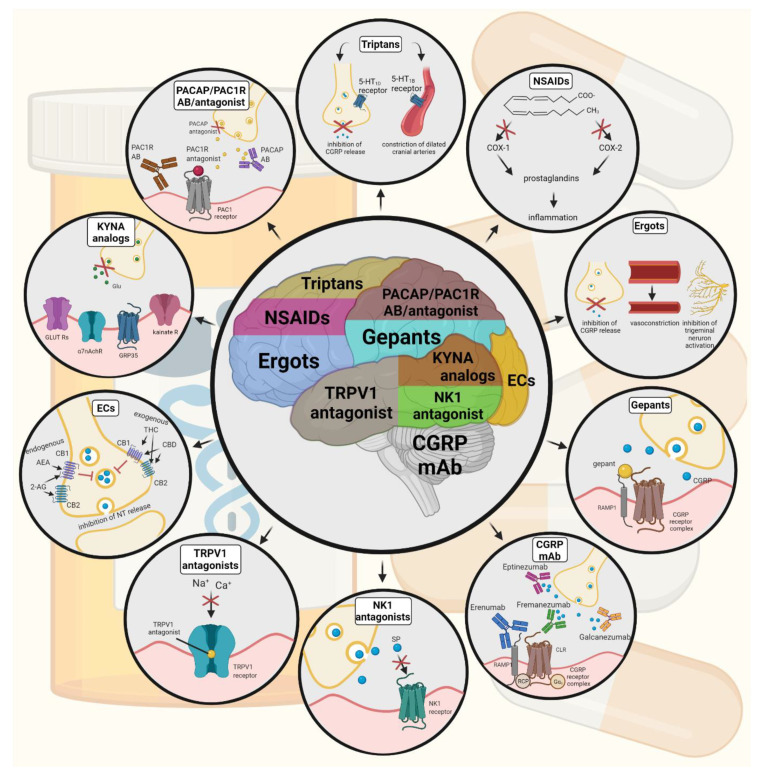
Possible treatments of neurogenic inflammation and migraine. NSAIDs, non-steroidal anti-inflammatory drugs; 5-HT, serotonin; CGRP, calcitonin gene-related peptide; COX, cyclooxygenase; Ab, antibody; NK1, neurokinin 1; TRPV1, transient receptor potential vanilloid receptor; SP, substance P; EC, endocannabinoids; AEA, anandamide; 2-AG, 2-arachidonoylglycerol; CB, cannabinoid receptor; THC, tetrahidrokanabinol; CBD, cannabidiol; NT, neurotransmitter; GLUT R, glutamate receptors; α7AchR, alpha-7 nicotinic receptor; GPR35, G protein-coupled receptor 35; PACAP, pituitary adenylate cyclase-activating polypeptide; PAC1R, pituitary adenylate cyclase 1 receptor.

References

    1. Steiner T.J., Stovner L.J., Vos T. GBD 2015: Migraine is the third cause of disability in under 50s. J. Headache Pain. 2016;17:104. doi: 10.1186/s10194-016-0699-5. - DOI - PMC - PubMed
    1. GBD 2016 Disease and Injury Incidence and Prevalence Collaborators Global, regional, and national incidence, prevalence, and years lived with disability for 328 diseases and injuries for 195 countries, 1990-2016: A systematic analysis for the Global Burden of Disease Study 2016. Lancet. 2017;390:1211–1259. doi: 10.1016/S0140-6736(17)32154-2. - DOI - PMC - PubMed
    1. Gazerani P., Cairns B.E. Sex-Specific Pharmacotherapy for Migraine: A Narrative Review. Front. Neurosci. 2020;14:222. doi: 10.3389/fnins.2020.00222. - DOI - PMC - PubMed
    1. Cerbo R., Pesare M., Aurilia C., Rondelli V., Barbanti P. Socio–economic costs of migraine. J. Headache Pain. 2001;2:s15–s19. doi: 10.1007/s101940170003. - DOI
    1. Mayans L., Walling A. Acute Migraine Headache: Treatment Strategies. Am. Fam. Physician. 2018;97:243–251. - PubMed

LinkOut - more resources