


Crumbling the Castle: Targeting DNABII Proteins for Collapsing Bacterial Biofilms as a Therapeutic Approach to Treat Disease and Combat Antimicrobial Resistance
- PMID: 35052981
- PMCID: PMC8773079
- DOI: 10.3390/antibiotics11010104
Crumbling the Castle: Targeting DNABII Proteins for Collapsing Bacterial Biofilms as a Therapeutic Approach to Treat Disease and Combat Antimicrobial Resistance
Abstract
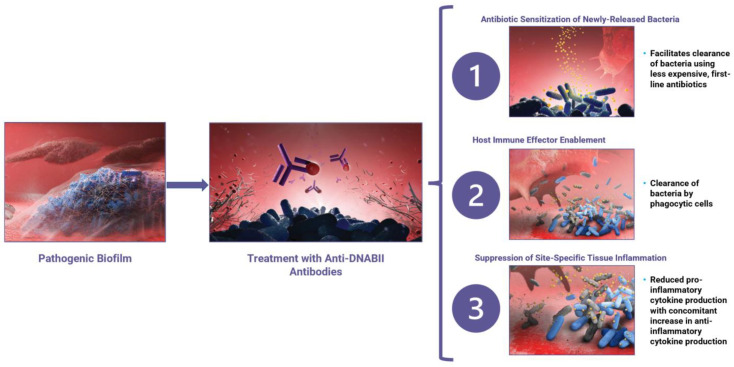
Antimicrobial resistance (AMR) is a concerning global threat that, if not addressed, could lead to increases in morbidity and mortality, coupled with societal and financial burdens. The emergence of AMR bacteria can be attributed, in part, to the decreased development of new antibiotics, increased misuse and overuse of existing antibiotics, and inadequate treatment options for biofilms formed during bacterial infections. Biofilms are complex microbiomes enshrouded in a self-produced extracellular polymeric substance (EPS) that is a primary defense mechanism of the resident microorganisms against antimicrobial agents and the host immune system. In addition to the physical protective EPS barrier, biofilm-resident bacteria exhibit tolerance mechanisms enabling persistence and the establishment of recurrent infections. As current antibiotics and therapeutics are becoming less effective in combating AMR, new innovative technologies are needed to address the growing AMR threat. This perspective article highlights such a product, CMTX-101, a humanized monoclonal antibody that targets a universal component of bacterial biofilms, leading to pathogen-agnostic rapid biofilm collapse and engaging three modes of action-the sensitization of bacteria to antibiotics, host immune enablement, and the suppression of site-specific tissue inflammation. CMTX-101 is a new tool used to enhance the effectiveness of existing, relatively inexpensive first-line antibiotics to fight infections while promoting antimicrobial stewardship.
Keywords: DNABII; antibiotic; antimicrobial resistance; biofilm; histone-like protein (HU); integration host factor (IHF).
Conflict of interest statement
C.C.M. is a co-founder of Clarametyx Biosciences, Inc. Both C.C.M. and V.L.H. have equity interests in Clarametyx Biosciences, Inc. J.V.R. declares no conflict of interest.
Figures
References
-
- Sharma P., Towse A. New Drugs to Tackle Antimicrobial Resistance: Analysis of EU Policy Options. [(accessed on 27 November 2021)]. Available online: https://www.ohe.org/publications/new-drugs-tackle-antimicrobial-resistan....
-
- Fact Sheet: Antimicrobial Resistance. [(accessed on 19 October 2021)]. Available online: https://www.who.int/news-room/fact-sheets/detail/antimicrobial-resistanc....
-
- CDC’s Antibiotic Resistance Threats in the United States. [(accessed on 19 October 2021)];2019 Available online: https://www.cdc.gov/drugresistance/biggest-threats.html.
-
- Nelson R.E., Hatfield K.M., Wolford H., Samore M.H., Scott R.D., Reddy S.C., Olubajo B., Paul P., Jernigan J.A., Baggs J. National Estimates of Healthcare Costs Associated with Multidrug-Resistant Bacterial Infections Among Hospitalized Patients in the United States. Clin. Infect. Dis. 2021;72:S17–S26. doi: 10.1093/cid/ciaa1581. - DOI - PMC - PubMed
-
- ECDC/EMEA Joint Technical Report The Bacterial Challenge: Time to React. A Call to Narrow the Gap between Multidrug-Resistant Bacteria in the EU and the Development of New Antibacterial Agents. [(accessed on 27 November 2021)]. Available online: https://www.fdanews.com/ext/resources/files/archives/e/EMEA-576176-2009.pdf.
LinkOut - more resources
Full Text Sources
Molecular Biology Databases
Research Materials
