


Implantable Cardioverter Defibrillator Multisensor Monitoring during Home Confinement Caused by the COVID-19 Pandemic
- PMID: 35053117
- PMCID: PMC8772791
- DOI: 10.3390/biology11010120
Implantable Cardioverter Defibrillator Multisensor Monitoring during Home Confinement Caused by the COVID-19 Pandemic
Abstract
Aims: The utilization of remote monitoring platforms was recommended amidst the COVID-19 pandemic. The HeartLogic index combines multiple implantable cardioverter defibrillator (ICD) sensors and has proved to be a predictor of impending heart failure (HF) decompensation. We examined how multiple ICD sensors behave in the periods of anticipated restrictions pertaining to physical activity.
Methods: The HeartLogic feature was active in 349 ICD and cardiac resynchronization therapy ICD patients at 20 Italian centers. The period from 1 January to 19 July 2020, was divided into three phases: pre-lockdown (weeks 1-11), lockdown (weeks 12-20), post-lockdown (weeks 21-29).
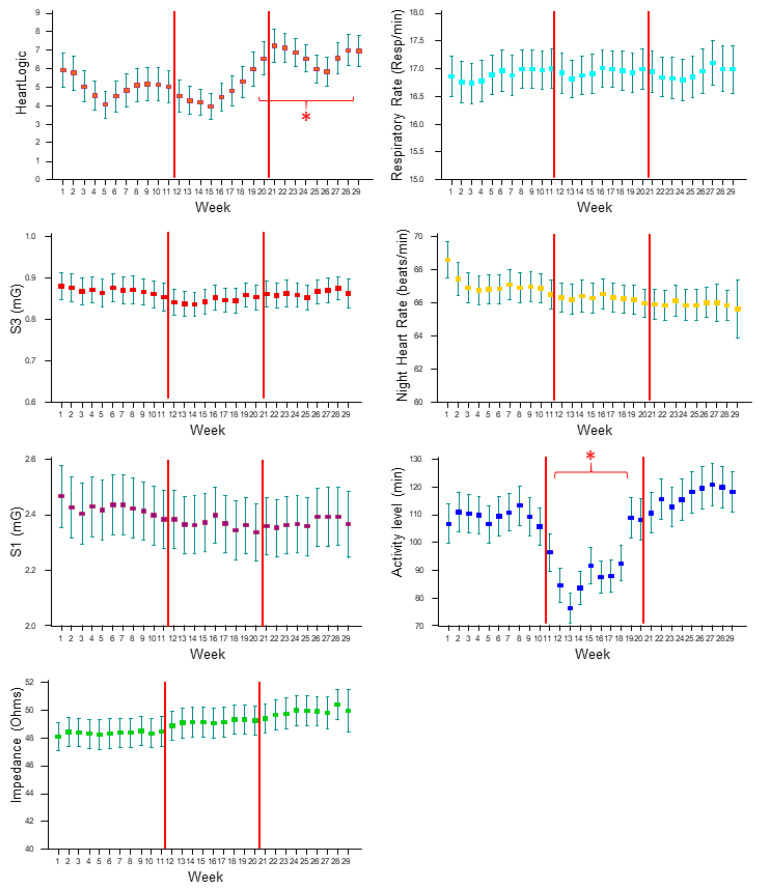
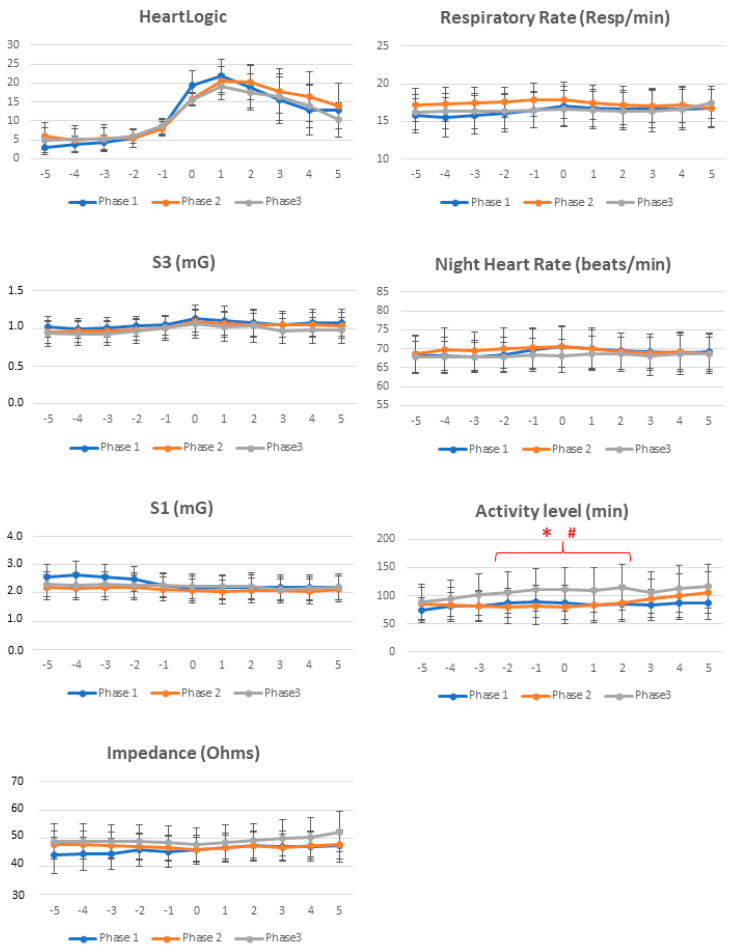
Results: Immediately after the implementation of stay-at-home orders (week 12), we observed a significant drop in median activity level whereas there was no difference in the other contributing parameters. The median composite HeartLogic index increased at the end of the Lockdown. The weekly rate of alerts was significantly higher during the lockdown (1.56 alerts/week/100 pts, 95%CI: 1.15-2.06; IRR = 1.71, p = 0.014) and post-lockdown (1.37 alerts/week/100 pts, 95%CI: 0.99-1.84; IRR = 1.50, p = 0.072) than that reported in pre-lockdown (0.91 alerts/week/100 pts, 95%CI: 0.64-1.27). However, the median duration of alert state and the maximum index value did not change among phases, as well as the proportion of alerts followed by clinical actions at the centers and the proportion of alerts fully managed remotely.
Conclusions: During the lockdown, the system detected a significant drop in the median activity level and generated a higher rate of alerts suggestive of worsening of the HF status.
Keywords: CRT; ICD; heart failure; multisensor; remote monitoring.
Conflict of interest statement
M. Ziacchi has received speaker fees from Abbott, Biotronik, Boston Scientific, Medtronic; I. Diemberger has received minor speaker fees from Boston Scientific, Medtronic and Biotronik; M. Campari and S. Valsecchi are employees of Boston Scientific. The other authors report no conflict.
Figures
References
-
- Lee I.M., Shiroma E.J., Lobelo F., Puska P., Blair S.N., Katzmarzyk P.T., Physical Activity Series Working Group Effect of physical inactivity on major non-communicable diseases worldwide: An analysis of burden of disease and life expectancy. Lancet. 2021;380:219–229. doi: 10.1016/S0140-6736(12)61031-9. - DOI - PMC - PubMed
-
- Palmisano P., Guerra F., Ammendola E., Ziacchi M., Luigi Pisanò E.C., Dell’Era G., Aspromonte V., Zaccaria M., Di Ubaldo F., Capucci A., et al. Italian Association of Arrhythmology and Cardiac Pacing (AIAC). Physical Activity Measured by Implanted Devices Predicts Atrial Arrhythmias and Patient Outcome: Results of IMPLANTED (Italian Multicentre Observational Registry on Patients with Implantable Devices Remotely Monitored) J. Am. Heart Assoc. 2018;7:e008146. - PMC - PubMed
-
- Bhatt A.S., Moscone A., McElrath E.E., Varshney A.S., Claggett B.L., Bhatt D.L., Januzzi J.L., Butler J., Adler D.S., Solomon S.D., et al. Fewer Hospitalizations for Acute Cardiovascular Conditions during the COVID-19 Pandemic. J. Am. Coll Cardiol. 2020;76:280–288. doi: 10.1016/j.jacc.2020.05.038. - DOI - PMC - PubMed
-
- De Filippo O., D’Ascenzo F., Angelini F., Bocchino P.P., Conrotto F., Saglietto A., Secco G.G., Campo G., Gallone G., Verardi R., et al. Reduced Rate of Hospital Admissions for ACS during COVID-19 Outbreak in Northern Italy. N. Engl. J. Med. 2020;383:88–89. doi: 10.1056/NEJMc2009166. - DOI - PMC - PubMed
LinkOut - more resources
Full Text Sources
Research Materials
Miscellaneous
