


Programmed Death-Ligand 1 (PD-L1) as Immunotherapy Biomarker in Breast Cancer
- PMID: 35053471
- PMCID: PMC8773553
- DOI: 10.3390/cancers14020307
Programmed Death-Ligand 1 (PD-L1) as Immunotherapy Biomarker in Breast Cancer
Abstract
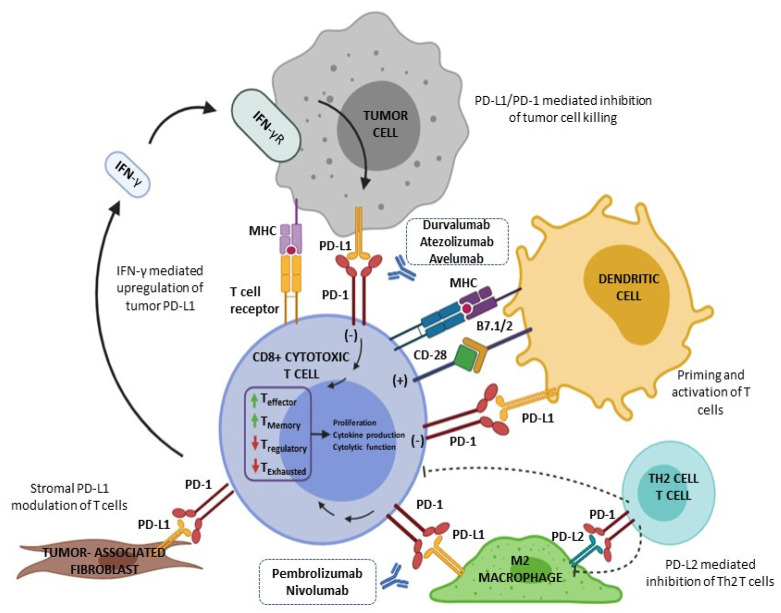
Breast cancer constitutes the most common malignant neoplasm in women around the world. Approximately 12% of patients are diagnosed with metastatic stage, and between 5 and 30% of early or locally advanced BC patients will relapse, making it an incurable disease. PD-L1 ligation is an immune inhibitory molecule of the activation of T cells, playing a relevant role in numerous types of malignant tumors, including BC. The objective of the present review is to analyze the role of PD-L1 as a biomarker in the different BC subtypes, adding clinical trials with immune checkpoint inhibitors and their applicable results. Diverse trials using immunotherapy with anti-PD-1/PD-L1 in BC, as well as prospective or retrospective cohort studies about PD-L1 in BC, were included. Despite divergent results in the reviewed studies, PD-L1 seems to be correlated with worse prognosis in the hormone receptor positive subtype. Immune checkpoints inhibitors targeting the PD-1/PD-L1 axis have achieved great response rates in TNBC patients, especially in combination with chemotherapy, making immunotherapy a new treatment option in this scenario. However, the utility of PD-L1 as a predictive biomarker in the rest of BC subtypes remains unclear. In addition, predictive differences have been found in response to immunotherapy depending on the stage of the tumor disease. Therefore, a better understanding of tumor microenvironment, as well as identifying new potential biomarkers or combined index scores, is necessary in order to make a better selection of the subgroups of BC patients who will derive benefit from immune checkpoint inhibitors.
Keywords: PD-L1; biomarker; breast cancer; chemotherapy; immunotherapy; prognostic value.
Conflict of interest statement
The authors declare no conflict of interest.
Figures
References
-
- Breast Cancer Metastasis and Drug Resistance. Springer Science and Business Media LLC; Berlin/Heidelberg, Germany: 2019.
-
- Dimitrova N., Saz Parkinson Z., Bramesfeld A., Uluturk Tekin A., Bocchi G., Pylkkanen L., Lopez Alcalde J., Neamtiu L., Ambrosio M., Deandrea S., et al. European Guidelines for Breast Cancer Screening and Diagnosis—The European Breast Guidelines. EUR 28360. Publications Office of the European Union; Luxembourg: 2016. JRC104007.
-
- Huang R.S.P., Haberberger J., Severson E., Duncan D.L., Hemmerich A., Edgerly C., Ferguson N.L., Williams E., Elvin J., Vergilio J.A., et al. A pan-cancer analysis of PD-L1 immunohistochemistry and gene amplification, tumor mutation burden and microsatellite instability in 48,782 cases. Mod. Pathol. 2021;34:252–263. doi: 10.1038/s41379-020-00664-y. - DOI - PubMed
-
- Noske A., Wagner D.-C., Schwamborn K., Foersch S., Steiger K., Kiechle M., Karapetyan S., Oettler D., Hapfelmeier A., Roth W., et al. 13P Comparison study of different programmed death-ligand 1 (PD-L1) assays, readers and scoring methods in triple-negative breast cancer (TNBC) Ann. Oncol. 2021;32:S26. doi: 10.1016/j.annonc.2021.03.027. - DOI - PMC - PubMed
Publication types
LinkOut - more resources
Full Text Sources
Research Materials
