Review
. 2021 Dec 26;12(1):30.
doi: 10.3390/life12010030.

Third-Generation Sequencing: The Spearhead towards the Radical Transformation of Modern Genomics

Affiliations
Review

Third-Generation Sequencing: The Spearhead towards the Radical Transformation of Modern Genomics

Konstantina Athanasopoulou et al. Life (Basel). .

Abstract

Although next-generation sequencing (NGS) technology revolutionized sequencing, offering a tremendous sequencing capacity with groundbreaking depth and accuracy, it continues to demonstrate serious limitations. In the early 2010s, the introduction of a novel set of sequencing methodologies, presented by two platforms, Pacific Biosciences (PacBio) and Oxford Nanopore Sequencing (ONT), gave birth to third-generation sequencing (TGS). The innovative long-read technologies turn genome sequencing into an ease-of-handle procedure by greatly reducing the average time of library construction workflows and simplifying the process of de novo genome assembly due to the generation of long reads. Long sequencing reads produced by both TGS methodologies have already facilitated the decipherment of transcriptional profiling since they enable the identification of full-length transcripts without the need for assembly or the use of sophisticated bioinformatics tools. Long-read technologies have also provided new insights into the field of epitranscriptomics, by allowing the direct detection of RNA modifications on native RNA molecules. This review highlights the advantageous features of the newly introduced TGS technologies, discusses their limitations and provides an in-depth comparison regarding their scientific background and available protocols as well as their potential utility in research and clinical applications.

Keywords: PacBio sequencing; direct RNA sequencing; epigenomics; epitranscriptomics; long-read sequencing; metagenomics; nanopore sequencing; single-molecule real-time sequencing; targeted DNA sequencing.


Conflict of interest statement

The authors declare no conflict of interest.

Figures
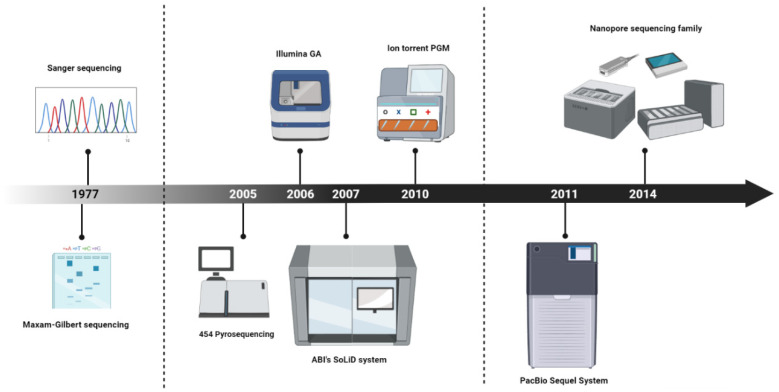
Figure 1
Figure 1
The milestones of sequencing development throughout the history of molecular biology.
Figure 2
Figure 2
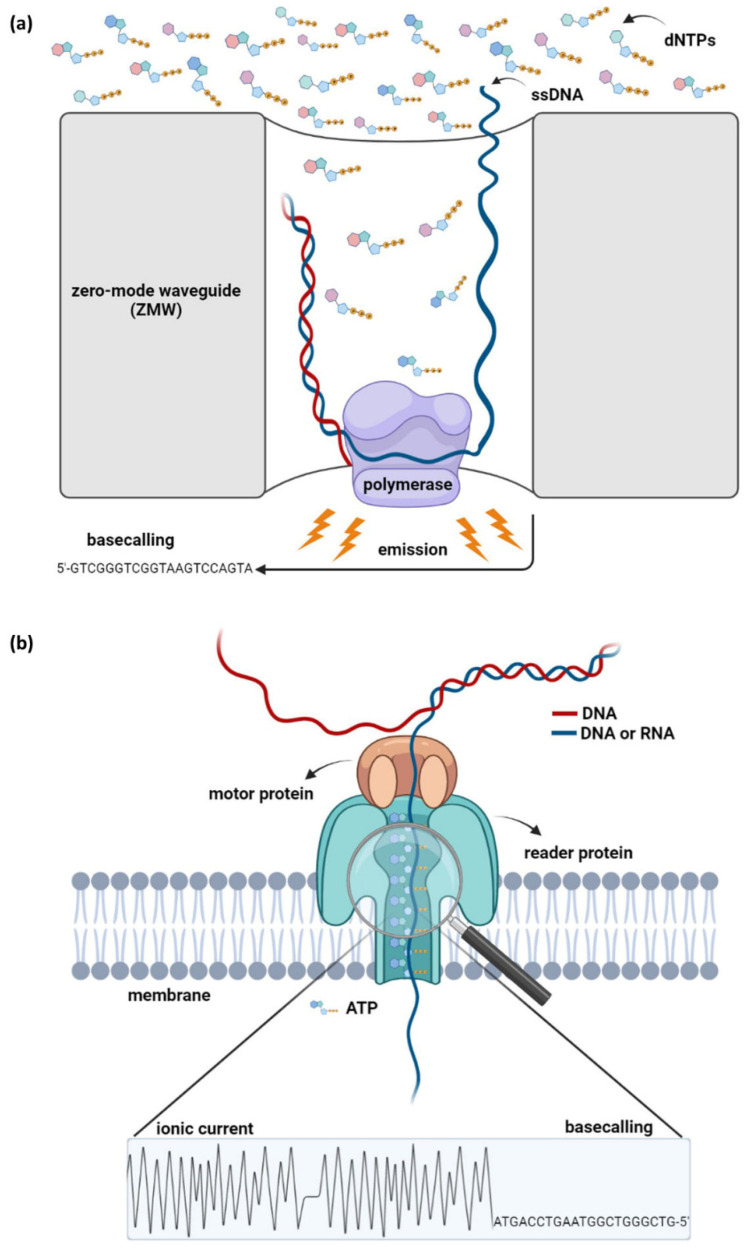
Scientific background of both third-generation sequencing technologies. (a) PacBio sequencing. The method is based on DNA sequencing by synthesis. The mobile single-stranded DNA is attached to the stable polymerase, which catalyzes the incorporation of dNTPs in a newly synthesized complementary DNA strand. The reaction occurs in specially designed zero-mode waveguides (ZMWs) that enable the observation of the emitted light. Afterwards, the signal is translated into nucleotide sequence, a procedure known as basecalling. (b) Nanopore sequencing. The method relies on the guidance of a single-stranded DNA or RNA molecule to a nanopore, a reader protein that detects alterations in the electrical current, which occurs during the passing through of the DNA/RNA.
Figure 3
Figure 3
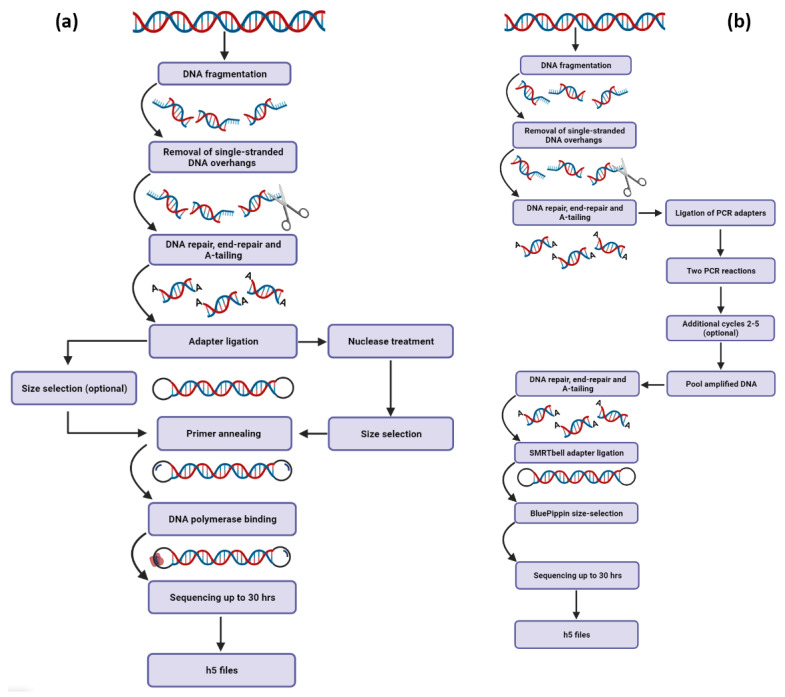
Schematic demonstration of PacBio’s main workflows for DNA sequencing. (a) The SMRTbell Express approach uses gDNA as a template for the construction of HiFi SMRTbell libraries that are ideal for variant detection and de novo assembly applications. When handling larger inserts, a permutation of the approach is suggested. An additional step that includes nuclease treatment is necessary for further DNA segmentation. (b) In cases of ultra-low DNA inputs, PCR reactions must be conducted to achieve higher quantity of the starting material.
Figure 4
Figure 4
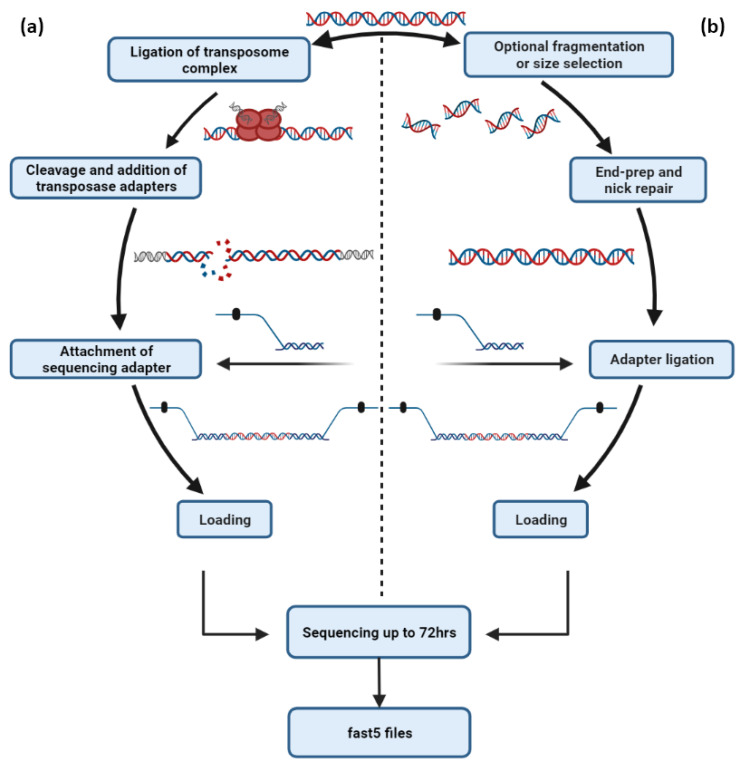
The most representative DNA-sequencing workflows of Oxford Nanopore Technologies. (a) For minimal library preparation time, ONT provides the Rapid Sequencing workflow, which exploits the innate qualities of transposase for the cleavage of genomic DNA and the subsequent adapter ligation. (b) For maximum throughput, ONT has developed the sequencing by ligation workflow, which includes DNA end repair and attachment of sequencing adapters for the sequencing of genomic DNA or specific amplicons.
Figure 5
Figure 5
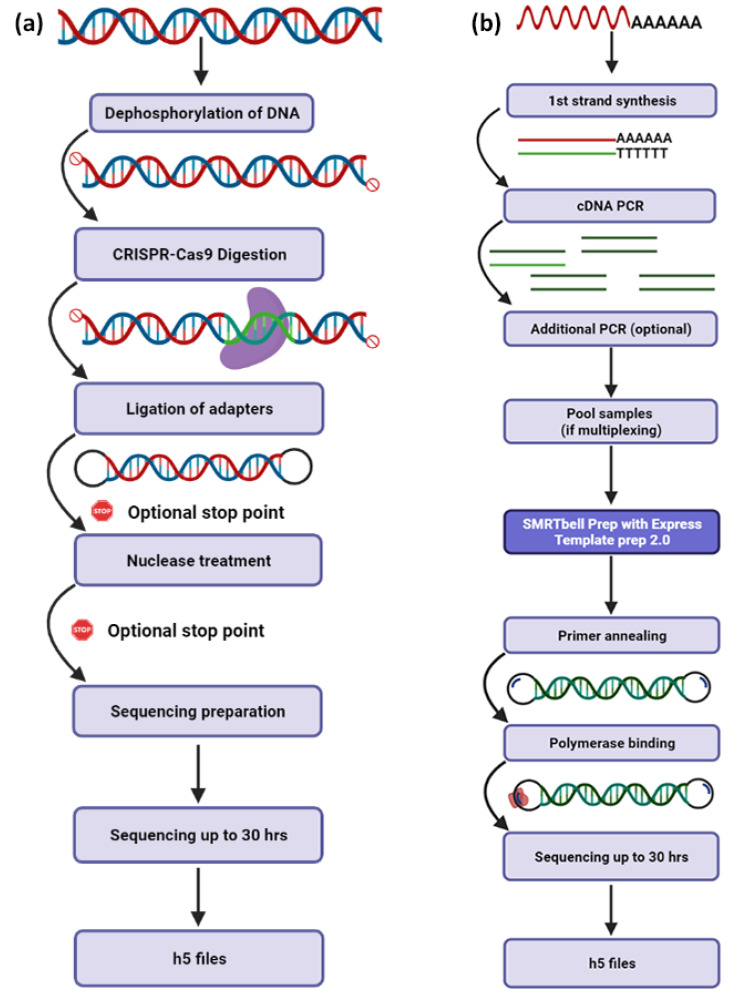
Schematic demonstration of fundamental workflows for PacBio’s libraries’ construction. (a) The process describes the sequencing of targeted regions of genomic DNA without the need of amplification. The innovation lies in the usage of the CRISPR-Cas9 system for template enrichment. (b) Iso-seq™ SMRTbell® workflow is designed to enable the characterization of full-length transcripts from total RNA. The procedure involves first-strand cDNA synthesis and PCR amplification, followed by the classic workflow for DNA sequencing library construction.
Figure 6
Figure 6
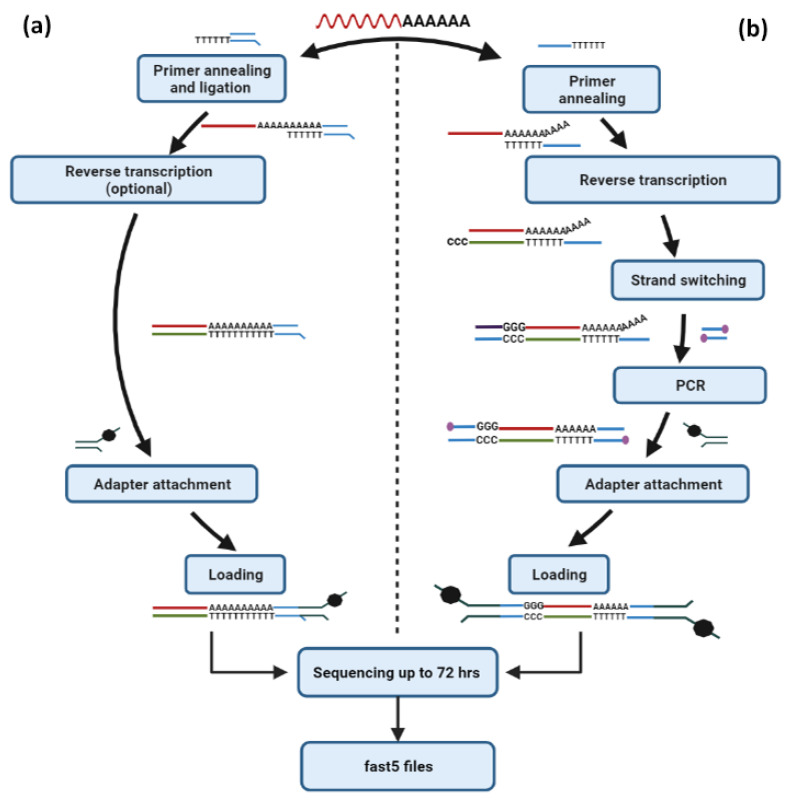
RNA-based sequencing protocols offered by Oxford Nanopore Technologies. (a) The Direct RNA sequencing approach enables the direct sequencing of RNA molecules without the need for amplification of the template and can be implemented with or without reverse transcription of the native RNA that is intended to be sequenced. (b) For high-throughput analysis of full-length transcripts, the PCR-cDNA sequencing approach is highly recommended, which requires poly A+ selected RNA as starting material and involves a reverse transcription step, cDNA amplification, adapter ligation and eventually sequencing.

References

    1. Sanger F., Coulson A.R. A rapid method for determining sequences in DNA by primed synthesis with DNA polymerase. J. Mol. Biol. 1975;94:441–448. doi: 10.1016/0022-2836(75)90213-2. - DOI - PubMed
    1. Sanger F., Nicklen S., Coulson A.R. DNA sequencing with chain-terminating inhibitors. Proc. Natl. Acad. Sci. USA. 1977;74:5463–5467. doi: 10.1073/pnas.74.12.5463. - DOI - PMC - PubMed
    1. Maxam A.M., Gilbert W. A new method for sequencing DNA. Proc. Natl. Acad. Sci. USA. 1977;74:560–564. doi: 10.1073/pnas.74.2.560. - DOI - PMC - PubMed
    1. Lander E.S., Linton L.M., Birren B., Nusbaum C., Zody M.C., Baldwin J., Devon K., Dewar K., Doyle M., FitzHugh W., et al. Initial sequencing and analysis of the human genome. Nature. 2001;409:860–921. doi: 10.1038/35057062. - DOI - PubMed
    1. Venter J.C., Adams M.D., Myers E.W., Li P.W., Mural R.J., Sutton G.G., Smith H.O., Yandell M., Evans C.A., Holt R.A., et al. The sequence of the human genome. Science. 2001;291:1304–1351. doi: 10.1126/science.1058040. - DOI - PubMed

LinkOut - more resources