. 2022 Jan 13;23(2):838.
doi: 10.3390/ijms23020838.

Computational Design of Miniproteins as SARS-CoV-2 Therapeutic Inhibitors

Affiliations

Computational Design of Miniproteins as SARS-CoV-2 Therapeutic Inhibitors

Bahaa Jawad et al. Int J Mol Sci. .

Abstract

A rational therapeutic strategy is urgently needed for combating SARS-CoV-2 infection. Viral infection initiates when the SARS-CoV-2 receptor-binding domain (RBD) binds to the ACE2 receptor, and thus, inhibiting RBD is a promising therapeutic for blocking viral entry. In this study, the structure of lead antiviral candidate binder (LCB1), which has three alpha-helices (H1, H2, and H3), is used as a template to design and simulate several miniprotein RBD inhibitors. LCB1 undergoes two modifications: structural modification by truncation of the H3 to reduce its size, followed by single and double amino acid substitutions to enhance its binding with RBD. We use molecular dynamics (MD) simulations supported by ab initio density functional theory (DFT) calculations. Complete binding profiles of all miniproteins with RBD have been determined. The MD investigations reveal that the H3 truncation results in a small inhibitor with a -1.5 kcal/mol tighter binding to RBD than original LCB1, while the best miniprotein with higher binding affinity involves D17R or E11V + D17R mutation. DFT calculations provide atomic-scale details on the role of hydrogen bonding and partial charge distribution in stabilizing the minibinder:RBD complex. This study provides insights into general principles for designing potential therapeutics for SARS-CoV-2.

Keywords: SARS-CoV-2; density functional calculation; miniprotein inhibitors modification; molecular dynamics simulation; therapeutics design.


Conflict of interest statement

The authors declare no conflict of interest.

Figures

Figure 1
Figure 1
Per-residue interaction spectrum of miniprotein:RBD complexes: (a,b) for M1-MD. (c,d) for M2-MD. The left panels are for RBD residues while the right panels are for miniprotein residues. The filled chart bars are for significant AAs (ΔGPer-residue ≤ −1 kcal/mol), while those with light color represent the favored AAs (ΔGPer-residue ≥ −1 to ≤ −0.15 kcal/mol). The unfilled bars are for unfavorably interacting AAs (ΔGPer-residue ≥ 0.15 kcal/mol).
Figure 2
Figure 2
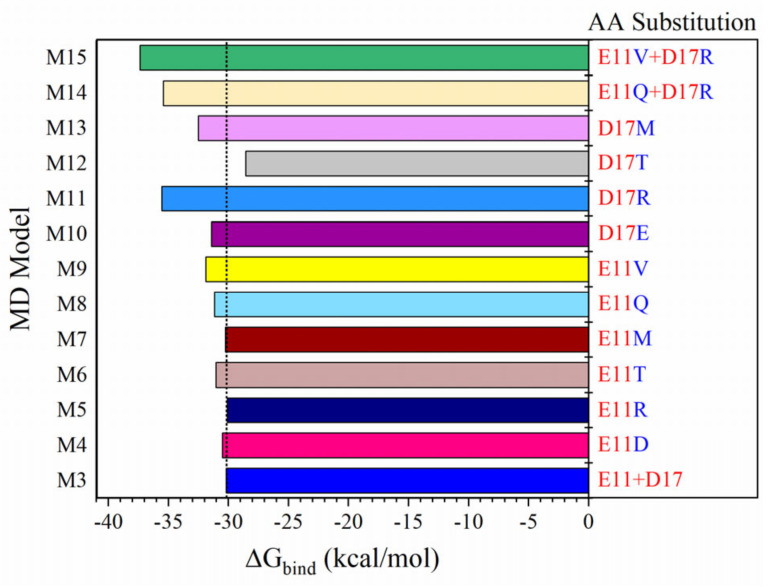
The impact of single and double AA substituting on the MP3 binding to RBD SARS-CoV-2. M3 used as a control. The residue positions that are replaced (in red letters) to other AAs (blue letters).
Figure 3
Figure 3
PC on the solvent excluded surface for (a) M3-DFT model (b,c) shows separated RBD with MP3, and (d,e) shows the rotated surface of RBD and MP3. Surface PC in the (f) M15-DFT model (g,h) shows separated RBD with MP15, and (i,j) shows rotated RBD and MP15. The color bar shows the total PC for different AAs from red (negative) to blue (positive). The navy blue and red AAs are identified and marked.
Figure 4
Figure 4
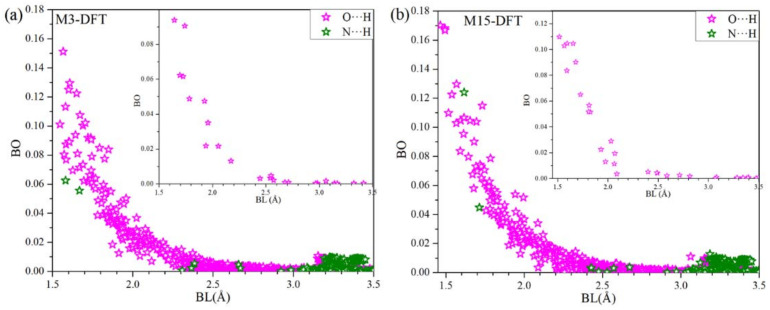
Hydrogen bonding distribution for the (a) M3-DFT and (b) M15-DFT. Inset: HBs between the respective RBD and miniprotein.
Figure 5
Figure 5
AA–AA interaction pair map between miniprotein and RBD of SARS-CoV-2 based on MD (a,b) and DFT (c,d) analysis. (a,b) AA–AA interacting pairs using pairwise BFE decomposition scheme for M3-MD (MP3:RBD) and M15-MD (MP15:RBD) models, respectively. (c,d) The AA–AA bond pair (AABP) for M3-DFT and M15-DFT models. Each square cell represents the intersection AA from RBD on the vertical axis and AA from miniprotein on the horizontal axis. These pairs have different strengths based on ΔGPair or AABP values.
Figure 6
Figure 6
Graphical illustration of models for miniprotein candidates in ribbon form to target RBD SARS-CoV-2. (a) Both LCB3 and LCB1 have three alpha-helices (H1, H2, and H3). The H3 of LCB1 is truncated to generate MP3 to reduce its size followed by AA substitutions at its residues 11 and 17. For AA substitutions, we created 10 different models for point mutations and two models for double mutation (see Table 1). (b) The solvated models of the bound miniprotein:RBD complex for MD (water represented by blue background). (c) The smaller DFT models (without water) built from MD models in (b) for MPs and small portion of RBD including only residues 401 to 508. For better visual clarity, the salt ions are hidden in (b,c).

References

    1. Jackson L.A., Anderson E.J., Rouphael N.G., Roberts P.C., Makhene M., Coler R.N., McCullough M.P., Chappell J.D., Denison M.R., Stevens L.J., et al. An mRNA Vaccine against SARS-CoV-2—Preliminary Report. N. Engl. J. Med. 2020;383:1920–1931. doi: 10.1056/NEJMoa2022483. - DOI - PMC - PubMed
    1. Tian J.-H., Patel N., Haupt R., Zhou H., Weston S., Hammond H., Logue J., Portnoff A.D., Norton J., Guebre-Xabier M., et al. SARS-CoV-2 spike glycoprotein vaccine candidate NVX-CoV2373 immunogenicity in baboons and protection in mice. Nat. Commun. 2021;12:372. doi: 10.1038/s41467-020-20653-8. - DOI - PMC - PubMed
    1. Vogel A.B., Kanevsky I., Che Y., Swanson K.A., Muik A., Vormehr M., Kranz L.M., Walzer K.C., Hein S., Güler A., et al. BNT162b vaccines protect rhesus macaques from SARS-CoV-2. Nature. 2021;592:283–289. doi: 10.1038/s41586-021-03275-y. - DOI - PubMed
    1. Panda P.K., Arul M.N., Patel P., Verma S.K., Luo W., Rubahn H.-G., Mishra Y.K., Suar M., Ahuja R. Structure-based drug designing and immunoinformatics approach for SARS-CoV-2. Sci. Adv. 2020;6:eabb8097. doi: 10.1126/sciadv.abb8097. - DOI - PMC - PubMed
    1. Kang Y.-F., Sun C., Zhuang Z., Yuan R.-Y., Zheng Q., Li J.-P., Zhou P.-P., Chen X.-C., Liu Z., Zhang X., et al. Rapid Development of SARS-CoV-2 Spike Protein Receptor-Binding Domain Self-Assembled Nanoparticle Vaccine Candidates. ACS Nano. 2021;15:2738–2752. doi: 10.1021/acsnano.0c08379. - DOI - PubMed

MeSH terms

Substances

LinkOut - more resources