. 2022 Jan 2;11(1):52.
doi: 10.3390/pathogens11010052.

Severe West Nile Virus Neuroinvasive Disease: Clinical Characteristics, Short- and Long-Term Outcomes

Affiliations

Severe West Nile Virus Neuroinvasive Disease: Clinical Characteristics, Short- and Long-Term Outcomes

Marija Santini et al. Pathogens. .

Abstract

West Nile Virus Neuroinvasive Disease (WNV NID) requires prolonged intensive care treatment, resulting in high mortality and early disability. Long-term results are lacking. We have conducted an observational retrospective study with a prospective follow-up of WNV NID patients treated at the Intensive Care Unit (ICU), University Hospital for Infectious Diseases, Zagreb, Croatia, 2013-2018. Short-term outcomes were vital status, length of stay (LOS), modified Rankin Scale (mRS), and disposition at discharge. Long-term outcomes were vital status and mRS at follow-up. Twenty-three patients were identified, 78.3% males, median age 72 (range 33-84) years. Two patients (8.7%) died in the ICU, with no lethal outcomes after ICU discharge. The median ICU LOS was 19 days (range 5-73), and the median hospital LOS was 34 days (range 7-97). At discharge, 15 (65.2%) patients had moderate to severe/mRS 3-5, 6 (26.0%) had slight disability/mRS 2-1, no patients were symptom-free/mRS 0. Ten (47.6%) survivors were discharged to rehabilitation facilities. The median time to follow-up was nine months (range 6-69). At follow-up, seven patients died (30.5%), five (21.7%) had moderate to severe/mRS 3-5, one (4.3%) had slight disability/mRS 2-1, six (26.1%) had no symptoms/mRS 0, and four (17.4%) were lost to follow-up. Briefly, ten (43.5%) survivors improved their functional status, one (4.3%) was unaltered, and one (4.3%) aggravated. In patients with severe WNV NID, intensive treatment in the acute phase followed by inpatient rehabilitation resulted in significant recovery of functional status after several months.

Keywords: West Nile virus; acute flaccid paralysis; critical care; encephalitis; modified Rankin scale; neuroinvasive disease; outcome; prognosis.


Conflict of interest statement

The authors declare no conflict of interest. The funders had no role in the design of the study; in the collection, analyses, or interpretation of data; in the writing of the manuscript; or in the decision to publish the results.

Figures
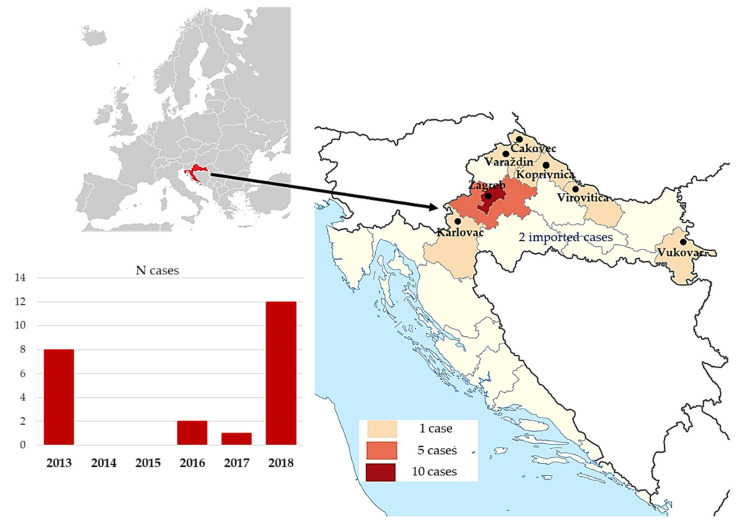
Figure 1
Figure 1
Distribution of patients with severe WNV NID in Croatia (2013–2018) according to year and geographic region.
Figure 2
Figure 2
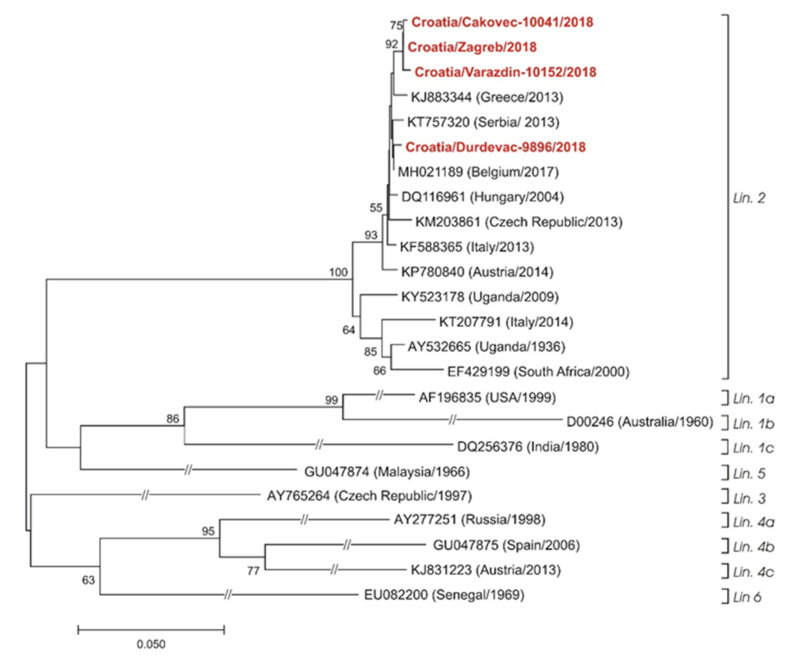
Phylogenetic neighbor-joining analysis of a 781-nucleotide fragment of the WNV NS5 gene (corresponding nucleotide positions 9076–9856 of the B956 strain, GenBank accession number AY532665) detected in patients with severe WNV NID in Croatia, 2018, and representative WNV strains. GenBank accession numbers, countries of origins, and isolation/detection years are indicated at the branches. Viruses from Croatia that were sequenced in this study are marked in bold and red color. WNV genetic lineages suggested by Rizzoli et al. (2015) [22] are indicated on the right. Lineage 7 could not be included in the analysis due to only partial sequence availability. Supporting (≥50%) bootstrap values of 1000 replicates are displayed at the nodes. Horizontal distances are proportional to genetic distance. Scale bar indicates nucleotide substitutions per site. The interrupted branches, indicated by double slashes, were shortened by 50% for better graphic representation.
Figure 3
Figure 3
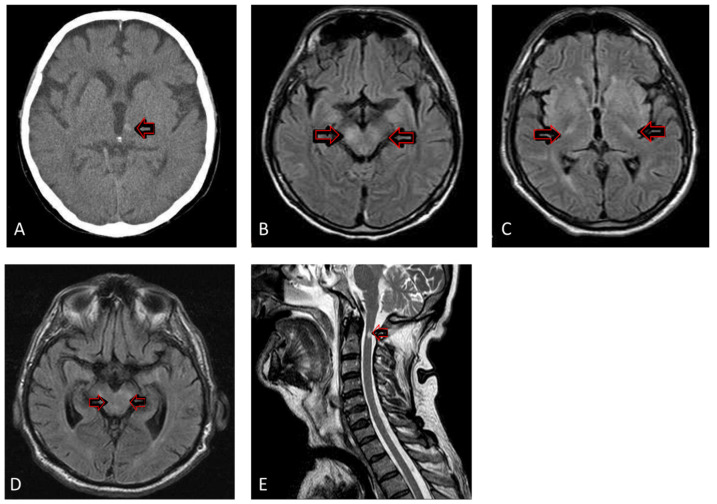
Selected brain and spinal cord Computer Tomography (CT) and Magnetic Resonance (MR) imaging in patients with severe WNV NID. (A): Native brain CT depicting a focal zone of haemorrhage in the left thalamus (arrow) (B): Brain MR in fluid attenuation inversion recovery (FLAIR) sequence in axial plane revealing hyperintense signal in crura cerebri (arrows) (C): Brain MR in FLAIR sequence in axial plane demonstrating high intensity signal in basal ganglia (arrows) (D): Brain MR in FLAIR sequence in axial plane displaying hyperintense signal in mesencephalon (arrows) (E): T2 weighted spinal MR, showing hyperintense signal in cervical spinal cord (arrow).
Figure 4
Figure 4
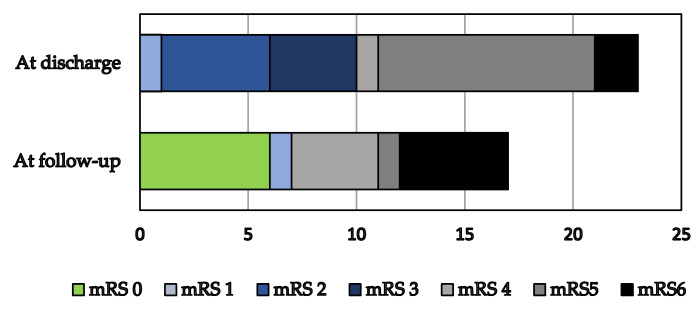
Outcomes at follow-up for 21 survivors. mRS Modified Rankin Scale: 0, no symptoms at all; 1, no significant disability despite symptoms, able to carry out all usual duties and activities; 2, slight disability, unable to carry out all previous activities, but able to look after own affairs without assistance; 3, moderate disability, requiring some help, but able to walk without assistance; 4, moderately severe disability, unable to walk without assistance, and unable to attend to own bodily needs without assistance; 5, severe disability, bedridden, incontinent, and requiring constant nursing care and attention; 6, death.

References

    1. Brown J.A., Factor D.L., Tkachenko N., Templeton S.M., Crall N.D., Pape W.J., Bauer M.J., Ambruso D.R., Dickey W.C., Marfin A.A. West Nile viremic blood donors and risk factors for subsequent West Nile fever. Vector-Borne Zoonotic Dis. 2007;7:479–488. doi: 10.1089/vbz.2006.0611. - DOI - PubMed
    1. Nash D., Mostashari F., Fine A., Miller J., O’Leary D., Murray K., Huang A., Rosenberg A., Greenberg A., Sherman M., et al. The outbreak of West Nile virus infection in the New York City area in 1999. N. Engl. J. Med. 2001;344:1807–1814. doi: 10.1056/NEJM200106143442401. - DOI - PubMed
    1. Orton S.L., Stramer S.L., Dodd R.Y. Self-reported symptoms associated with West Nile virus infection in RNA-positive blood donors. Transfusion. 2006;46:272–277. doi: 10.1111/j.1537-2995.2006.00710.x. - DOI - PubMed
    1. Zou S., Foster G.A., Dodd R.Y., Petersen L.R., Stramer S.L. West Nile fever characteristics among viremic persons identified through blood donor screening. J. Infect. Dis. 2010;202:1354–1361. doi: 10.1086/656602. - DOI - PubMed
    1. Weatherhead J.E., Miller V.E., Garcia M.N., Hasbun R., Salazar L., Dimachkie M.M., Murray K.O. Long-term neurological outcomes in West Nile virus-infected patients: An observational study. Am. J. Trop. Med. Hyg. 2015;92:1006–1012. doi: 10.4269/ajtmh.14-0616. - DOI - PMC - PubMed

LinkOut - more resources