


Next-Generation Sequencing-Based Study of Helicobacter pylori Isolates from Myanmar and Their Susceptibility to Antibiotics
- PMID: 35056645
- PMCID: PMC8781859
- DOI: 10.3390/microorganisms10010196
Next-Generation Sequencing-Based Study of Helicobacter pylori Isolates from Myanmar and Their Susceptibility to Antibiotics
Abstract
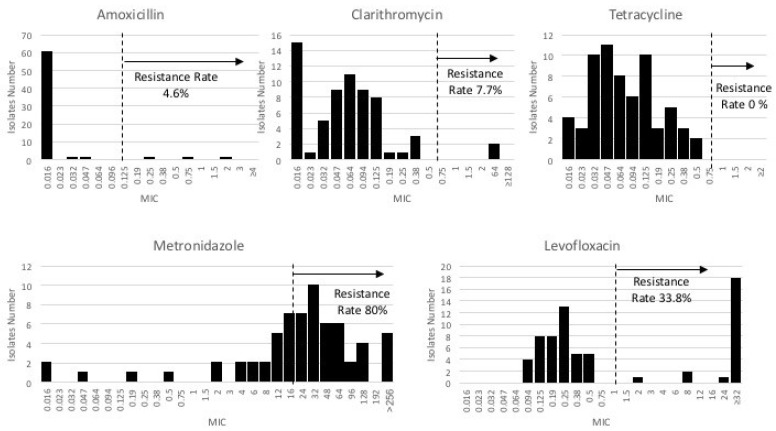
Evaluation of Helicobacter pylori resistance to antibiotics is crucial for treatment strategy in Myanmar. Moreover, the genetic mechanisms involved remain unknown. We aimed to investigate the prevalence of H. pylori infection, antibiotic resistance, and genetic mechanisms in Myanmar. One hundred fifty patients from two cities, Mawlamyine (n = 99) and Yangon (n = 51), were recruited. The prevalence of H. pylori infection was 43.3% (65/150). The successfully cultured H. pylori isolates (n = 65) were tested for antibiotic susceptibility to metronidazole, levofloxacin, clarithromycin, amoxicillin, and tetracycline by Etest, and the resistance rates were 80%, 33.8%, 7.7%, 4.6%, and 0%, respectively. In the multidrug resistance pattern, the metronidazole-levofloxacin resistance was highest for double-drug resistance (16/19; 84.2%), and all triple-drug resistance (3/3) was clarithromycin-metronidazole-levofloxacin resistance. Twenty-three strains were subjected to next-generation sequencing to study their genetic mechanisms. Interestingly, none of the strains resistant to clarithromycin had well-known mutations in 23S rRNA (e.g., A2142G, A2142C, and A2143G). New type mutation genotypes such as pbp1-A (e.g., V45I, S/R414R), 23S rRNA (e.g., T248C), gyrA (e.g., D210N, K230Q), gyrB (e.g., A584V, N679H), rdxA (e.g., V175I, S91P), and frxA (e.g., L33M) were also detected. In conclusion, the prevalence of H. pylori infection and its antibiotic resistance to metronidazole was high in Myanmar. The H. pylori eradication regimen with classical triple therapy, including amoxicillin and clarithromycin, can be used as the first-line therapy in Myanmar. In addition, next-generation sequencing is a powerful high-throughput method for identifying mutations within antibiotic resistance genes and monitoring the spread of H. pylori antibiotic-resistant strains.
Keywords: Helicobacter pylori; amoxicillin; antibiotic resistance; clarithromycin; infectious disease; levofloxacin; mutations; next-generation sequencing.
Conflict of interest statement
The authors declare no conflict of interest. The funders had no role in the design of the study; in the collection, analyses, or interpretation of data; in the writing of the manuscript, or in the decision to publish the results.
Figures

References
-
- Hooi J.K.Y., Lai W.Y., Ng W.K., Suen M.M.Y., Underwood F.E., Tanyingoh D., Malfertheiner P., Graham D.Y., Wong V.W.S., Wu J.C.Y., et al. Global prevalence of Helicobacter pylori infection: Systematic review and meta-analysis. Gastroenterology. 2017;153:420–429. doi: 10.1053/j.gastro.2017.04.022. - DOI - PubMed
-
- Moayyedi P., Axon A.T.R., Feltbower R., Duffett S., Crocombe W., Braunholtz D., Richards I.D.G., Dowell A.C., Forman D. Relation of adult lifestyle and socioeconomic factors to the prevalence of Helicobacter pylori infection. Int. J. Epidemiol. 2002;31:624–631. doi: 10.1093/ije/31.3.624. - DOI - PubMed
Grants and funding
- DK62813/NH/NIH HHS/United States
- 221S0002/Ministry of Education, Culture, Sports, Science and Technology
- 16H06279/Ministry of Education, Culture, Sports, Science and Technology
- 18KK0266/Ministry of Education, Culture, Sports, Science and Technology
- 19H03473/Ministry of Education, Culture, Sports, Science and Technology
LinkOut - more resources
Full Text Sources
