Review
. 2021 Dec 21;14(1):11.
doi: 10.3390/pharmaceutics14010011.

Klotho and Mesenchymal Stem Cells: A Review on Cell and Gene Therapy for Chronic Kidney Disease and Acute Kidney Disease

Affiliations
Review

Klotho and Mesenchymal Stem Cells: A Review on Cell and Gene Therapy for Chronic Kidney Disease and Acute Kidney Disease

Marcella Liciani Franco et al. Pharmaceutics. .

Abstract

Chronic kidney disease (CKD) and acute kidney injury (AKI) are public health problems, and their prevalence rates have increased with the aging of the population. They are associated with the presence of comorbidities, in particular diabetes mellitus and hypertension, resulting in a high financial burden for the health system. Studies have indicated Klotho as a promising therapeutic approach for these conditions. Klotho reduces inflammation, oxidative stress and fibrosis and counter-regulates the renin-angiotensin-aldosterone system. In CKD and AKI, Klotho expression is downregulated from early stages and correlates with disease progression. Therefore, the restoration of its levels, through exogenous or endogenous pathways, has renoprotective effects. An important strategy for administering Klotho is through mesenchymal stem cells (MSCs). In summary, this review comprises in vitro and in vivo studies on the therapeutic potential of Klotho for the treatment of CKD and AKI through the administration of MSCs.

Keywords: Klotho; acute kidney injury; chronic kidney disease; mesenchymal stem cells.


Conflict of interest statement

The authors declare no conflict of interest.

Figures
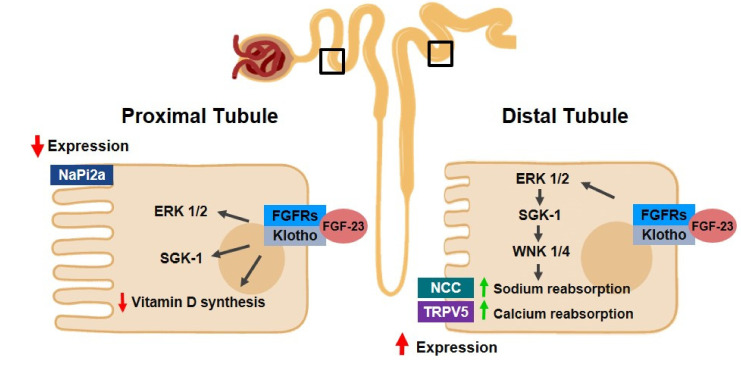
Figure 1
Figure 1
Klotho and FGF23 in mineral homeostasis in kidneys. In proximal tubules, the Klotho/fibroblast growth-factor (FGF) 23/fibroblast growth factor receptors (FGFRs) complex activates extracellular signal-regulated kinase (ERK) 1/2, serum/glucocorticoid-regulated kinase (SGK)-1 and with no lysine kinase (WNK) 1/4 pathways, which results in the reduction of the expression of sodium phosphate co-transporter (NaPi2a), leading to phosphaturia. In distal tubules, in turn, the same complex and signaling pathways are activated and this results in an increase in sodium chloride cotransporter (NCC) and transient receptor potential cation channel subfamily V member 5 (TRPV5) channels, which contributes to increases in both sodium and calcium reabsorption, respectively.
Figure 2
Figure 2
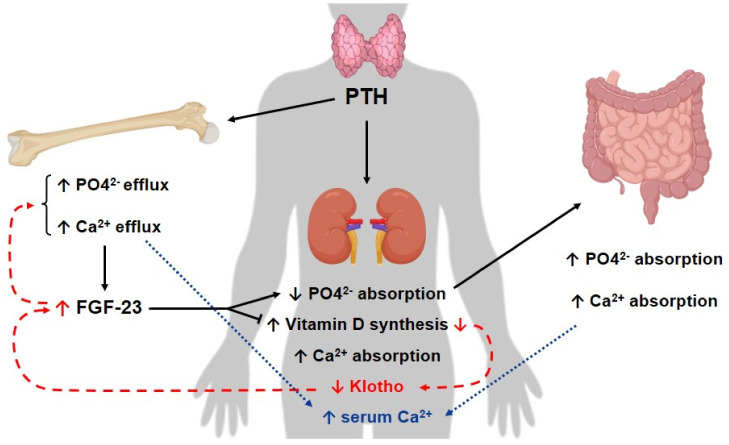
Klotho/FGF and PTH axis in CKD. In kidneys, parathyroid hormone (PTH) leads to an increase in calcium (Ca2+) absorption and Vitamin D synthesis, whereas it diminishes phosphorus absorption. On the other hand, PTH stimulates both phosphorus and calcium efflux in bones. In turn, PTH-stimulated Vitamin D production increases the gastrointestinal reabsorption of these minerals. As a result, both gastrointestinal calcium reabsorption and its efflux from bones contribute to a rise in calcium excretion. Phosphorus (PO42) is also eliminated as a consequence. In chronic kidney disease (CKD) (red dotted line), there is a reduction in Klotho expression, alongside a decrease in Vitamin D levels and an increase in fibroblast growth factor (FGF-)23 levels. It is important to mention that the decrease of Vitamin D is related to the decrease of Klotho in the kidneys, which then leads to a rise in FGF-23 levels in the bones. As a consequence, this hormone diminishes Vitamin D production. As a result of this axis dysregulation, the inhibition of PTH synthesis promoted by these components is lost, which leads to a rise in the levels of this hormone, which also contributes to the elevation of these molecules. Secondary hyperparathyroidism associated with CKD might be a result of the described imbalance in this axis for CKD patients.
Figure 3
Figure 3
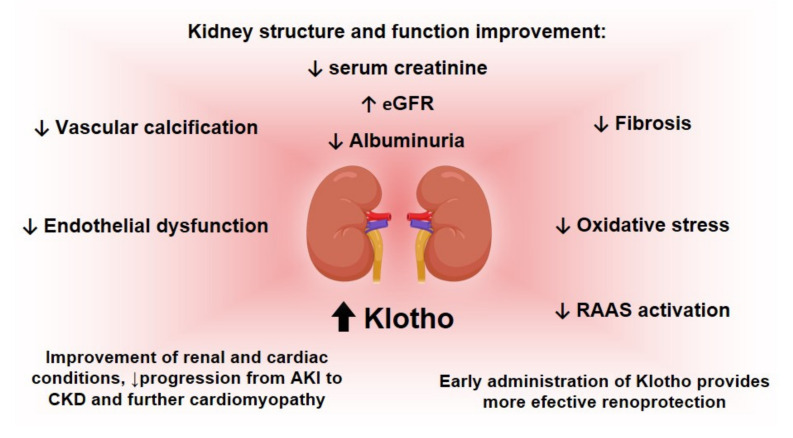
Renal benefits after restoration of Klotho levels. The figure shows some of the benefits for kidneys obtained with the reestablishment of Klotho levels, concerning the progression of acute kidney disease (AKI) and chronic kidney disease (CKD) and other phenotypes associated with these diseases. Klotho ameliorates processes involved in the advancement of renal diseases, such as the inhibition of the renin-aldosterone-angiotensin system (RAAS), fibrosis and oxidative stress. In addition, Klotho also reduces vascular calcification and vascular dysfunction and it promotes the improvement of renal structural and functional conditions, such as an increase in the estimated glomerular filtration rate (eGFR) and a decrease in serum creatinine.
Figure 4
Figure 4
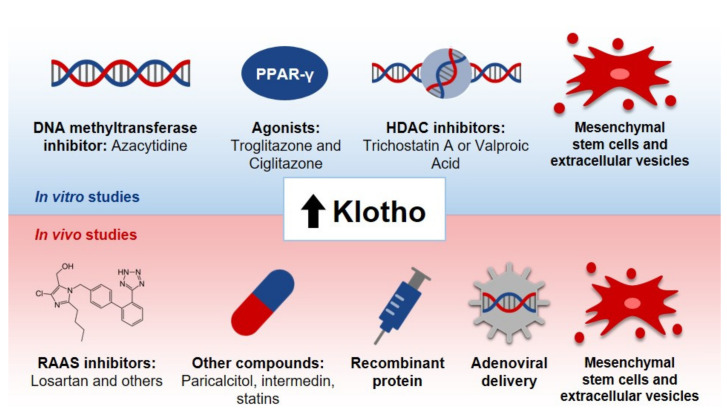
Possible therapeutic approaches for the restoration of Klotho levels. The figure summarizes some of the potential strategies to increase Klotho levels, considering both endogenous and exogenous alternatives for that purpose, as reviewed by Buchanan, et al. [2].
Figure 5
Figure 5
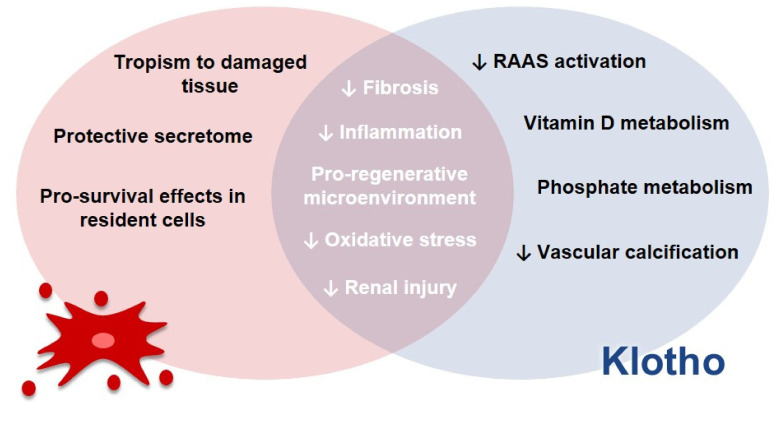
Synergism between mesenchymal stem cells (MSCs) and Klotho. We speculate, based on data in the literature, that, in vivo, the properties of MSCs, such as tropism to damaged tissues, their protective secretome and pro-survival effects in resident cells, would act alongside the beneficial effects of Klotho, such as its reduction of renin-angiotensin-aldosterone-system (RAAS) activation, its influence on vitamin D and phosphate metabolism and the reduction in vascular calcification, As a result, there would be reduction in fibrosis and inflammation, improvement of pro-regenerative conditions for the damaged tissue, as well as a reduction in oxidative stress and renal injury in general.

References

    1. Kuro-O M., Matsumura Y., Aizawa H., Kawaguchi H., Suga T., Utsugi T., Ohyama Y., Kurabayashi M., Kaname T., Kume E., et al. Mutation of the mouse klotho gene leads to a syndrome resembling ageing. Nature. 1997;390:45–51. doi: 10.1038/36285. - DOI - PubMed
    1. Buchanan S., Combet E., Stenvinkel P., Shiels P.G. Klotho, Aging, and the Failing Kidney. Front. Endocrinol. 2020;11:560. doi: 10.3389/fendo.2020.00560. - DOI - PMC - PubMed
    1. Lanzani C., Citterio L., Vezzoli G. Klotho: A link between cardiovascular and non-cardiovascular mortality. Clin. Kidney J. 2020;13:926–932. doi: 10.1093/ckj/sfaa100. - DOI - PMC - PubMed
    1. Bloch L., Sineshchekova O., Reichenbach D., Reiss K., Saftig P., Kuro-O M., Kaether C. Klotho is a substrate for α-, β- and γ-secretase. FEBS Lett. 2009;583:3221–3224. doi: 10.1016/j.febslet.2009.09.009. - DOI - PMC - PubMed
    1. Chen C.-D., Podvin S., Gillespie E., Leeman S.E., Abraham C.R. Insulin stimulates the cleavage and release of the extracellular domain of Klotho by ADAM10 and ADAM17. Proc. Natl. Acad. Sci. USA. 2007;104:19796–19801. doi: 10.1073/pnas.0709805104. - DOI - PMC - PubMed

LinkOut - more resources