Review
. 2021 Dec 22;14(1):18.
doi: 10.3390/pharmaceutics14010018.

An Up-to-Date Review of Natural Nanoparticles for Cancer Management

Affiliations
Review

An Up-to-Date Review of Natural Nanoparticles for Cancer Management

Daniel Ion et al. Pharmaceutics. .

Abstract

Cancer represents one of the leading causes of morbidity and mortality worldwide, imposing an urgent need to develop more efficient treatment alternatives. In this respect, much attention has been drawn from conventional cancer treatments to more modern approaches, such as the use of nanotechnology. Extensive research has been done for designing innovative nanoparticles able to specifically target tumor cells and ensure the controlled release of anticancer agents. To avoid the potential toxicity of synthetic materials, natural nanoparticles started to attract increasing scientific interest. In this context, this paper aims to review the most important natural nanoparticles used as active ingredients (e.g., polyphenols, polysaccharides, proteins, and sterol-like compounds) or as carriers (e.g., proteins, polysaccharides, viral nanoparticles, and exosomes) of various anticancer moieties, focusing on their recent applications in treating diverse malignancies.

Keywords: chemotherapeutic agents targeted delivery; natural anticancer compounds; natural cancer therapies; natural nanocarriers; natural nanoparticles; novel cancer treatment alternatives.


Conflict of interest statement

The authors declare no conflict of interest.

Figures

Figure 1
Figure 1
Limitations of conventional cancer treatment strategies. Created based on information from [13,20,21,22,23,24,25].
Figure 2
Figure 2
NPs roles in regulating TME and improving tumor immunotherapy. Created based on information from [1,30,34,35,36]. Abbreviations: APCs—antigen-presenting cells; DCs—dendritic cells; TME—tumor microenvironment; ECM—extracellular matrix; MHC—major histocompatibility complex; CTL—cytotoxic T lymphocyte.
Figure 3
Figure 3
Polyphenols classification and examples. Created based on information from [44,45,46].
Figure 4
Figure 4
Baicalein anticancer activity by binding to and interacting with specific cellular targets. Reprinted from an open-access source [63].
Figure 5
Figure 5
EGCG delivery possibilities for cancer therapy: (1) incorporation of ligands on NPs surface for specific targeting of cancer cell receptors or antigens; (2) EGCG used as a capping agent; (3) surface functionalization with polymers for improving drug release, cellular uptake, and intestinal absorption; (4) co-encapsulation with conventional chemotherapeutic agents. Reprinted from an open-access source [66].
Figure 6
Figure 6
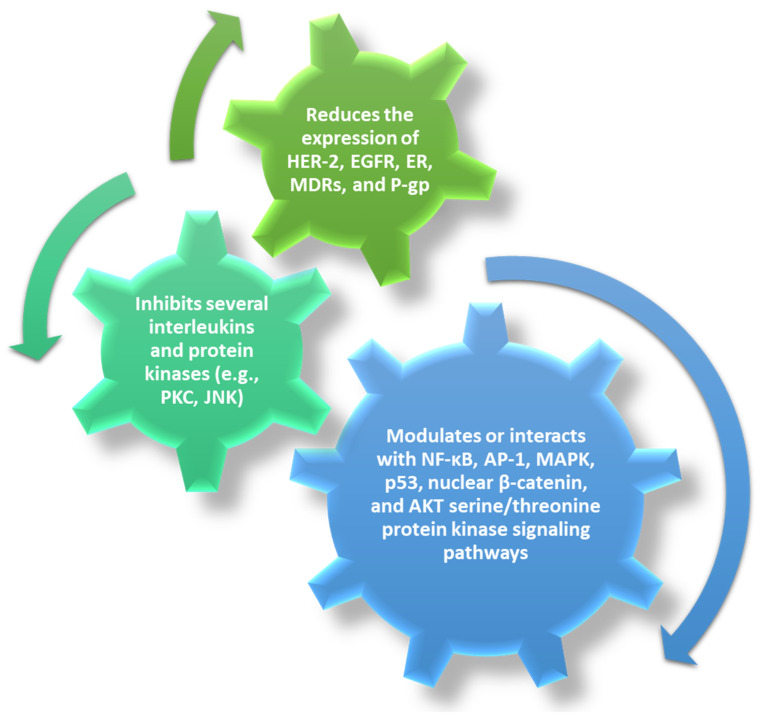
Anticancer effects of curcumin. Created based on information from [39,97].
Figure 7
Figure 7
Overview of the main discussed categories of natural nanocarriers for cancer management.

References

    1. Gao S., Yang D., Fang Y., Lin X., Jin X., Wang Q., Wang X., Ke L., Shi K. Engineering Nanoparticles for Targeted Remodeling of the Tumor Microenvironment to Improve Cancer Immunotherapy. Theranostics. 2019;9:126–151. doi: 10.7150/thno.29431. - DOI - PMC - PubMed
    1. Davatgaran-Taghipour Y., Masoomzadeh S., Farzaei M.H., Bahramsoltani R., Karimi-Soureh Z., Rahimi R., Abdollahi M. Polyphenol nanoformulations for cancer therapy: Experimental evidence and clinical perspective. Int. J. Nanomed. 2017;12:2689–2702. doi: 10.2147/IJN.S131973. - DOI - PMC - PubMed
    1. Sayiner M., Golabi P., Younossi Z.M. Disease Burden of Hepatocellular Carcinoma: A Global Perspective. Dig. Dis. Sci. 2019;64:910–917. doi: 10.1007/s10620-019-05537-2. - DOI - PubMed
    1. Bray F., Ferlay J., Soerjomataram I., Siegel R.L., Torre L.A., Jemal A. Global cancer statistics 2018: GLOBOCAN estimates of incidence and mortality worldwide for 36 cancers in 185 countries. CA Cancer J. Clin. 2018;68:394–424. doi: 10.3322/caac.21492. - DOI - PubMed
    1. Arifin M.Z., Parikesit A.A., Agustriawan D. Molecular simulation oF MDM2 and E6AP proteins as P53 regulator in cervical cancer. Biointerface Res. Appl. Chem. 2020;10:5875–5879. doi: 10.33263/BRIAC104.875879. - DOI

LinkOut - more resources