. 2022 Jan 20;22(1):67.
doi: 10.1186/s12879-022-07043-9.

Spatiotemporal prediction of vancomycin-resistant Enterococcus colonisation

Affiliations

Spatiotemporal prediction of vancomycin-resistant Enterococcus colonisation

J M van Niekerk et al. BMC Infect Dis. .

Abstract

Background: Vancomycin-resistant enterococci (VRE) is the cause of severe patient health and monetary burdens. Antibiotic use is a confounding effect to predict VRE in patients, but the antibiotic use of patients who may have frequented the same ward as the patient in question is often neglected. This study investigates how patient movements between hospital wards and their antibiotic use can explain the colonisation of patients with VRE.

Methods: Intrahospital patient movements, antibiotic use and PCR screening data were used from a hospital in the Netherlands. The PageRank algorithm was used to calculate two daily centrality measures based on the spatiotemporal graph to summarise the flow of patients and antibiotics at the ward level. A decision tree model was used to determine a simple set of rules to estimate the daily probability of patient VRE colonisation for each hospital ward. The model performance was improved using a random forest model and compared using 30% test sample.

Results: Centrality covariates summarising the flow of patients and their antibiotic use between hospital wards can be used to predict the daily colonisation of VRE at the hospital ward level. The decision tree model produced a simple set of rules that can be used to determine the daily probability of patient VRE colonisation for each hospital ward. An acceptable area under the ROC curve (AUC) of 0.755 was achieved using the decision tree model and an excellent AUC of 0.883 by the random forest model on the test set. These results confirms that the random forest model performs better than a single decision tree for all levels of model sensitivity and specificity on data not used to estimate the models.

Conclusion: This study showed how the movements of patients inside hospitals and their use of antibiotics could predict the colonisation of patients with VRE at the ward level. Two daily centrality measures were proposed to summarise the flow of patients and antibiotics at the ward level. An early warning system for VRE can be developed to test and further develop infection prevention plans and outbreak strategies using these results.

Keywords: Centrality measure; Dynamic directed spatiotemporal graph; Healthcare decision support; Intrahospital patient movements; Spatiotemporal risk factors; Vancomycin-resistant enterococci.


Conflict of interest statement

The authors declare that they do not have any conflict of interest.

Figures

Fig. 1
Fig. 1
VRE tests and the number of positive VRE test results during 2018–2019
Fig. 2
Fig. 2
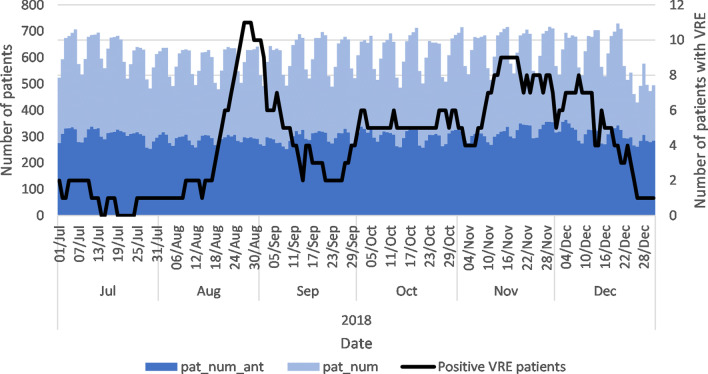
Number of patient and patients using antibiotics. pat_num_ant = the number of patients using antibiotics in each ward; pat_num = the number of patients in each ward
Fig. 3
Fig. 3
Number of patient and patients using antibiotics in example general care ward. pat_num_ant = the number of patients using antibiotics in each ward; pat_num = the number of patients in each ward
Fig. 4
Fig. 4
Average daily PageRank covariate and the number of VRE positive patients. PR_pat_num = PageRank of patient movements between wards; PR_pat_num_ant = PageRank of patient movements using antibiotics
Fig. 5
Fig. 5
Average daily PageRank covariate and the number of VRE positive patients in example ward general care ward. PR_pat_num = PageRank of patient movements between wards; PR_pat_num_ant = PageRank of patient movements using antibiotics
Fig. 6
Fig. 6
Decision tree for the daily VRE colonisation in a hospital ward using PageRank and traditional covariates. pat_num_ant = the number of patients using antibiotics in each ward; PR_pat_num_ant = PageRank of patient movements currently using antibiotics; PR_pat_num = PageRank of patient movements between wards. In each node, the percentage of wards with at least one patient colonised with VRE is shown above the sample distribution of the node
Fig. 7
Fig. 7
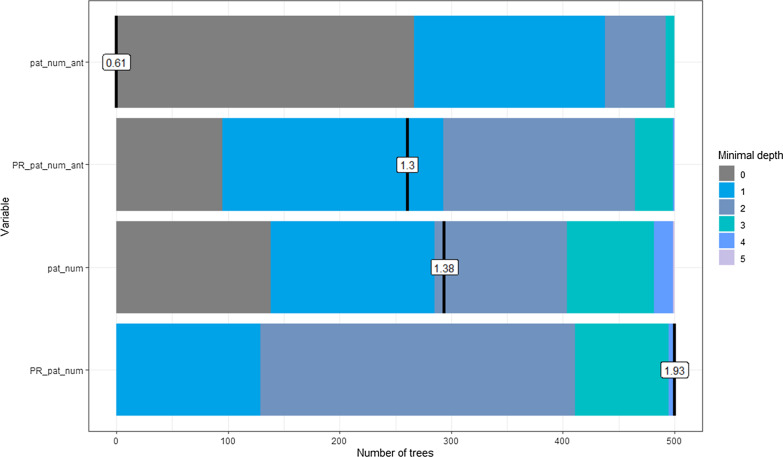
Minimal depth for each covariate in the 500 random forest decision trees. pat_num_ant = the number of patients using antibiotics in each ward; PR_pat_num_ant = PageRank of patient movements currently using antibiotics; pat_num = the number of patients in each ward; PR_pat_num = PageRank of patient movements between wards
Fig. 8
Fig. 8
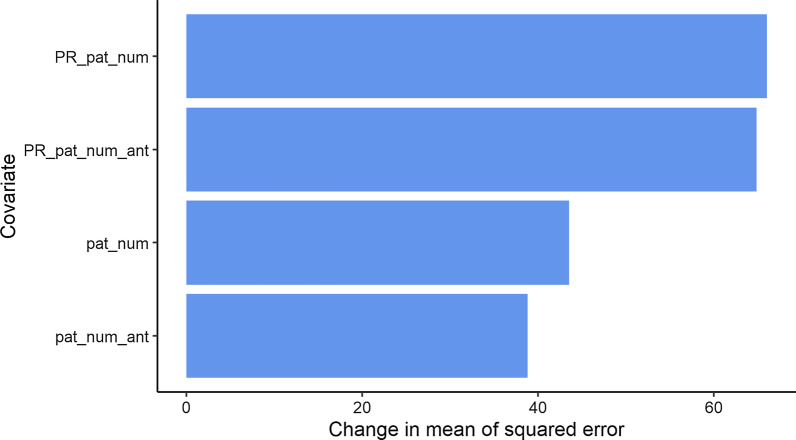
The change in mean squared error when covariate values are replaced with random values. PR_pat_num = PageRank of patient movements between wards; PR_pat_num_ant = PageRank of patient movements currently using antibiotics; pat_num = the number of patients in each ward; pat_num_ant = the number of patients using antibiotics in each ward
Fig. 9
Fig. 9
The change in residual sum of squares when covariate values are replaced with random values. PR_pat_num_ant = PageRank of patient movements currently using antibiotics; PR_pat_num = PageRank of patient movements between wards; pat_num_ant = the number of patients using antibiotics in each ward; pat_num = the number of patients in each ward
Fig. 10
Fig. 10
Lorenz curves of the decision tree and random forest models

References

    1. O’Driscoll T, Crank CW. Vancomycin-resistant enterococcal infections: epidemiology, clinical manifestations, and optimal management. Infect Drug Resist. 2015;8:217–230. - PMC - PubMed
    1. Datta R, Juthani-Mehta M. Burden and management of multidrug-resistant organisms in palliative care. Palliative Care. 2017 doi: 10.1177/1178224217749233. - DOI - PMC - PubMed
    1. Satilmis L, Vanhems P, Bénet T. Outbreaks of Vancomycin-resistant enterococci in hospital settings: a systematic review and calculation of the basic reproductive number. Infect Control Hosp Epidemiol. 2015;37(3):289–294. doi: 10.1017/ice.2015.301. - DOI - PubMed
    1. Mutters NT, Mersch-Sundermann V, Mutters R, Brandt C, Schneider-Brachert W, Frank U. Control of the spread of vancomycin-resistant enterococci in hospitals: epidemiology and clinical relevance. Deutsches Arzteblatt Int. 2013;110(43):725–732. - PMC - PubMed
    1. García Martínez de Artola D, Castro B, Ramos MJ, Díaz Cuevas Z, Lakhwani S, Lecuona M. Outbreak of vancomycin-resistant enterococcus on a haematology ward: management and control. J Infect Prevent. 2017;18(3):149–153. doi: 10.1177/1757177416687832. - DOI - PMC - PubMed

MeSH terms

LinkOut - more resources