


The source and fate of Mycobacterium tuberculosis complex in wastewater and possible routes of transmission
- PMID: 35057793
- PMCID: PMC8781043
- DOI: 10.1186/s12889-022-12527-z
The source and fate of Mycobacterium tuberculosis complex in wastewater and possible routes of transmission
Abstract
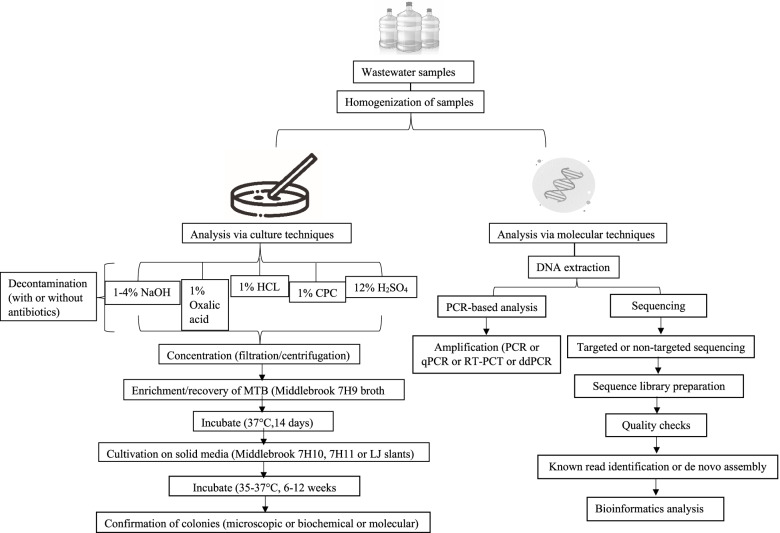
Background: The Mycobacterium tuberculosis complex (MTBC) consists of causative agents of both human and animal tuberculosis and is responsible for over 10 million annual infections globally. Infections occur mainly through airborne transmission, however, there are possible indirect transmissions through a faecal-oral route which is poorly reported. This faecal-oral transmission could be through the occurrence of the microbe in environments such as wastewater. This manuscript, therefore, reviews the source and fate of MTBC in the wastewater environment, including the current methods in use and the possible risks of infections.
Results: The reviewed literature indicates that about 20% of patients with pulmonary TB may have extra-pulmonary manifestations such as GITB, resulting in shedding in feaces and urine. This could potentially be the reason for the detection of MTBC in wastewater. MTBC concentrations of up to 5.5 × 10⁵ (±3.9 × 10⁵) copies/L of untreated wastewater have been reported. Studies have indicated that wastewater may provide these bacteria with the required nutrients for their growth and could potentially result in environmental transmission. However, 98.6 (± 2.7) %, removal during wastewater treatment, through physical-chemical decantation (primary treatment) and biofiltration (secondary treatment) has been reported. Despite these reports, several studies observed the presence of MTBC in treated wastewater via both culture-dependent and molecular techniques.
Conclusion: The detection of viable MTBC cells in either treated or untreated wastewater, highlights the potential risks of infection for wastewater workers and communities close to these wastewater treatment plants. The generation of aerosols during wastewater treatment could be the main route of transmission. Additionally, direct exposure to the wastewater containing MTBC could potentially contribute to indirect transmissions which may lead to pulmonary or extra-pulmonary infections. This calls for the implementation of risk reduction measures aimed at protecting the exposed populations.
Keywords: Environment; Mycobacterium tuberculosis complex (MTBC); Sewage; Wastewater.
© 2022. The Author(s).
Conflict of interest statement
No competing interests to declare.
Figures
Similar articles
-
Unlocking environmental contamination of animal tuberculosis hotspots with viable mycobacteria at the intersection of flow cytometry, PCR, and ecological modelling.Sci Total Environ. 2023 Sep 15;891:164366. doi: 10.1016/j.scitotenv.2023.164366. Epub 2023 May 26. Sci Total Environ. 2023. PMID: 37245818
-
Mapping high-risk areas for Mycobacterium tuberculosis complex bacteria transmission: Linking host space use and environmental contamination.Sci Total Environ. 2024 Nov 25;953:176053. doi: 10.1016/j.scitotenv.2024.176053. Epub 2024 Sep 5. Sci Total Environ. 2024. PMID: 39244050
-
Molecular surveillance of tuberculosis-causing mycobacteria in wastewater.Heliyon. 2022 Feb 4;8(2):e08910. doi: 10.1016/j.heliyon.2022.e08910. eCollection 2022 Feb. Heliyon. 2022. PMID: 35198775 Free PMC article.
-
Human tuberculosis and Mycobacterium tuberculosis complex: A review on genetic diversity, pathogenesis and omics approaches in host biomarkers discovery.Microbiol Res. 2021 May;246:126674. doi: 10.1016/j.micres.2020.126674. Epub 2021 Jan 29. Microbiol Res. 2021. PMID: 33549960 Review.
-
Epidemiology of Tuberculosis in Multi-Host Wildlife Systems: Implications for Black (Diceros bicornis) and White (Ceratotherium simum) Rhinoceros.Front Vet Sci. 2020 Nov 4;7:580476. doi: 10.3389/fvets.2020.580476. eCollection 2020. Front Vet Sci. 2020. PMID: 33330701 Free PMC article. Review.
Cited by
-
Antimicrobial Resistance in Aquaculture Environments: Unravelling the Complexity and Connectivity of the Underlying Societal Drivers.Environ Sci Technol. 2022 Nov 1;56(21):14891-14903. doi: 10.1021/acs.est.2c00799. Epub 2022 Sep 14. Environ Sci Technol. 2022. PMID: 36102785 Free PMC article.
-
Evidence of Mycobacterium bovis DNA in shared water sources at livestock-wildlife-human interfaces in KwaZulu-Natal, South Africa.Front Vet Sci. 2025 Feb 28;12:1483162. doi: 10.3389/fvets.2025.1483162. eCollection 2025. Front Vet Sci. 2025. PMID: 40093619 Free PMC article.
-
Metagenomic next-generation sequencing for Mycobacterium tuberculosis complex detection: a meta-analysis.Front Public Health. 2023 Aug 11;11:1224993. doi: 10.3389/fpubh.2023.1224993. eCollection 2023. Front Public Health. 2023. PMID: 37637815 Free PMC article. Review.
-
Tuberculosis prevention: current strategies and future directions.Clin Microbiol Infect. 2024 Sep;30(9):1123-1130. doi: 10.1016/j.cmi.2023.10.023. Epub 2023 Oct 31. Clin Microbiol Infect. 2024. PMID: 37918510 Free PMC article. Review.
-
The Impact of Tetracycline on the Soil Microbiome and the Rhizosphere of Lettuce (Lactuca sativa L.).Int J Mol Sci. 2025 Mar 21;26(7):2854. doi: 10.3390/ijms26072854. Int J Mol Sci. 2025. PMID: 40243447 Free PMC article.
References
-
- Sgaragli G, Frosini M. Human tuberculosis I. epidemiology, diagnosis and pathogenetic mechanisms. Curr Med Chem. 2016;23(25):2836–2873. - PubMed
-
- World Health Organization. WHO Global Tuberculosis report: World Health Organization; 2019. https://www.who.int/teams/global-tuberculosis-programme/tb-reports
Publication types
MeSH terms
Substances
LinkOut - more resources
Full Text Sources
Medical
