. 2022 Jan 25;119(4):e2114024119.
doi: 10.1073/pnas.2114024119.

Recurrent mutations in topoisomerase IIα cause a previously undescribed mutator phenotype in human cancers

Affiliations

Recurrent mutations in topoisomerase IIα cause a previously undescribed mutator phenotype in human cancers

Arnoud Boot et al. Proc Natl Acad Sci U S A. .

Abstract

Topoisomerases nick and reseal DNA to relieve torsional stress associated with transcription and replication and to resolve structures such as knots and catenanes. Stabilization of the yeast Top2 cleavage intermediates is mutagenic in yeast, but whether this extends to higher eukaryotes is less clear. Chemotherapeutic topoisomerase poisons also elevate cleavage, resulting in mutagenesis. Here, we describe p.K743N mutations in human topoisomerase hTOP2α and link them to a previously undescribed mutator phenotype in cancer. Overexpression of the orthologous mutant protein in yeast generated a characteristic pattern of 2- to 4-base pair (bp) duplications resembling those in tumors with p.K743N. Using mutant strains and biochemical analysis, we determined the genetic requirements of this mutagenic process and showed that it results from trapping of the mutant yeast yTop2 cleavage complex. In addition to 2- to 4-bp duplications, hTOP2α p.K743N is also associated with deletions that are absent in yeast. We call the combined pattern of duplications and deletions ID_TOP2α. All seven tumors carrying the hTOP2α p.K743N mutation showed ID_TOP2α, while it was absent from all other tumors examined (n = 12,269). Each tumor with the ID_TOP2α signature had indels in several known cancer genes, which included frameshift mutations in tumor suppressors PTEN and TP53 and an activating insertion in BRAF. Sequence motifs found at ID_TOP2α mutations were present at 80% of indels in cancer-driver genes, suggesting that ID_TOP2α mutagenesis may contribute to tumorigenesis. The results reported here shed further light on the role of topoisomerase II in genome instability.

Keywords: cancer; duplications; indel mutational signature; topoisomerase II; yeast.


Conflict of interest statement

Competing interest statement: S.G.R., A.B., and one of the reviewers of this manuscript, Professor E.R., participated in the Pan-Cancer Analysis of Whole Genomes (PCAWG) Consortium, which comprised over 700 researchers from around the world. S.G.R., A.B., and Professor E.R. did not directly work or publish together.

Figures
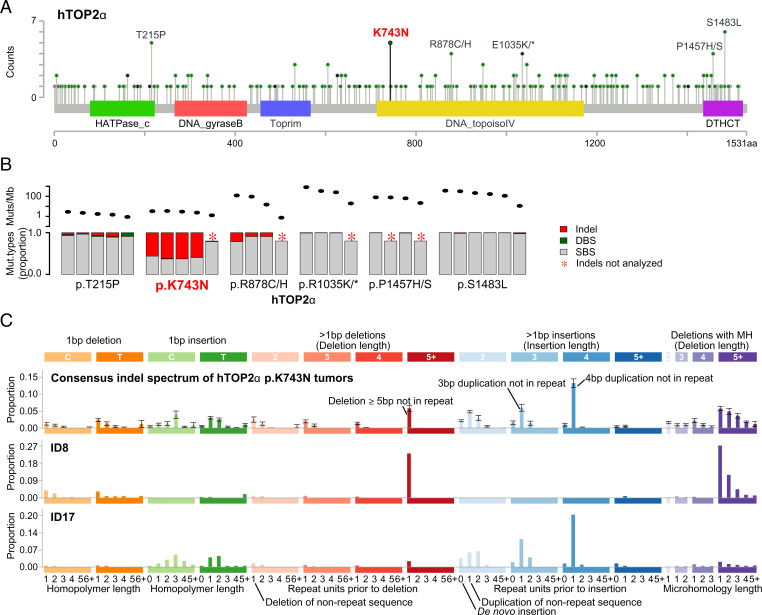
Fig. 1.
Fig. 1.
hTOP2α hotspot mutations and associated mutagenesis. (A) Recurrent amino acid substitutions in hTOP2α (figure generated using MutationMapper) (43). Amino acid positions are marked on the x axis and domains are shown by colored rectangles with names below. (B) Total mutation counts and proportions of indel, DBS, and SBS mutations in hTOP2α hotspot carriers as reported by Alexandrov et al. (11). Ovals in the Top subpanel show the combined mutation load of indels, DBSs, and SBSs; bars in the Bottom panel show the proportions of indels (red), DBSs (green), and SBSs (gray). (C) Consensus indel mutation spectrum of tumors carrying the hTOP2α p.K743N substitution and the ID8 and ID17 indel mutational signatures (11). Each bar shows the mean proportion of indels in a given indel class; error bars show SEM. Abbreviations: DBS, doublet base substitution; MH, microhomology; Mut, mutation; SBS, single base substitution. Please see https://www.synapse.org/#!Synapse:syn11801742 for an explanation of the indel classes.
Fig. 2.
Fig. 2.
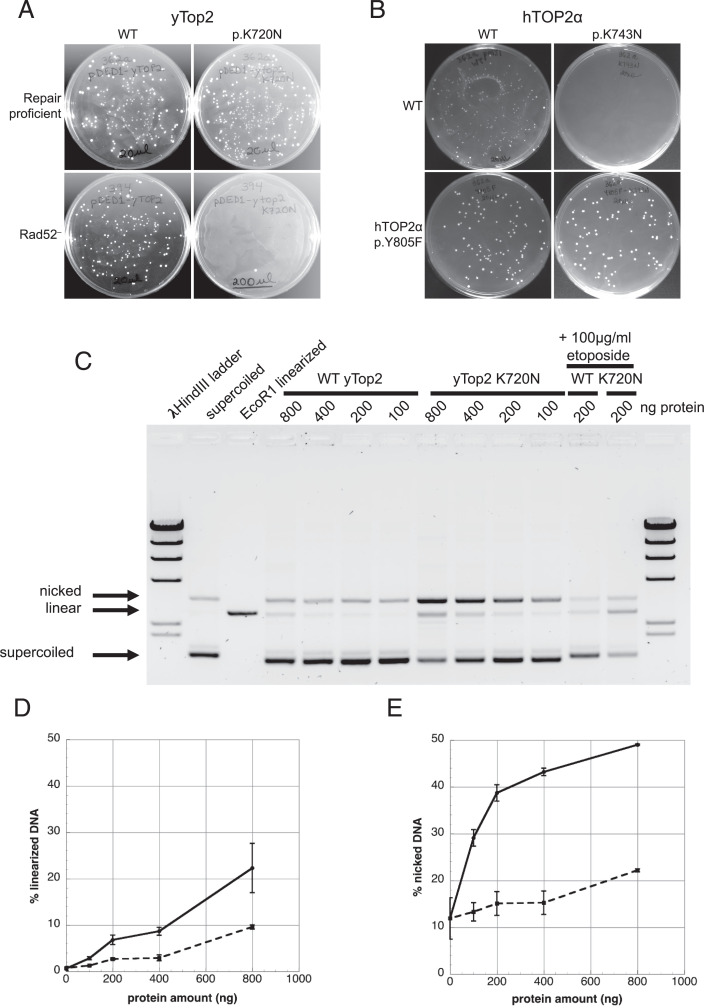
yTop2-K720N effects on cell viability and DNA-damaging properties. (A) Viability after transformation of a plasmid overexpressing yTop2 or yTop2-K720N into wild-type (WT) and recombination-deficient (Rad52) strains. (B) Viability following overexpression of hTOP2α or hTOP2α p.K743N in yeast. Introduction of p.Y805F into hTOP2α p.K743N rescued the toxicity. (C) yTop2-mediated cleavage of negatively supercoiled pUC18 in the presence of Mg2+ as a function of protein concentration. Samples with 200 ng WT yTop2 or yTop2-K720N proteins and 100 µg/mL etoposide are included as positive controls for DNA cleavage. (D) Quantitation of linear DNA and (E) nicked DNA generated by WT yTop2 (dashed lines) or yTop2-K720N (solid lines) protein; bars indicate SEM, n = 3.
Fig. 3.
Fig. 3.
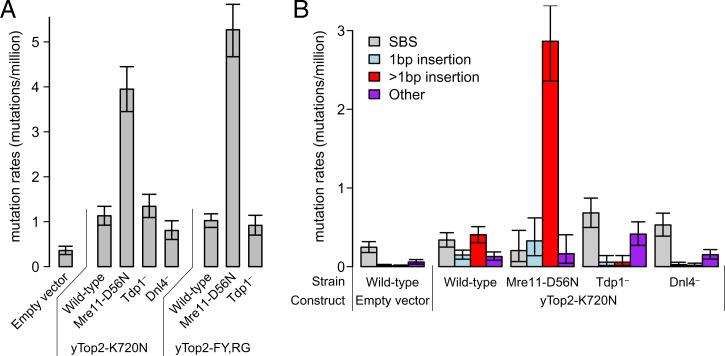
Mutations induced by yTop2-K720N. (A) Overall mutation rates at the yeast CAN1 locus with 95% confidence intervals. Data for empty vector and yTop2-FY,RG are from Stantial et al. (10). (B) Rates of various types of mutations at the same locus shown separately. Mre11-D56N, genetically inactivated nuclease subunit of the MRX complex; Tdp1, tyrosyl-DNA-phosphodiesterase I; Dnl4, DNA ligase required for NHEJ; SBS, single base substitution.
Fig. 4.
Fig. 4.
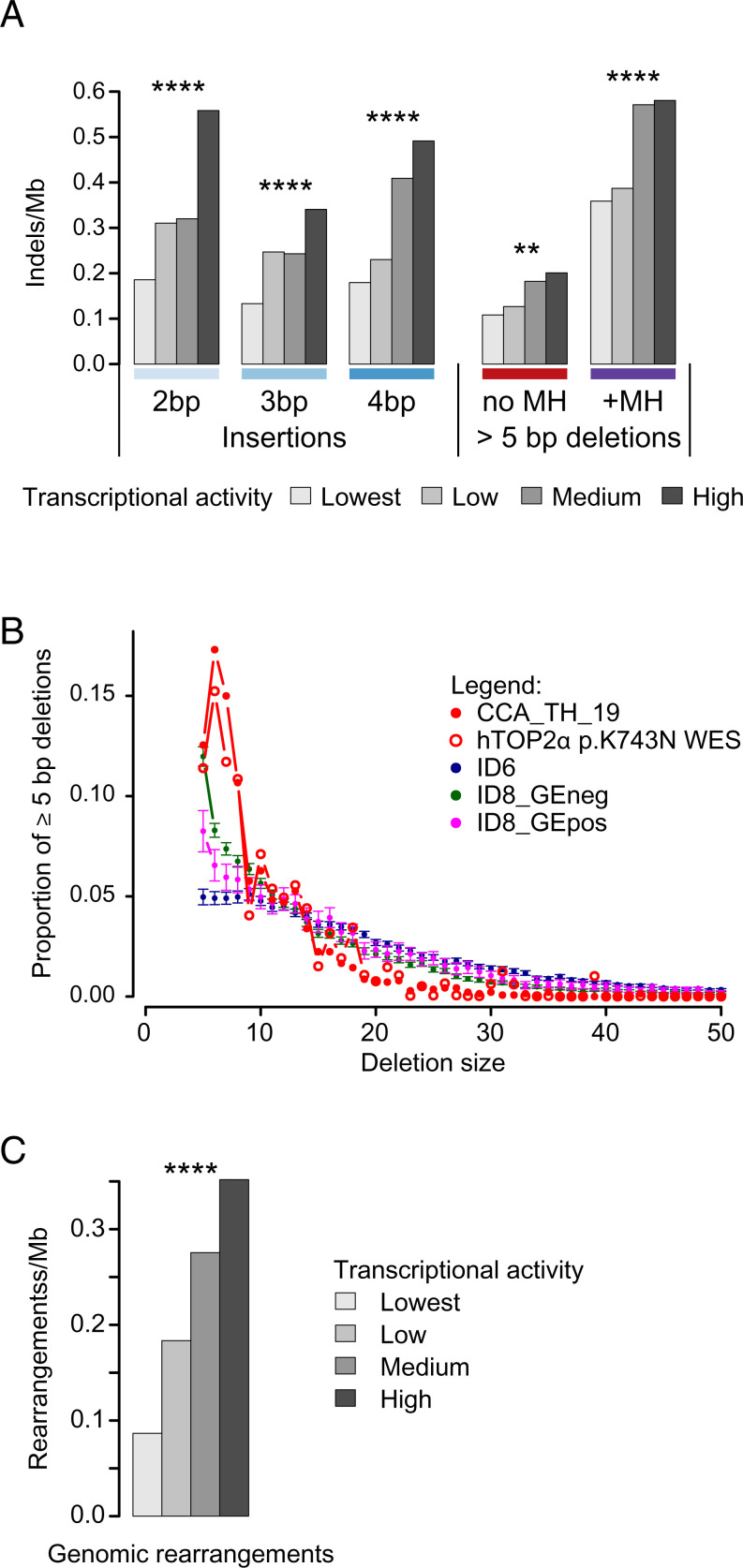
Characterization of ID_TOP2α. (A) Positive correlation between transcriptional activity and 2- to 4-bp duplications and deletions ≥5 bp in CCA_TH_19. (B) Comparison of size distributions of deletions ≥5 bp in hTOP2α p.K743N carriers, in tumors with high counts of ID6 deletions, in tumors with high counts of ID8 deletions with increasing mutation density in highly transcribed genes (ID8_GEpos), and in tumors with high counts of ID8 deletions without this characteristic (ID8_GEneg). Please see SI Appendix for details. Compared to each of the other groups of tumors, hTOP2α p.K743N carriers were enriched for 6- to 8-bp deletions (P < 0.0001 for each of the pairwise comparisons, two-sided Wilcoxon rank-sum tests). For ID6, ID8_Geneg, and ID8_GEpos, means and 95% confidence intervals are plotted. For display purposes, all hTOP2α p.K743N WES data were combined; statistical comparisons between the groups were performed using the individual tumors. (C) Positive correlation between transcriptional activity and genomic rearrangements in CCA_TH_19. ** and **** indicate Benjamini–Hochberg false discovery rates of <0.01 and <0.0001, based on P values from two-sided Cochran–Armitage tests for trend. Mb, megabase; MH, microhomology.
Fig. 5.
Fig. 5.
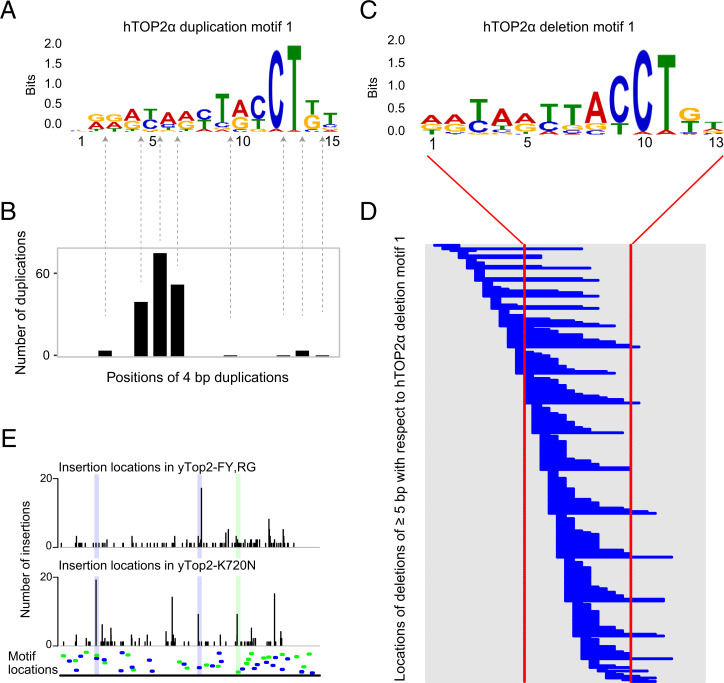
Similar motifs associated with duplications and deletions in hTOP2α p.K743N tumors. (A) Duplication motif 1, extracted from sequences surrounding 4-bp duplications in CCA_TH_19 using MEME (22). See SI Appendix, Figs. S14 and S15 for similar motifs extracted from other duplication sizes and from hTOP2α p.K743N tumors with WES. (B) Positions of duplications in relation to the motif in A as detected by MAST (23) with E values <10. (C) Deletion motif 1 extracted from sequences overlapping deletions of length 2, 3, 4, or ≥2 bp not in repeats in CCA_TH_19. (D) Positions of deletions relative to the motif in C. Each horizonal blue line indicates the position and extent of a deletion. Shown are deletions in or near sequences in which MAST detected the deletion with E value <10. (E) Overlap between the motif in A and insertion mutations in yeast can1 mutation data. Bottom shows the locations of hTOP2α sequence motifs as detected by FIMO using the motif in A as the query, ordered by P value (most significant at the Bottom). Motifs are in blue (detected on the reference genome strand) or green (detected on the opposite strand). The panels above depict the locations of insertions >1 bp in the yTop2-FY,RG and yTop2-K720N data. Several hotspots are highlighted.

References

    1. Vos S. M., Tretter E. M., Schmidt B. H., Berger J. M., All tangled up: How cells direct, manage and exploit topoisomerase function. Nat. Rev. Mol. Cell Biol. 12, 827–841 (2011). - PMC - PubMed
    1. Pendleton M., Lindsey R. H. Jr., Felix C. A., Grimwade D., Osheroff N., Topoisomerase II and leukemia. Ann. N. Y. Acad. Sci. 1310, 98–110 (2014). - PMC - PubMed
    1. Wang J. C., Moving one DNA double helix through another by a type II DNA topoisomerase: The story of a simple molecular machine. Q. Rev. Biophys. 31, 107–144 (1998). - PubMed
    1. Corbett K. D., Berger J. M., Structure, molecular mechanisms, and evolutionary relationships in DNA topoisomerases. Annu. Rev. Biophys. Biomol. Struct. 33, 95–118 (2004). - PubMed
    1. Pommier Y., Leo E., Zhang H., Marchand C., DNA topoisomerases and their poisoning by anticancer and antibacterial drugs. Chem. Biol. 17, 421–433 (2010). - PMC - PubMed

Publication types

MeSH terms

Substances