


Remarks on Multimodality: Grammatical Interactions in the Parallel Architecture
- PMID: 35059636
- PMCID: PMC8764459
- DOI: 10.3389/frai.2021.778060
Remarks on Multimodality: Grammatical Interactions in the Parallel Architecture
Abstract
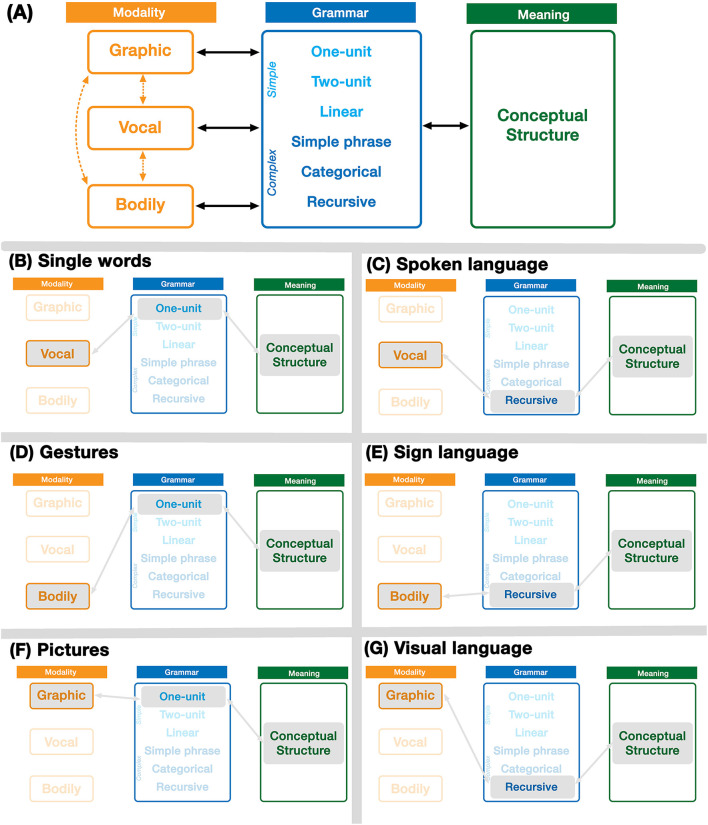
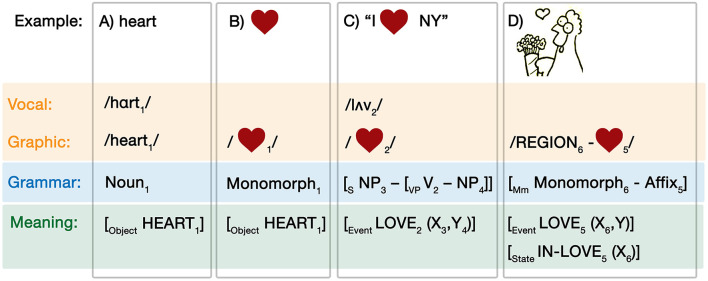
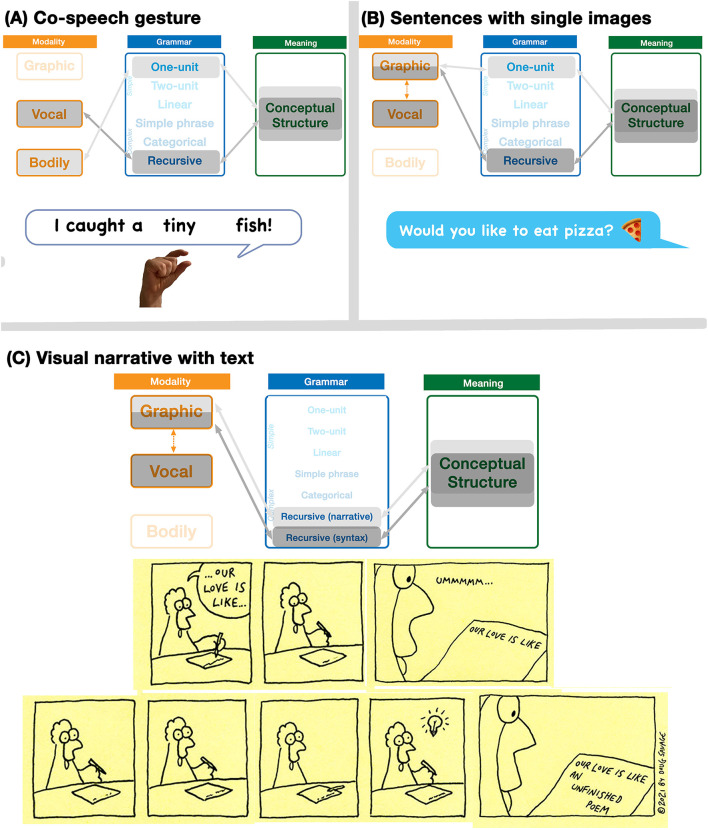
Language is typically embedded in multimodal communication, yet models of linguistic competence do not often incorporate this complexity. Meanwhile, speech, gesture, and/or pictures are each considered as indivisible components of multimodal messages. Here, we argue that multimodality should not be characterized by whole interacting behaviors, but by interactions of similar substructures which permeate across expressive behaviors. These structures comprise a unified architecture and align within Jackendoff's Parallel Architecture: a modality, meaning, and grammar. Because this tripartite architecture persists across modalities, interactions can manifest within each of these substructures. Interactions between modalities alone create correspondences in time (ex. speech with gesture) or space (ex. writing with pictures) of the sensory signals, while multimodal meaning-making balances how modalities carry "semantic weight" for the gist of the whole expression. Here we focus primarily on interactions between grammars, which contrast across two variables: symmetry, related to the complexity of the grammars, and allocation, related to the relative independence of interacting grammars. While independent allocations keep grammars separate, substitutive allocation inserts expressions from one grammar into those of another. We show that substitution operates in interactions between all three natural modalities (vocal, bodily, graphic), and also in unimodal contexts within and between languages, as in codeswitching. Altogether, we argue that unimodal and multimodal expressions arise as emergent interactive states from a unified cognitive architecture, heralding a reconsideration of the "language faculty" itself.
Keywords: codeswitching; grammar; linguistic theory; multimodality; parallel architecture.
Copyright © 2022 Cohn and Schilperoord.
Conflict of interest statement
The authors declare that the research was conducted in the absence of any commercial or financial relationships that could be construed as a potential conflict of interest.
Figures

References
-
- Bateman J. A. (2014). Text and Image: A Critical Introduction to the Visual/Verbal Divide. New York, NY: Routledge. 10.4324/9781315773971 - DOI
-
- Bateman J. A., Wildfeuer J., Hiippala T. (2017). Multimodality: Foundations, Research and Analysis–A Problem-Oriented Introduction. Berlin: Walter de Gruyter GmbH & Co KG. p. 488. 10.1515/9783110479898 - DOI
-
- Clark H. H. (1996). Using Language. Cambridge: Cambridge University Press. 10.1017/CBO9780511620539 - DOI
-
- Cohn N. (2012). Explaining “I can't draw”: Parallels between the structure and development of language and drawing. Hum. Dev. 55, 167–192. 10.1159/000341842 - DOI
LinkOut - more resources
Full Text Sources
