. 2022 Jan 13;3(1):100968.
doi: 10.1016/j.xpro.2021.100968. eCollection 2022 Mar 18.

Protocol for single-cell isolation and genome amplification of environmental microbial eukaryotes for genomic analysis

Affiliations

Protocol for single-cell isolation and genome amplification of environmental microbial eukaryotes for genomic analysis

Doina Ciobanu et al. STAR Protoc. .

Abstract

We describe environmental microbial eukaryotes (EMEs) sample collection, single-cell isolation, lysis, and genome amplification, followed by the rDNA amplification and OTU screening for recovery of high-quality species-specific genomes for de novo assembly. These protocols are part of our pipeline that also includes bioinformatic methods. The pipeline and its application on a wide range of phyla of different sample complexity are described in our complementary paper. In addition, this protocol describes optimized lysis, genome amplification, and OTU screening steps of the pipeline. For complete details on the use and execution of this protocol, please refer to Ciobanu et al. (2021).

Keywords: Cell isolation; Environmental sciences; Flow Cytometry/Mass Cytometry; Genomics; Microbiology; Molecular Biology; Sequence analysis; Sequencing; Single Cell.


Conflict of interest statement

The authors declare no competing interests.

Figures

None
Graphical abstract
Figure 1
Figure 1
Representative outcomes for fast real-time MDA of environmental microbial eukaryotes (A) Fast MDA protocol. Left: short MDA. Target genome size was 30.77 Mb, average GC%. 100-cell (dark blue) and 50-cell (light blue) amplified after 40 min and single cells (green) amplified well after 50 min. Positive control (black) (E. coli gDNA) amplified after 80 min. There were three instances where negative control amplified (pink) (cycle 9, 13, and 17). This is most likely attributed to contamination from using ECHO machine to dispense MDA. Right: longer MDA. Target genome size was 11 Mb, average GC%. Positive control (black) (E. coli gDNA) amplified at 60 min, multiple-cell FACS sorts in light green amplified after 150 min, single-cell wells amplified after 200 min. Negative controls in red did not amplify. This plate was dispensed using an automated multi-channel pipette in a clean hood. (B) Target genome size was 30.77 Mb, average GC%. In black are positive control purified gDNA wells. In red are negative control wells. Dark blue are wells with multiple-cell FACS sorts; Light green are single-cell FACS sorts. (C) Target genome size was 46.5 Mb, average GC%. MDA reaction volume was 2 μL MDA mix over 0.75 μL Lysis and Stop, customized reagent volumes. Single cells (light blue) amplified sparingly starting after 50 min 100-cell (dark blue) also amplified sparingly after 30 min. There were three instances where negative control amplified (at cycle 18, 19, 20). Positive control (E. coli gDNA) amplification pattern does not match the normal pattern. Nevertheless, this MDA gave a very good rDNA OTU amplification and target OTU frequency (See Figures 2 and 4). We speculate that this batch of the Repli-G had a slightly higher concentration of the enzyme, which along with an efficient early lysis led to an earlier amplification of an already large genome (46 Mb) and the MDA plateau was reached after a few cycles due to saturation of the ultra-low reaction volume.
Figure 2
Figure 2
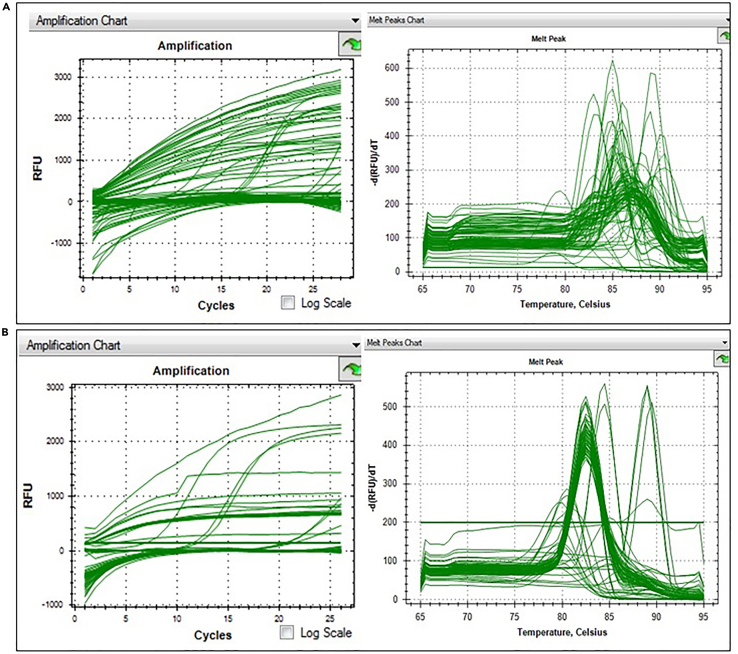
rDNA-fragment real-time PCR of the Thamnocephalis sphaerospora MDA plate from Figure 1C Left side shows amplification curves, melting curves are on the right side. (A) 16S PCR with v6 region universal primers (926, 1392). This primer pair amplifies also the 18S region in some organisms. Left side shows amplification curves, which confirm our assumption of early saturation of the MDA reaction due to big genome size, low reaction volume and high enzyme processivity. See Figure 3 for the BLAST result of these reactions. (B) Nested 18S (SR7R) and ITS (ITS4, ITS5) PCR. Most of the positive reactions with correct melting curves were obtained from the nested ITS primer pair.
Figure 3
Figure 3
Representative picture of the BLASTn result view for OTU screening (A) Shown are all positive 16S rDNA qPCR results that gave the target OTU BLASTn result. These are the results of the 16s qPCR shown in Figure 2 using the gDNA template from the Figure 1C MDA. (B) Alignment score showing the aligned part of the sequence and the length of the sequence. (C) Alignment table with the names of the organisms that match the query, on the left, and the statistics of the aligned part.
Figure 4
Figure 4
View of the BLAST interface to be used for the clean FASTA files
Figure 5
Figure 5
Ice block configuration with aluminum foil tray and tubes MDA reaction mix should be UV-ed in the tray with some UV-clean refrigerated water to ensure constant cooling.
Figure 6
Figure 6
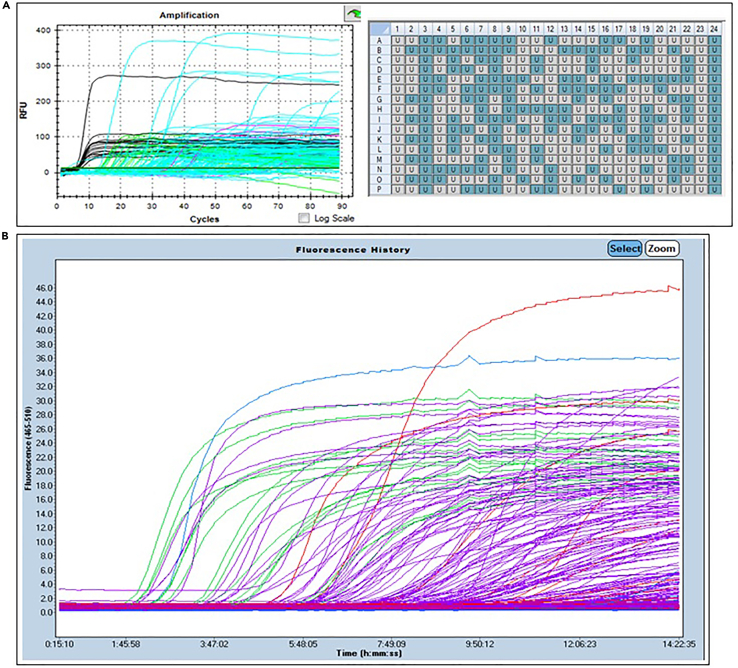
Representative outcomes for slow real-time MDA of environmental microbial eukaryotes (A) Target genome size was 18.2 Mb genome with average GC%. MDA mix was dispensed with automated pipette in a clean hood. Black, positive control, 1 pg S. pombe purified gDNA; green, positive control, 100-cell sorts; pink, negative control, lysis and MDA mix, 16 wells; blue, 288 wells, single cells. Right side: shown the plate layout with amplified wells in blue. (B) Target genome size was 10.7 Mb genome with average GC% and cell wall. MDA mix was dispensed with Echo. Due to large volumes of the MDA mix, contamination was introduced during Echo dispensing (blue and red). If larger volumes of the reaction are to be dispensed via Echo, a better sterilization of the fluidics of the instrument has to be achieved and a test amplification should be performed the day before dispensing. Alternatively, hand dispensing using an automated pipette in a clean hood is recommended. Keeping the MDA reaction mix to a minimum volume also eliminates contamination. Otherwise sequencing of the contaminating organism can help remove the reads prior assembly. Negative controls: blue, 16 wells, MDA mix; red, 48 wells, Lysis buffer with MDA mix; green, positive control, 16 wells, 100 cells; purple, 288 wells, single cells.
Figure 7
Figure 7
Fragment of the qPCR results table generated after selecting wells of interest Shown are the wells with Cq value predictive of the amount of the gDNA generated. Only the samples with positive Cq value were used for rDNA qPCR.
Figure 8
Figure 8
Selection of the PCR reactions, of the rDNA-fragment, with correct melting curves (A) Single Melting curve with characteristic temperature for 800–1500 bp fragment. This reaction is suitable for Sanger sequencing and most likely has a homogenous set of DNA fragments from one species. (B) The melting curve with a shoulder could represent either high genomic DNA background or a few different sequences. This reaction should be used either for nested PCR, or an agarose gel run to determine exact cause. If there are two distinct bands, this can be sequenced via an NGS method, long read setting. (C) Two melting curves both with temperatures above 70°C represent two distinct fragment, one shorter one longer. This type of reaction should be sequenced either via an NGS method, long read setting or eliminated from the further study, if a clean single species genome is the goal. (D) Melting peak temperature is higher than 90°C, these fragments may be larger than 1500 bp and/or genomic DNA. Gel electrophoresis can help identify if there is an amplified band. If only gDNA smear is visible, no sequencing will help for OTU screening.

References

    1. Altschul S.F., Gish W., Miller W., Myers E.W., Lipman D.J. Basic local alignment search tool. J. Mol. Biol. 1990;215:403–410. - PubMed
    1. BD Influx™ Cell Sorter User’s Guide. (2011) bdbiosciences.com 23-11543-00 Rev. 01 4/2011.
    1. Ciobanu D., Clum A., Ahrendt S., Andreopoulos W.B., Salamov A., Chan S., Quandt C.A., Foster B., Meier-Kolthoff J.P., Tang Y.T., et al. A single-cell genomics pipeline for environmental microbial eukaryotes. iScience. 2021;24:102290. - PMC - PubMed
    1. Dawson S.C., Pace N.R. Novel kingdom-level eukaryotic diversity in anoxic environments. PNAS. 2002;99:8324–8329. - PMC - PubMed
    1. Lazarus K.L., Benny G.L., Ho H.M., Smith M.E. Phylogenetic systematics of Syncephalis (Zoopagales, Zoopagomycotina), a genus of ubiquitous mycoparasites. Mycologia. 2017;109:333–349. - PubMed

Publication types