


Association between household air pollution and nasopharyngeal pneumococcal carriage in Malawian infants (MSCAPE): a nested, prospective, observational study
- PMID: 35063113
- PMCID: PMC8789559
- DOI: 10.1016/S2214-109X(21)00405-8
Association between household air pollution and nasopharyngeal pneumococcal carriage in Malawian infants (MSCAPE): a nested, prospective, observational study
Abstract
Background: Household air pollution from solid fuels increases the risk of childhood pneumonia. Nasopharyngeal carriage of Streptococcus pneumoniae is a necessary step in the development of pneumococcal pneumonia. We aimed to assess the association between exposure to household air pollution and the prevalence and density of S pneumoniae carriage among children.
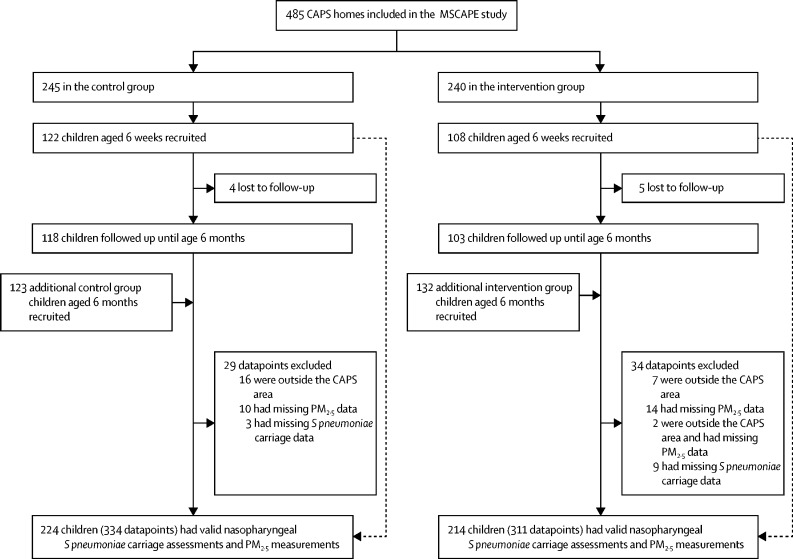
Methods: The Malawi Streptococcus pneumoniae Carriage and Air Pollution Exposure study was a nested, prospective, observational study of children participating in the cluster randomised controlled Cooking and Pneumonia Study (CAPS) in the Karonga Health and Demographic Surveillance System (HDSS) area in northern Malawi. CAPS compared the effects of a cleaner burning biomass-fuelled cookstove (intervention group) with traditional open-fire cooking (control group) on the incidence of pneumonia in children. Eligible children aged 6 weeks or 6 months (those recruited a 6 weeks were also followed up at age 6 months) were identified by the Karonga HDSS centre. Nasopharyngeal swabs were taken to detect S pneumoniae, and infant exposure to particulate matter with a diameter of ≤2·5 μm (PM2·5) exposure was assessed by use of a MicroPEM device. The primary outcome was the prevalence of nasopharyngeal S pneumoniae carriage in all children aged 6 months, assessed in all children with valid data on PM2·5. The effects of the intervention stoves (intention-to-treat analysis) and PM2·5 (adjusted exposure-response analysis) on the prevalence of S pneumoniae carriage were also assessed in the study children.
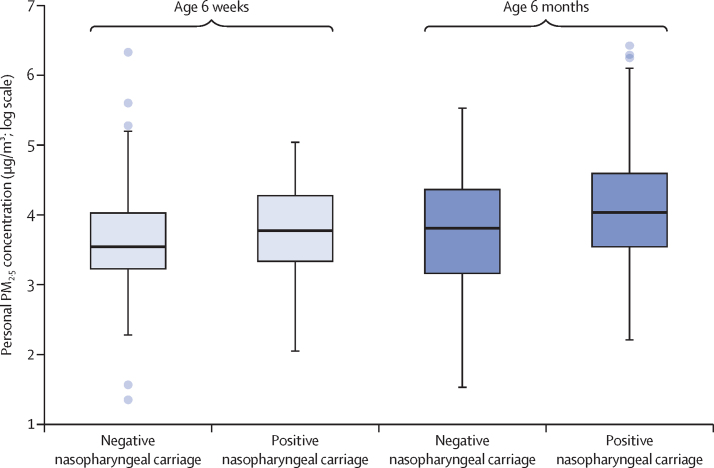
Findings: Between Nov 15, 2015, and Nov 2, 2017, 485 children were recruited (240 from the intervention group and 245 from the control group). Of all 450 children with available data at age 6 months, 387 (86% [95% CI 82-89]) were positive for S pneumoniae. Geometric mean PM2·5 exposure was 60·3 μg/m3 (95% CI 55·8-65·3) in S pneumoniae-positive children and 47·0 μg/m3 (38·3-57·7) in S pneumoniae-negative children (p=0·044). In the intention-to-treat analysis, a non-significant increase in the risk of S pneumoniae carriage was observed in intervention group children compared with control group children (odds ratio 1·36 [95% CI 0·95-1·94]; p=0·093). In the exposure-response analysis, a significant association between PM2·5 exposure and S pneumoniae carriage was observed; a one unit increase in decile of PM2·5 was found to significantly increase the risk of S pneumoniae carriage by 10% (1·10 [1·01-1·20]; p=0·035), after adjustment for age, sex, 13-valent pneumococcal conjugate vaccination status, season, current use of antibiotics, and MicroPEM run-time.
Interpretation: Despite the absence of effect from the intervention cookstove, household air pollution exposure was significantly associated with the prevalence of nasopharyngeal S pneumoniae carriage. These results provide empirical evidence for the potential mechanistic association between exposure to household air pollution and childhood pneumonia.
Funding: Bill & Melinda Gates Foundation.
Copyright © 2022 The Author(s). Published by Elsevier Ltd. This is an Open Access article under the CC BY 4.0 license. Published by Elsevier Ltd.. All rights reserved.
Conflict of interest statement
Declaration of interests We declare no competing interests.
Figures
Comment in
-
Effect of household air pollution on pneumococcal carriage.Lancet Glob Health. 2022 Feb;10(2):e167-e168. doi: 10.1016/S2214-109X(21)00503-9. Lancet Glob Health. 2022. PMID: 35063105 No abstract available.
References
-
- WHO Number of deaths: data by WHO region. 2020. https://apps.who.int/gho/data/view.main.CM1300N?lang=en
-
- WHO Number of deaths in children aged <5, by cause. 2021. https://www.who.int/data/gho/data/indicators/indicator-details/GHO/numbe...
-
- Peabody JW, Riddell TJ, Smith KR, et al. Indoor air pollution in rural China: cooking fuels, stoves, and health status. Arch Environ Occup Health. 2005;60:86–95. - PubMed
Publication types
MeSH terms
LinkOut - more resources
Full Text Sources
Medical
Miscellaneous
