


Review of barriers and interventions to promote treatment engagement for pediatric attention deficit hyperactivity disorder care
- PMID: 35070771
- PMCID: PMC8717033
- DOI: 10.5498/wjp.v11.i12.1206
Review of barriers and interventions to promote treatment engagement for pediatric attention deficit hyperactivity disorder care
Abstract
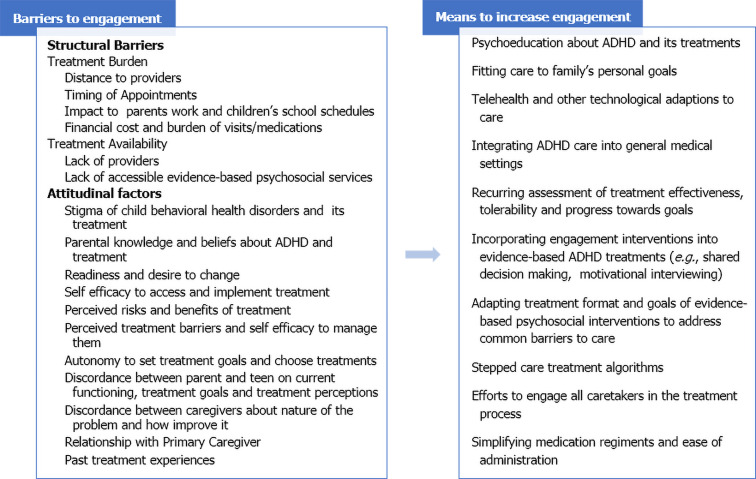
Attention deficit hyperactivity disorder (ADHD) is a common and impairing behavioral health disorder, impacting over 5% of children worldwide. There are multiple evidence-based pharmacological and psychosocial treatments for ADHD, and greater service utilization is associated with improved acute and long-term outcomes. However, long-term outcomes are suboptimal as multimodal treatments are often not accessed and most care ends prematurely. This narrative review discusses barriers to engagement for children and adolescents with ADHD and their families as well as interventions to overcome these barriers. Families face a variety of structural and attitudinal barriers, ranging from cost and access to stigma and low self-efficacy to successfully implement change. There are multiple interventions that may enhance engagement with ADHD care including psychoeducation, integration of behavioral services in general medical settings, telehealth as well as specific adaptations to existing ADHD treatments, such as the use of motivational interviewing or shared decision making. Integration of behavioral health into general medical settings and telehealth have been found in controlled studies to increase access by reducing both structural and attitudinal barriers. Adding motivational interviewing, shared decision making and other engagement interventions to evidence-based ADHD treatments has been found to reduce attitudinal barriers that translates into improved participation and satisfaction while enhancing outcomes. However, little is known about how to promote extended engagement with ADHD services even though a chronic care model for ADHD is recommended.
Keywords: Adolescents; Attention deficit hyperactivity disorder; Barriers; Children; Interventions; Treatment engagement.
©The Author(s) 2021. Published by Baishideng Publishing Group Inc. All rights reserved.
Conflict of interest statement
Conflict-of-interest statement: Soutullo CA reports non-personal research funds from Texas Child Mental Health Care Consortium (Youth Depression & Suicide Network) SB11, Lundbeck and Janssen; is a consultant and advisory board member of Editorial Médica Panamericana, EUNETHYDIS (European Network on Hyperkinetic Disorder), NeuroTech Solutions Ltd-Israel, Limbix -United States and Shire - Spain; received speaker’s bureau fees from Bial- Portugal, Medice -Germany, Rubio-Spain and Shire-Spain, and royalties from Editorial Médica Panamericana - Spain; Waxmonsky JG has received research funding from Supernus, and Pfizer, is a consultant for Purdue Pharma, Intracellular Therapies; Baweja R reports no conflicts of interest related to the subject of this article.
Figures
References
-
- Polanczyk G, de Lima MS, Horta BL, Biederman J, Rohde LA. The worldwide prevalence of ADHD: a systematic review and metaregression analysis. Am J Psychiatry . 2007;164:942–948. - PubMed
-
- Swanson JM, Arnold LE, Molina BSG, Sibley MH, Hechtman LT, Hinshaw SP, Abikoff HB, Stehli A, Owens EB, Mitchell JT, Nichols Q, Howard A, Greenhill LL, Hoza B, Newcorn JH, Jensen PS, Vitiello B, Wigal T, Epstein JN, Tamm L, Lakes KD, Waxmonsky J, Lerner M, Etcovitch J, Murray DW, Muenke M, Acosta MT, Arcos-Burgos M, Pelham WE, Kraemer HC MTA Cooperative Group. Young adult outcomes in the follow-up of the multimodal treatment study of attention-deficit/hyperactivity disorder: symptom persistence, source discrepancy, and height suppression. J Child Psychol Psychiatry . 2017;58:663–678. - PMC - PubMed
-
- Wolraich ML, Hagan JF Jr, Allan C, Chan E, Davison D, Earls M, Evans SW, Flinn SK, Froehlich T, Frost J, Holbrook JR, Lehmann CU, Lessin HR, Okechukwu K, Pierce KL, Winner JD, Zurhellen W Subcommittee on Children and Adolescents with Attention-Deficit/Hyperactive Disorder. Clinical Practice Guideline for the Diagnosis, Evaluation, and Treatment of Attention-Deficit/Hyperactivity Disorder in Children and Adolescents. Pediatrics . 2019;144 - PMC - PubMed
-
- Froehlich TE, Brinkman WB. Multimodal Treatment of the School-aged Child With Attention-Deficit/Hyperactivity Disorder. JAMA Pediatr . 2018;172:109–110. - PubMed
-
- National Institute for Health and Care Excellence (NICE) Attention deficit hyperactivity disorder: Diagnosis and management (NG87). [cited 26 March 2021]. Available from: https://www.nice.org.uk/guidance/ng87 .
Publication types
LinkOut - more resources
Full Text Sources
