Randomized Controlled Trial
. 2022 Apr 1;71(4):722-732.
doi: 10.2337/db21-0728.

Immune and Metabolic Effects of Antigen-Specific Immunotherapy Using Multiple β-Cell Peptides in Type 1 Diabetes

Affiliations
Randomized Controlled Trial

Immune and Metabolic Effects of Antigen-Specific Immunotherapy Using Multiple β-Cell Peptides in Type 1 Diabetes

Yuk-Fun Liu et al. Diabetes. .

Abstract

Type 1 diabetes is characterized by a loss of tolerance to pancreatic β-cell autoantigens and defects in regulatory T-cell (Treg) function. In preclinical models, immunotherapy with MHC-selective, autoantigenic peptides restores immune tolerance, prevents diabetes, and shows greater potency when multiple peptides are used. To translate this strategy into the clinical setting, we administered a mixture of six HLA-DRB1*0401-selective, β-cell peptides intradermally to patients with recent-onset type 1 diabetes possessing this genotype in a randomized placebo-controlled study at monthly doses of 10, 100, and 500 μg for 24 weeks. Stimulated C-peptide (measuring insulin functional reserve) had declined in all placebo subjects at 24 weeks but was maintained at ≥100% baseline levels in one-half of the treated group. Treatment was accompanied by significant changes in islet-specific immune responses and a dose-dependent increase in Treg expression of the canonical transcription factor FOXP3 and changes in Treg gene expression. In this first-in-human study, multiple-peptide immunotherapy shows promise as a strategy to correct immune regulatory defects fundamental to the pathobiology of autoimmune diabetes.

Trial registration: ClinicalTrials.gov NCT02620332.


Conflict of interest statement

Duality of Interest. Y.-F.L. has consulted for UCB Pharma. M.P. has consulted for UCB Pharma and benefits from a license agreement with King’s College London. T.T. has received speaker fees from UCB Pharma. No other potential conflicts of interest relevant to this article were reported.

Figures

Figure 1
Figure 1
Study design and treatment groups. Graphical representation of study design showing timing of treatments and evaluation of immunological and metabolic measurements. Drug indicates study drug administration, and T cell indicates blood draw for immune readouts.
Figure 2
Figure 2
Consolidated Standards of Reporting Trials diagram showing screening and treatment allocation.
Figure 3
Figure 3
Change in C-peptide, HbA1c, and insulin use during MultiPepT1De treatment from baseline to 24 weeks. A and B: C-peptide data are shown as mean change from baseline in normalized C-peptide AUC (□, placebo; ▵, 10-μg dose; ▴, 100-μg dose; ▾, 500-μg dose), LS mean AUC change from baseline comparing placebo (□) and the combined treatment groups (▵). C: Individual C-peptide AUC data at baseline and 24 weeks (open symbols show C-peptide responders who retained ≥100% of baseline C-peptide level, and closed symbols show C-peptide nonresponders). D and E: Mean change from baseline in HbA1c and in insulin usage.
Figure 4
Figure 4
Islet-specific cytokine responses and Treg phenotype changes. A: Cumulative IFN-γ, IL-10, and IL-17 responses to PI across all treatment groups, as measured by ELISpot (open bars, placebo group; shaded bars, 10-μg dose group; hatched bars, 100-μg group; striped bars, 500-μg dose group). B: IL-17 responses to specified antigenic stimuli, as measured by ELISpot comparing C-peptide responders (shaded bars) and nonresponders (open bars). C: Analysis of Treg changes in expression of FOXP3. Change in FOXP3 expression levels (mean fluorescence intensity [MFI] at week 24 relative to baseline) on all Treg subsets (CD4+CD25hiFOXP3+) and antigen-experienced (CD45RA) subsets coexpressing CD39 and CD73 comparing subjects treated with peptide and placebo. ▪, C-peptide responders; ▴, C-peptide nonresponders. D: Dose-response relationship of FOXP3 MFI change and MultiPepT1De in all Treg subsets. *P < 0.05, **P < 0.01, ***P < 0.001. Pbo, placebo.
Figure 5
Figure 5
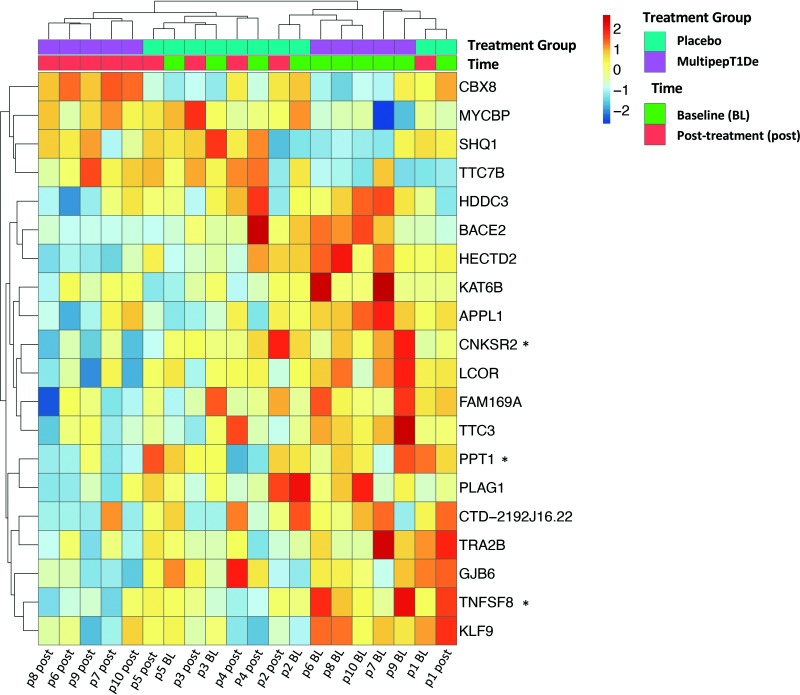
Expression of genes differentially expressed in MultiPepT1De-treated samples. The top 20 differentially expressed genes identified in this analysis were normalized genewise and hierarchically clustered by genes and samples. Participant numbers and time points are indicated at the bottom of the plot. Genes that differed significantly (FDR controlled at q = 0.01) between groups (combined placebo and baseline samples from treated individuals vs. posttreatment samples) are indicated by an asterisk.
Figure 6
Figure 6
Change in Treg expression after MultiPepT1De treatment. Difference between pre- and posttreatment expression of the top 20 differentially expressed genes from Fig. 5, normalized genewise and hierarchically clustered by genes and samples. Participant numbers are indicated at the bottom of the plot.

Comment in

References

    1. Patterson CC, Gyürüs E, Rosenbauer J, et al. . Trends in childhood type 1 diabetes incidence in Europe during 1989-2008: evidence of non-uniformity over time in rates of increase. Diabetologia 2012;55:2142–2147 - PubMed
    1. Lachin JM, McGee P; DCCT/EDIC Research Group . Impact of C-peptide preservation on metabolic and clinical outcomes in the Diabetes Control and Complications Trial. Diabetes 2014;63:739–748 - PMC - PubMed
    1. Sørensen JS, Johannesen J, Pociot F, et al. .; Danish Society for Diabetes in Childhood and Adolescence . Residual β-cell function 3-6 years after onset of type 1 diabetes reduces risk of severe hypoglycemia in children and adolescents. Diabetes Care 2013;36:3454–3459 - PMC - PubMed
    1. Killestein J. Anti-CD3 monoclonal antibody in new-onset type 1 diabetes mellitus. N Engl J Med 2002;347:1116–1117 - PubMed
    1. Keymeulen B, Vandemeulebroucke E, Ziegler AG, et al. . Insulin needs after CD3-antibody therapy in new-onset type 1 diabetes. N Engl J Med 2005;352:2598–2608 - PubMed

Publication types