


Review
doi: 10.1038/s41419-022-04523-3.
Advances in the pathogenesis of psoriasis: from keratinocyte perspective
Affiliations
- PMID: 35075118
- PMCID: PMC8786887
- DOI: 10.1038/s41419-022-04523-3
Item in Clipboard
Review
Advances in the pathogenesis of psoriasis: from keratinocyte perspective
Cell Death Dis.
.
Abstract
Psoriasis is a complex long-lasting inflammatory skin disease with high prevalence and associated comorbidity. It is characterized by epidermal hyperplasia and dermal infiltration of immune cells. Here, we review the role of keratinocytes in the pathogenesis of psoriasis, focusing on factors relevant to genetics, cytokines and receptors, metabolism, cell signaling, transcription factors, non-coding RNAs, antimicrobial peptides, and proteins with other different functions. The critical role of keratinocytes in initiating and maintaining the inflammatory state suggests the great significance of targeting keratinocytes for the treatment of psoriasis.
© 2022. The Author(s).
Conflict of interest statement
The authors declare no competing interests.
Figures
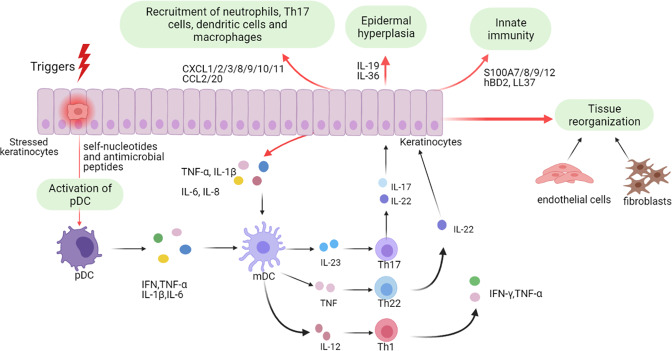
This figure depicts the pathological process of psoriasis mainly from the keratinocyte perspective. Keratinocytes can be stimulated by initial triggers, and stressed keratinocytes release self-nucleotides and antimicrobial peptide, activate pDCs and subsequent mDCs, involving in the initiation phase of psoriasis. After cytokines stimulation, activated keratinocytes influence psoriasis pathology from aspects of inflammatory infiltration, epidermal hyperplasia, innate immunity, tissue reorganization, etc. pDCs plasmacytoid dendritic cells, mDCs myeloid dendritic cells, IFN interferon, TNF-α tumor necrosis factor-α, IL-1β interleukin-1β, Th1 T helper 1.
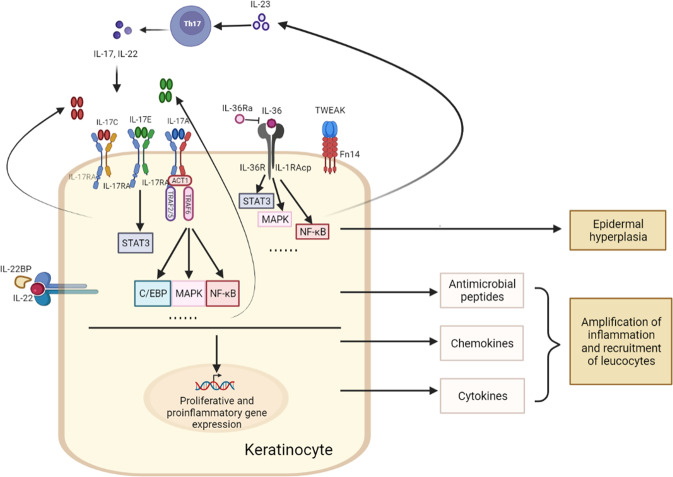
Cytokines are essential in the pathogenesis of psoriasis. Recently, cytokines derived from or receptors expressed on keratinocytes have shown great importance in psoriasis. Keratinocytes are critical cytokine responders in psoriasis, as keratinocyte-specific deletion of their receptors (such as IL-17RA and IL-36R) alleviated psoriasiform lesion in psoriatic mouse model. Keratinocyte-derived IL-17C, IL-17E, IL-36, and IL-23 could induce expression of proliferative and proinflammatory genes by multiple signaling pathways, leading to epidermal hyperplasia and amplification of inflammation and leukocyte infiltration. IL-17RA IL-17 receptor A, TRAF6 TNF receptor-associated factor 6, IL-36R IL-36 receptor, IL-1RAcp IL-1 receptor accessory protein, TWEAK tumor necrosis factor (TNF)-like weak inducer of apoptosis, Fn14 factor-inducible 14, IL-22BP IL-22 binding protein.
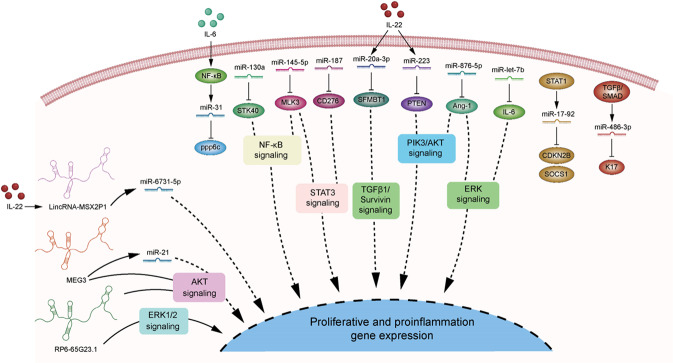
Non-coding RNAs play pivotal roles in the pathogenesis of psoriasis. In keratinocytes, they can affect cell proliferation, apoptosis, differentiation, and inflammatory response through targeting multiple signaling pathways, such as NF-κB signaling, STAT3 signaling, ERK signaling, AKT signaling, etc. Also, expression of some of microRNAs are found to be regulated by NF-κB, STAT, or TGFβ signaling. MEG3 maternally expressed gene 3, ppp6c protein phosphatase 6, STK40 serine/threonine kinase 40, MLK3 mixed-lineage kinase 3, SFMBT1 Scm like with four mbt domains 1, PTEN phosphatase and tensin homolog, Ang1 Angiopoietin-1, CDKN2B cyclin-dependent kinase inhibitor 2B, SOCS1 suppressor of cytokine signaling 1, K17 keratin 17.
References
Publication types
MeSH terms
Substances
Grants and funding
LinkOut - more resources
Full Text Sources
Other Literature Sources
Medical
